Maize had a humble start in this world. Thousands of years ago, it was a clumpy grass with shell-laden pods — hardly resembling today’s elegant stalks loaded with ears. These days, it’s the most grown crop on the planet at 494 million acres a year, with nearly 20% of those in the U.S.
Farmers grow corn because it’s profitable and productive. In 2023, one farmer grew a world record 623.8 bushels per acre in the National Corn Growers Association yield contest, thanks to precision management, advanced genetics and consistent monitoring. U.S. average corn yields have jumped over sixfold in the past century — steadily increasing nearly 2 bushels per acre per year for the last 70 years.
So, what happened to make yields grow year after year, despite drought, heat and everything else Mother Nature throws at us? Check these out:
Crop was measured and managed. Farmers with high yields like to say, “If you don’t measure it, you can’t manage it.” As early as 1870, farmers and plant breeders would conduct yield trials to see if certain races outperformed others.
Around 1900, corn events became popular at county and state fairs. Corn was judged on the uniform appearance of 10 ears, believing that this uniformity would also improve the variety’s yield potential, said Lance Gibson, Corteva Agriscience agronomy training manager.
In the 1910s, more scientific yield tests were introduced at the county level in Illinois and Iowa. These captured the attention of young Henry A. Wallace, a recent Iowa State graduate, who encouraged his alma mater to create the Iowa Corn Yield Test in 1920.
On-farm test plots and yield contests lead to better seed population management. This early work to measure performance laid the groundwork for plant breeding and crop trials for the next century.
Hybrids changed everything. Hybrid corn resulted in yield gains over open-pollinated production, soon becoming a standard for corn breeding, said Mark Licht, Iowa State University Extension agronomist. It was the major driver for higher yields. As a corn breeder, Wallace jump-started that movement. He created hybrids and had five entries in the 1924 Iowa Corn Yield Test.
“This began to show how hybridization and breeding could improve yield,” Gibson said. “It was a better method for discovering the best traits.”
By the 1930s, hybrids were outyielding open-pollinated corn 7% to 10%, depending on the year and region. A 1936 drought proved even more conclusively how hybrids outperformed open-pollinated corn, said Bob Nielsen, a retired Purdue Extension agronomist.
The following year, seed companies invested heavily in new hybrids and developed strains that were not only drought resistant but also stood up better and responded to synthetic fertilizer. Sales exploded. This was the turning point for hybrid corn.
Yields popped from synthetic fertilizer. The Haber-Bosch process — a method for producing ammonia from atmospheric nitrogen — was developed in Germany, and later used to create bombs for both world wars. After World War II, munitions plants were converted to make nitrogen fertilizer. At the same time, seed companies were improving inbred lines and noticed some of the single crosses were nitrogen-responsive.
“We had all this ammonia and nitrate chemical availability left over from those plants,” said Thomas Hoegemeyer, a retired plant breeder from Nebraska. “We figured out when we started using single crosses, some were very nitrogen-responsive, resulting in really high yields at high nitrogen rates.”
By being able to select for those superior hybrids, the corn yield, due to genetics alone, increased dramatically.
Tools protected crops. Weeds and disease once took a big chunk of yield before harvest. Today, fungicides and herbicides help protect potential yield. Fungicide adoption was largely seen as a benefit to high-value horticulture crops until Asian soybean rust threatened U.S. soybean production.
“At that time, farmers would prepurchase fungicides to have on hand,” Licht said. “When Asian soybean rust didn’t develop into a Midwest threat as expected, fungicides were tested on both corn and soybeans to determine if they could protect against other common fungal pathogens such as eyespot, grey leaf spot and northern corn leaf blight.
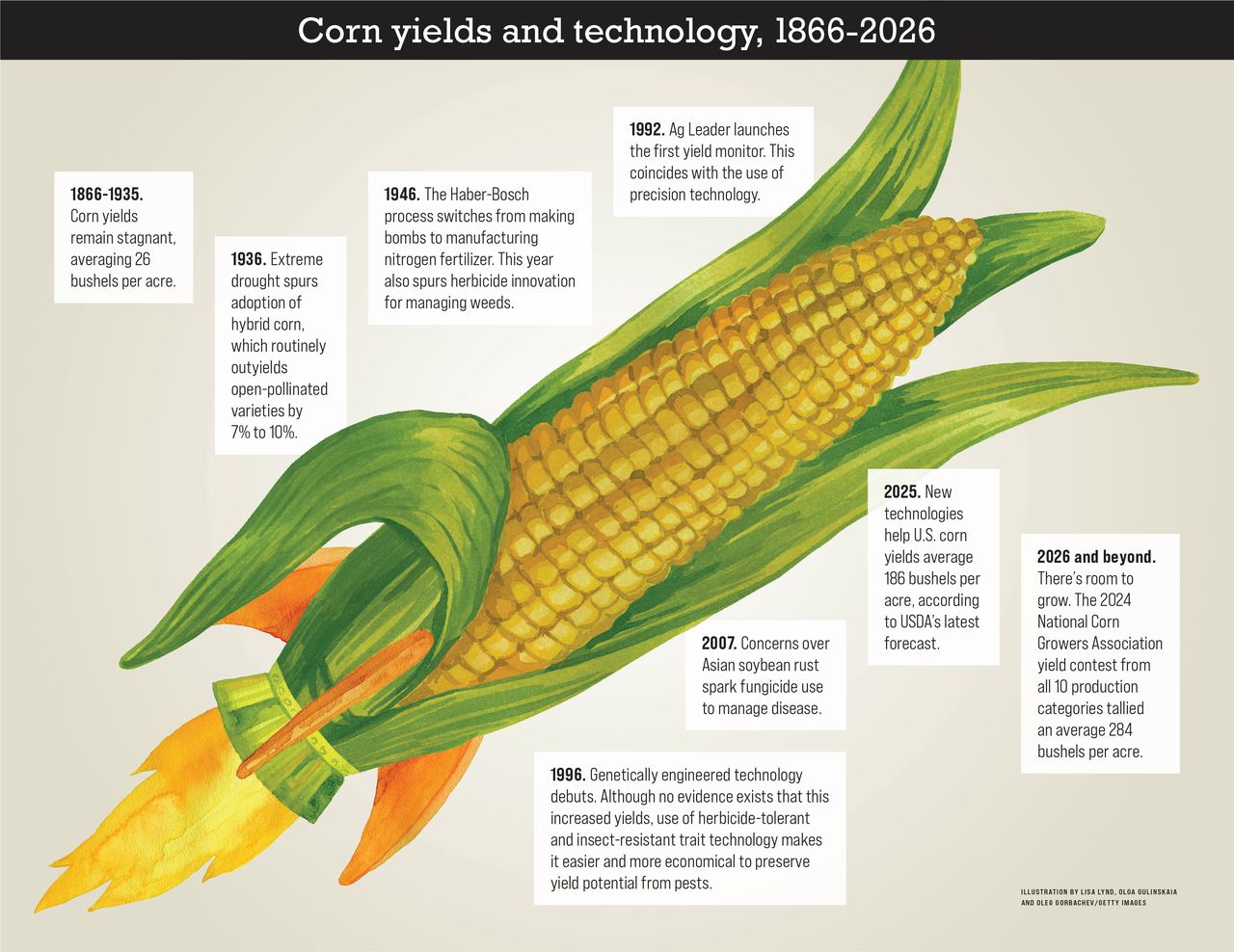
“Fungicide use took off after 2007 and is now an integral way to help control pathogens such as tar spot and southern corn rust.”
Precision tech and data entered. Yield monitors and variable-rate fertilizer applications helped farmers zero in on specific ways to boost yield in highly productive fields and minimize cost in poor ones. Farmers began collecting a flood of soil data through soil maps gleaned from GPS.
The problem was not the data; it was figuring out how to put that data into action, a challenge that still exists today for some farmers. Still, precision tools continue to make breakthroughs for corn farmers.
“Precision technologies are now on the verge of allowing farmers to make real-time decisions through remote sensing, data analytics and crop modeling,” Licht said.
Genetic engineering helped. Farmers in 1996 began planting genetically engineered corn to protect against European corn borer and corn rootworm. Varieties were also introduced to allow plants to tolerate herbicides like Roundup. The results were impressive, and rapid adoption followed.
“Technically, there is no evidence from historical national corn yields that transgenic trait adoption has caused any change in the yield trend line since the beginning of transgenic trait adoption in 1996,” Nielsen said. “Transgenic traits have mostly made it easier and more economical for farmers to preserve yield potential in the presence of important pests.”
Genetic engineering lessened the need for tillage as a pest management strategy.
“The insect resistance and herbicide traits enabled no-till, fewer trips through the field and reduced costs for pesticides,” Hoegemeyer said, “along with increased farm size, as it reduced labor and management needed per acre.”
Genetically modified crops also shifted the power in breeding commercial corn hybrids into fewer hands. Genetic engineering was and is expensive; it takes a whole different level of technology to create traits.
In turn, the trait creators could set prices based on high research and development costs.
“It really changed the complexion of the industry,” Hoegemeyer said. “There was a battle: Would traits dictate what hybrids were in the market, or would raw genetic performance? Quite honestly, both Bt and Roundup resistance traits were so powerful, they pretty much dictated which hybrids would be in the market.”
Genetic selection today comes with improvements like better nitrogen efficiency, stress tolerance and drought tolerance.
Knowledge passed to next generation. Imagine trying to grow more corn year after year without any prior experience, knowledge or test results. Corn farming certainly succeeded from innovation, but none of that would have mattered had it not been for the curious farmers who strove for better results with each growing season.
A vast majority of U.S. farms are owned by multigenerational family operations, a distinct advantage that allows for generational learning and improvement year after year.
Golden era ushered in. Over several decades, these innovations created a golden era for modern crop production. It began with plant breeding and hybrids, and then continued with commercial fertilizer, herbicides, fungicides, mechanization, precision planting and genetic engineering.
How high corn yields go in the future is anyone’s guess. Today, technologies like genomic selection — DNA markers — provide more potential upside than Wallace could ever have imagined.
“Now with genetic markers, we can look at millions of combinations,” Gibson said. “Each new technology adds to yield improvement.”
There’s room to grow. USDA’s latest forecast of a 186-bushel-per-acre national average is modest compared to the average 284-bushel-per-acre results from all 10 production categories in the 2024 National Corn Growers Association yield contest.
Still, farmers, plant breeders and agronomists can be proud of how far corn yields have come in the past century.
“What’s phenomenal is U.S. corn yields were seven times better in 2025 than in the period between the Civil War and the 1930s,” Gibson said. “I don’t think the people who started this ever envisioned getting this far.”
Nielsen agrees. “In response to continued improvements in genetic yield potential and stress tolerance — plus increased adoption of nitrogen fertilizer, chemical pesticides, agricultural mechanization, and overall improved soil and crop management practices — the annual rate of corn yield improvement more than doubled to about 1.9 bushels per acre per year since the ’50s, and is now gaining at around 2.6 bushels per acre per year today,” he concluded.