I’ve been talking about the benefits of wide-swath, same-day haylage for years. But have you wondered about the science behind why it works better for silage?
I’ll cover that later, but let’s discuss why traditional windrow drying is wrong for silage.
Traditional haylage is cut directly to narrow windrows, allowed to dry for two to three days and then chopped. It’s dry as baled hay on the outside and wet as fresh-mowed on the inside.
This appears practical, but it flies in the face of how forages dry for silage. You pay a high price in the number of digestible components lost.
Silage does not dry the same as hay. The factors that affect drying of forages are assumed to be the same from start to finish, but this is not true.
Drying occurs in three phases:
- Phase 1 is a rapid loss of moisture, down to 60% to 65% moisture (35% to 40% dry matter), the level at which silage is made.
- Phase 2 is a slower process, down to about 40% moisture.
- Phase 3 is the longest phase, with moisture levels safe for storing dry hay.
In the first phase, moisture moves along the stem to the leaf as the primary pathway in the early stages of drying. It is driven by leaf photosynthesis that converts moisture into milk-supporting digestible carbohydrates.
At least 35% to 40% of the moisture contained in the alfalfa stem at cutting exits the plant through the leaf by photosynthesis during field drying. This is similar for grass leaves. The younger and more tender the plant, the more moisture is removed through the leaves.
The more the leaves are exposed to sunlight, the more moisture is used by photosynthesis. The more the leaves are attached to an undamaged stem, the greater the volume of moisture removed throughout the whole plant.
The second phase is a drier moisture. This loss of moisture through the side of the alfalfa stems is 10 times less than the movement along the length of the stem and out through the leaves. Breaking the epidermis by conditioning can increase the drying rate below 50% moisture.
This middle stage is more typical of the popular understanding of the mechanism of drying, with heavy reliance on mechanical conditioning. It is only beneficial for dry hay and is counterproductive for silage.
The third phase removes tightly held water. It is well below 50% moisture and continues until forage is dry enough to store for hay. It is highly dependent on weather conditions.
Photosynthesis, evapotranspiration matter
The primary method for moisture loss is through the leaves by photosynthesis, followed by evapotranspiration through the stomata.
In case you didn’t pay attention in science class, photosynthesis is where the plant, when exposed to sunlight, takes carbon dioxide from the air and water from within the plant to make highly digestible carbohydrates and oxygen that we breathe. It removes moisture at an incredible rate.
On a sunny day, haylage can get to over 40% dry matter in two hours. Stomata are pores in the plant leaf where carbon dioxide and oxygen can freely pass, and moisture, drawn from the stem, can also leave the plant.
Stomata respond to light, temperature, water availability and other stimuli. They close at night or in the shade of a narrow windrow, and open during the day and in sunlight. Closing the stomata shuts down photosynthetic drying.
Past research has found that the drying rate of intact forage plants is considerably greater than that of equivalent amounts of detached leaves and stems. Plant moisture is 57% to 65% (35% to 43% dry matter) at stomata closure, well within the range for making excellent silage. Thus, loss through photosynthesis and stomata is the primary mechanism for reducing plant moisture to silage-making levels.
Traditional haylage-making focused on field curing is based on old methods to the detriment of highly effective evapotranspiration. Mowing into narrow swaths immediately shades most of the forage, stopping the rapid moisture loss from photosynthesis and closing the stomata quickly. Both stop the primary mechanism for moisture loss in silage and lose feed value through respiration.
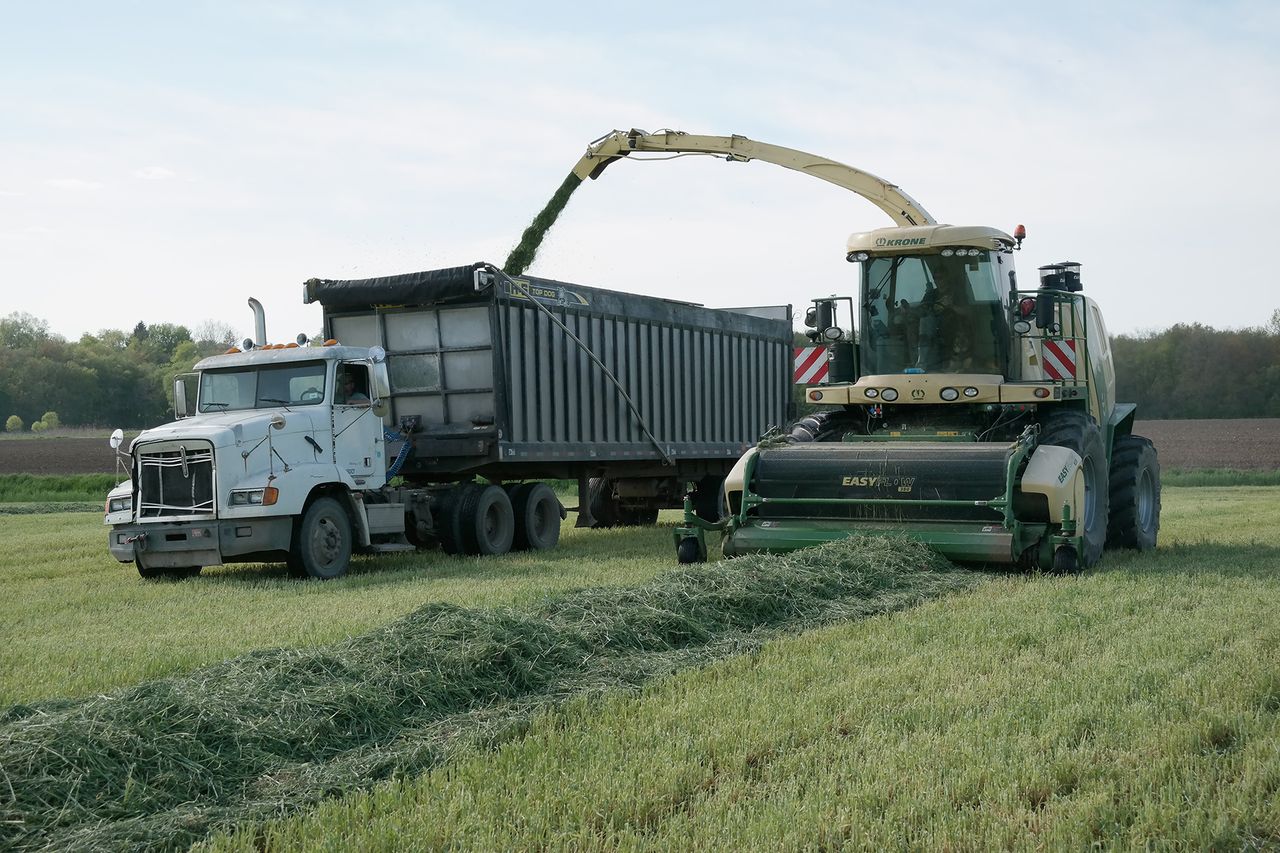
Why going wide is better
Spreading the swath to the full width of the cutter bar maximizes exposure to sunlight. Sunlight interception is critical to drive photosynthesis, which uses up moisture at a rapid rate. Leaves exposed to light consume and lose moisture quickly. This is the most critical factor in accelerating drying for silage.
Sunlight keeps stomata open until moisture falls below silage levels. Laying a cut swath at greater than 85% of cutter-bar width in our research received three times more sunlight than the narrow swath. This stimulates moisture loss from the plant growing and increases the plant's feed quality by producing digestible components due to the greater leaf area subject to incoming radiation.
Why you shouldn’t condition
Conditioning is counterproductive for silage drying. Tine conditioners are even worse because they not only break capillary flow in the stems, but also remove the leaves, which are the critical place for converting water into carbohydrates.
Conditioning reduces drying for silage and is not effective on third, fourth and fifth cutting with their smaller-diameter stems. Adding insult to injury is the density of the narrow swath. Laundry does not dry in a pile, nor does haylage.
Why and how drying affects forage quality
How you dry directly affects the forage quality that reaches your cows because it affects water-soluble carbohydrates (energy) in silage.
Immediately after cutting, the plant tissue continues to respire until the cells are no longer alive. The greatest change that occurs is the respiration loss of carbohydrates. This highly digestible material makes even small respiratory losses important, representing about 14% of the total dry matter loss for wilted silage.
Under wet and humid conditions, respiratory losses may be 15% to 30% of the initial dry matter. This condition exists in the center of a narrow swath of haylage in the field. The better the forage quality, the greater the respiration losses. Respiration ceases when the dry matter reaches 35% to 40%. Each hour the silage sits in a narrow windrow you are losing energy.
Past research has found that crushing increases the respiration rate of alfalfa by 15% more than uncrushed stems.
A wide swath has more than three times as many plants exposed to sunlight. So, it gains milk-producing carbohydrates from photosynthesis more than what’s lost by respiration. This reduction of respiratory loss by photosynthesis ceases when the forage reaches 40% to 50% dry matter, past the time to chop for silage.
Keep in mind that cutting in the evening in order to have higher sugars in forage does not work in the humid East, where nighttime maintains the swath at 100% humidity, thus prolonging respiration.
Why going wide is better for milk production
I have found that narrow swaths decrease potential milk production from the time the crop is cut until it is dry enough to chop for silage.
Wide swaths increase potential milk production per ton dry matter as photosynthesis produces readily digestible carbohydrates in excess of that consumed by respiration. The majority of this shows up as starch rather than sugars (starch is composed of 2,000 to 200,000 sugar molecules).
Other research by Fredric Owens of Oklahoma State found that starch levels decreased 57% in red clover and 56% in alfalfa during narrow wilting. This is a significant loss of readily digestible carbohydrates between mowing and ensiling.
Owens also found that 73% to 94% of the sugar in wilted forage was used during ensiling. Most starch was degraded during wilting rather than during ensiling. Prolonged wilting from narrow swaths and conditioning can reduce the concentration of sugar to levels below that required for successful fermentation, thus causing a change in the concentration and distribution of fermented products in the silo.
We found that wide swaths consistently had better lactic-to-acetic ratios than the narrow swath. Thus, prolonged wilting may further reduce silage quality and bunk life from narrow swaths. The loss of sugar substrate allows clostridia to ruin the feed value and increase butyric acid in the forage. A proper inoculant added at the chopper will also reduce this from happening if there is sugar substrate.
This follows through to feeding in that fermented samples from rapidly dried wide swaths contained 300 more potential pounds of milk per ton of dry matter than the forage produced by the slower-drying narrow swaths.
The bottom line on how to do it
Width matters more than conditioning for silage. But you are not getting the most of the wide-swath benefit unless your mower leaves a swath greater than 85% of the cutter-bar width. If your mower does not allow this, then open it as wide as you can to achieve as much drying benefit as possible (until you can get the right mower).
If you have a 13- to 14-foot mower that can only leave a swath of 6 feet, then the added cost of tedding will be beneficial until you can trade it in for the proper mower. Some farmers have added bars to the back of their mowers to re-spread the swath to the full width of the cutter bar.
On triple mowers, remove all deflection shields, especially those at the front of the machine. Yes, you drive on a small portion of forage, but cutting at a 3- to 4-inch height raises the forage back off the ground after the tractor passes.
One last caution, if you use the double or triple windrow aspect of managing wide swath. Silage will come in much faster than ever before. You will need to upgrade the tractor weight on the silo to keep packing at the correct level. If not, all the savings in wide-swath forage quality will be lost by spoiled silage from insufficient packing.
And don’t forget: This system will not work if there is no sun!