The Wheat Quality Council’s annual Hard Winter Wheat Tour is a tradition that brings farmers and industry leaders to the heart of winter wheat country in May. Over the course of two and a half days, participants will drive set routes across the state, evaluating crop conditions and measuring the crop’s potential yield.
This year’s crop is facing drought conditions, and a late freeze event May 6 covered the western third of the state.
According to the May 5 U.S. Drought Monitor Map, 70% of the state is experiencing drought, ranging from abnormally dry to moderate drought in central Kansas and severe to extreme drought in the western two-thirds of the state. All of it is landing squarely over the majority of historic Kansas wheat acres.
The May 4 USDA National Agricultural Statistics Service’s weekly Kansas Crop Progress and Condition Report has the 2026 wheat crop developing far ahead of schedule, with 78% of the crop rated very poor, poor and fair, and just 22% rated good to excellent. Winter wheat in Kansas is 95% jointed, and 70% of the crop is already headed out.
While the May 12 USDA Crop Production Report will be released the first day participants are crossing the state on the Wheat Tour, Gregg Ibendahl at Kansas State University released his wheat yield outlook for 2026.
Ibendahl’s model predicted Kansas wheat yields as of May 4 ranging from 36.6 to 41.2 bushels per acre, with a predicted average of 38.9 bushels per acre. Ibendahl’s modeling predicts production in Kansas at about 238 million bushels.
Kansas conditions
In south-central Kansas, Tim Turek is looking at a highly variable crop ranging from poor to below average, with drought being the limiting factor. A freeze event in April dinged some of the wheat, with a few white heads here and there. And while he did scout some powdery mildew early in the season and a little stripe rust, disease was really the least of this wheat’s worries, he said.
Turek said there are fields in his area around Caldwell, Kan., that have potential to yield and are at pretty much full berry.
“It’s turning gold and starting to want to mature,” he said. “We were set up for a home run until this spring just slowly took it away from us.”
Clay Schemm works on his family farm around Sharon Springs in west-central Kansas. He said conditions out that way are a mixed bag depending on the subsoil moisture left in fields from the previous crop, and if the fields were in the right area to get limited amounts of precipitation.
Schemm said his family’s farm counted just ¼ inch of moisture from January to March, with an unseasonably warm winter and high wind that dried out fields even more. April brought a little rain that would help the wheat that’s out there, Schemm said.
When we spoke May 7, a late freeze event had occurred the night before, with results on the crop yet to be seen. Schemm said the crop is about 60% boot stage in his area, with about 20% of the crop already showing heads.
“It’s a critical time for temperatures,” he said.
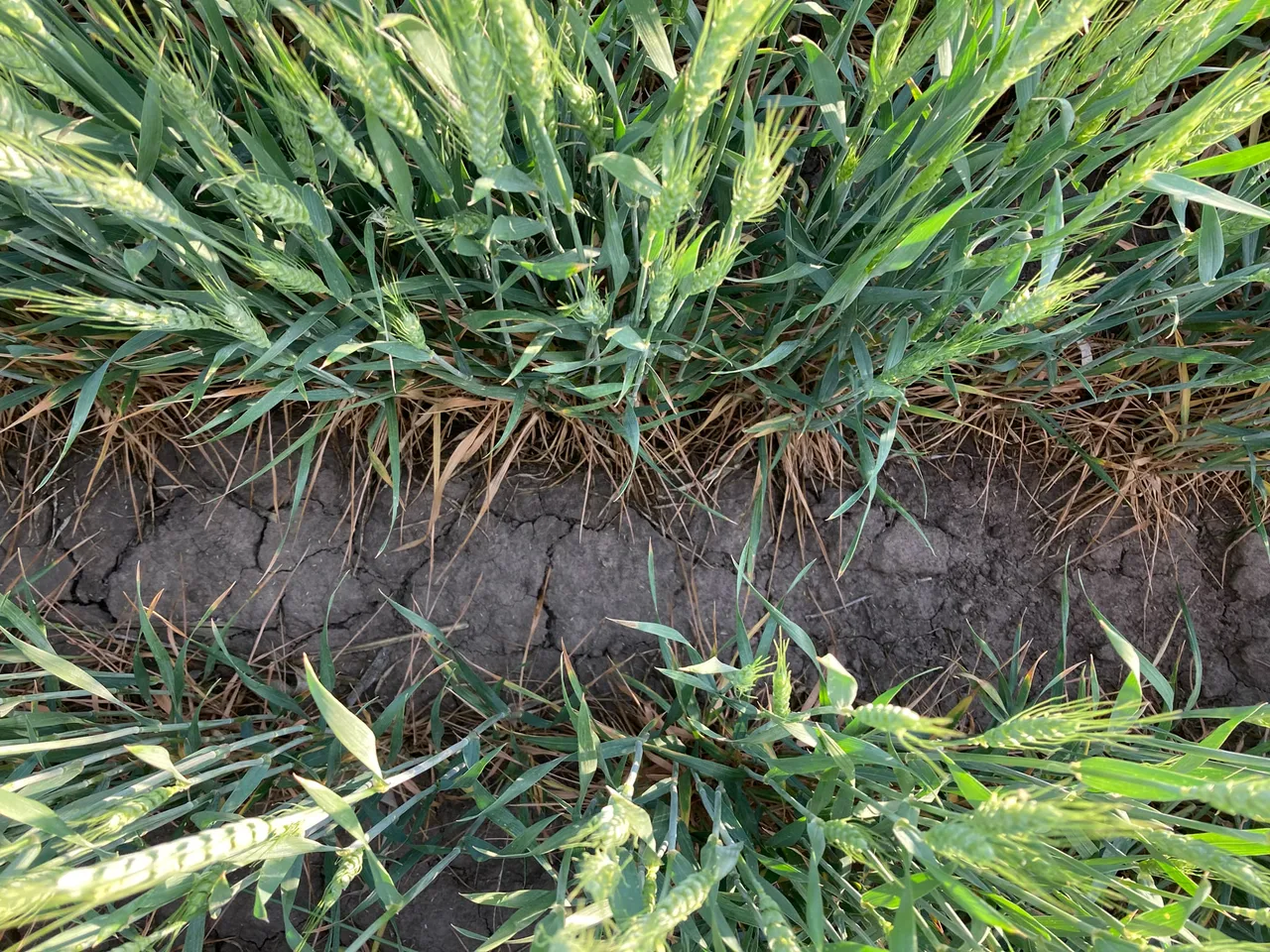
Farmers like Schemm will be checking to see if the grain actually fills considering the tough conditions it has already faced. What does get harvested, though, likely will have good protein potential.
One thing is for sure: May is going to be a hectic month for the family, Schemm said. Corn planting dates have been pushed earlier, and the wheat crop is maturing fast in these conditions.
“In our area, [Risk Management Agency] planting dates have been pushed back for corn, and we plant our milo earlier, right after the corn gets in the ground,” Schemm said. “So, if we have wheat to harvest this year, I imagine I’ll go from planting and putting on spring preemerge straight to the shed and pulling the combine out to go harvest.”
Conditions in other states
The neighboring states of Oklahoma, Colorado and Nebraska are in similar situations. The Oklahoma Wheat Commission reported May 5 that drought stress, uneven rainfall, disease pressure and an earlier-than-normal harvest window is the story of the season.
“The [southwest and western Oklahoma] crop remains under pressure, with nearly half of Oklahoma wheat rated poor to very poor, while only a small share is rated good to excellent,” according to the report. “Even so, some areas near Apache, El Reno, and parts of Caddo and Washita counties are still showing yield potential where moisture and stand conditions have held on.”
The commission also reported that some fields are moving to harvest, while others have already been sprayed out and abandoned.
The Oklahoma Grain and Feed Association’s 2026 crop estimate May 5, as reported by members, pegged the state’s wheat yield at about 47.79 million bushels, significantly below the 10-year average of 94.49 million bushels. That’s with 2.06 million harvested acres and a 23.11 bushel per acre average yield.
Colorado’s May 1 Wheat Outlook reported that the state’s facing the same drought pressures as the rest of the region. Some moisture did land the week of May 1, but the crop is already so advanced that it may have been too little, too late.
“Given that this crop is running about two to three weeks ahead of schedule and is already starting to head, freeze damage continues to be a concern,” according to the report.
Nebraska planted a record-low number of wheat acres last fall at just 850,000. Farmers in the state have described the crop condition in western Nebraska as “dire,” with many considering abandoning wheat acres and planting them to corn or sorghum.