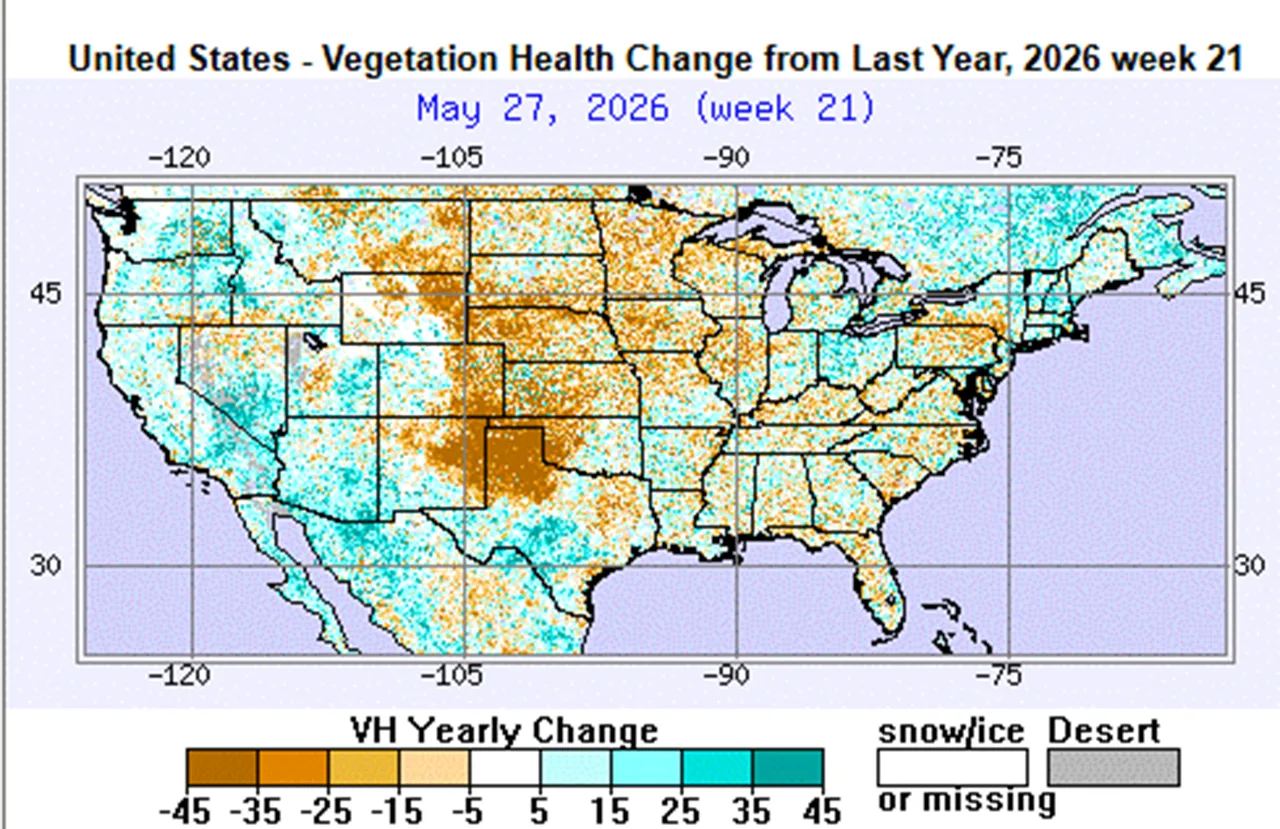
Judging crops months before harvest boils down to perspective, and the difference between bulls and bears as summer begins likely depends on whether their view is across the lane or from 25,000 miles above it.
USDA’s first crop ratings of the season released Monday, June 1, are made from observations by Extension agents and others who drive by fields in their neighborhoods. Their verdict: 67% of the corn crop is in good or excellent condition. That’s right in line with the average over the past 40 years, and suggests yields around 184 bushels per acre, close to the 183 bpa expected based on historical trends.
Assuming this first estimate holds, my forecasting model puts average nearby futures for the 2026-27 marketing year around $4.25 a bushel, with a top third selling range from $4.75 to $5.10. July 2027 corn spent much of May above that target before easing back to $5 to kick off June.
Futures for delivery of 2026 crop corn were supported for much of the first half of the year by ideas farmers would cut back on seedings by 3.5% this spring. Plantings would still be the third highest on record at 95.3 million acres, with a 184-bpa yield producing a crop of just over 16 billion bushels.
The view from satellites orbiting Earth captured by Vegetation Health Index maps normally shows U.S. cropland conditions improving as fields green up in the spring. But this year stress spread in the western part of the growing region. That points to potential for below normal yields if the trend continues, with corn coming in at 179.4 bushels per acre, down around 3% from expected production of 15.6 billion bushels.
While that would still be the third biggest crop ever, projected stocks leftover on Aug. 31, 2027, at the end of the marketing year would fall to 1.8 billion bushels. Based on this scenario, nearby futures might average $4.65 to $4.85, with the top third of the selling range around $5.10 to $5.50. July 2027 corn futures flirted with $5.30 in mid-May, smack in the middle of that target.
Condition ratings from weekly Crop Progress reports tend to start off strong, then fade into September when averages improve through harvest. But 2026 is starting off a bit differently. Already a quarter of corn fields are in drought, and updated weather outlooks published at the end of May on Sunday showed increasing risk for summer.
Does a rough start signal a small crop?
Initial crop conditions don’t show a strong correlation with final yields, but a rough start to spring can be noted in years with poor production, such as 1988 and 1993. And these weekly reports quickly attain the level of statistical significance, suggesting the connection is more than mere chance.
Still, timely rains during mid-summer pollination and late season grain fill can turn around a crop that at first seems to be suffering. And better growing conditions aren’t out of the question, because El Nino warming of the equatorial Pacific is expected to emerge soon. That pattern is associated with higher than normal corn yields in the U.S. and Argentina, though production of grain crops in Australia typically is lower.
This setup suggests rallies on weather scares are possible but could be fleeting until traders know more about not only production, but how demand shapes up as the pipeline refills with new crop this fall.