The soybean market latched onto the coattails of a roaring bull market in soybean oil in the first half of 2026, which helped briefly lift July futures to a two-year high, above $12.50 per bushel in March.
With a potential record U.S. soybean crop in the works, will the bulls lose their grip?
It isn’t that the biofuels boom that propelled a 60% rally in soy oil futures through May is about to go bust. The record domestic crushing pace and broader global acceleration into biofuels promise to support the soy complex well into next year.
But the market eventually will factor in planted acres. Many market watchers believe USDA’s initial soybean acreage estimate of 84.7 million is low. USDA may boost planted acres significantly in the June 30 report.
“I’m still worried about more downside in soybeans long term,” said broker Mark Knight, a farm marketing consultant at the Farmer’s Keeper advisory firm. Knight said he wouldn’t be surprised to see planted soybeans hiked by 1 million to 2 million acres.
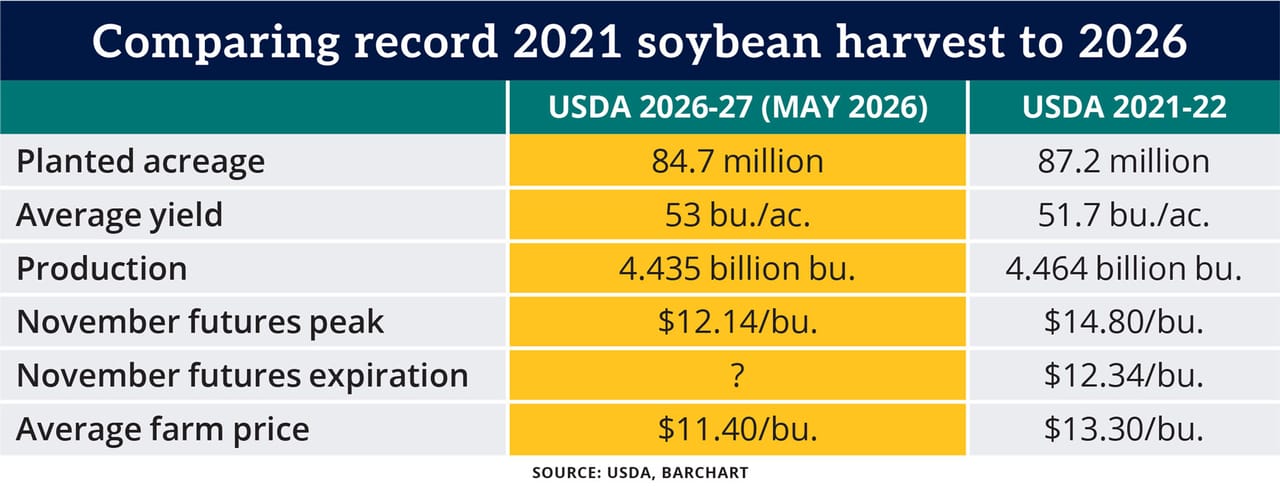
In USDA’s initial forecasts for the 2026-27 marketing year, U.S. soybean production came in at 4.435 billion bushels, just 29 million bushels below the 2021 record. (Plantings were 87.2 million acres that year.) USDA has the 2026 average yield pegged at 53 bushels per acre, matching 2025’s record. In 2021, yields averaged 51.7 bpa.
Veteran grain market analyst Bryce Knorr sees potential for higher yields, especially if a percolating El Niño takes root. El Niño has been associated with cooler, wetter Midwest summers and higher yields.
“If this connection holds for 2026, yields could be around 4% better than expected, hitting 190 bushels per acre for corn and 55 bpa for soybeans,” Knorr wrote in a Farm Futures Ag Marketing IQ column in May.
Farmers who have priced little or none of their expected 2026 harvest should consider the potential for sharp market downside if no weather scares emerge. In 2021, November soybean futures peaked at $14.80 per bushel in early June before marching lower for most of the summer and fall, ending at $12.34 by expiration, a drop of nearly 17%.
Five years later, market dynamics are quite different. Despite heightened uncertainty over the Middle East and a record Brazil crop, November 2026 soybeans have held up relatively well, maintaining a strong uptrend from mid-January lows and briefly topping $12 in mid-May.
Track carry
Additionally, carry in the soybean market expanded over much of the spring, meaning prices for November 2026 and early 2027 futures built a greater premium to nearby prices (a similar pattern was happening in corn). At the end of May, the premium March 2027 futures held over November 2026 hit 14 cents, near a four-month high.
By tracking carry trends and other market patterns, farmers can inform hedging strategies and identify possible pricing opportunities. A strengthening carry could be interpreted as a signal to put grain in storage and reap higher prices down the road, but it’s not that simple. In carry markets, some advisers recommend options-based strategies to “capture the carry” — i.e., selling call options on deferred futures at levels above current prices — but other factors must be considered, including storage costs and risk tolerance.
The first five months of 2026 were volatile but also offered reasons for price optimism. Summer may or may not change the narrative. If the narrative does change, it may happen fast. Prepare accordingly.