USDA’s much-anticipated June Acreage and quarterly Grain Stocks reports brought soybean numbers that both bulls and bears could sink their teeth into but that ultimately, from the market’s directional perspective, amounted to mostly empty calories.
Soybean futures did manage a modest early-July rally but didn’t stray much beyond the range the market held for much of June. The lack of major surprises left the impression of a stalemated market destined to extend a sideways grind for the time being. But within the numbers lurked signs of potential for sudden, sharp swings in either direction. A few highlights:
Acreage on the nose. USDA raised its 2026 U.S. soybean plantings estimate by 665,000 acres from its March forecast to more than 85.36 million acres, nearly matching the average analyst estimate of just under 85.37 million acres. Acreage is up 5.1% from the 81.21 million acres seeded in 2025, a six-year low.
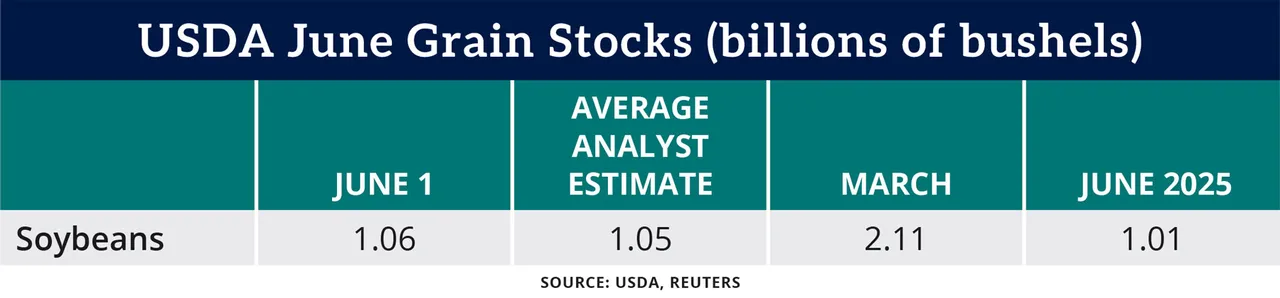
Stocks high and tight. Overall U.S. soybean stocks as of June 1 totaled 1.06 billion bushels, up 5.3% from a year earlier and about 15 million bushels above the average analyst estimate. However, on-farm stocks were down 11% to 367 million bushels, a reflection of strong domestic crush demand that’s compelling farmers to clean out their bins.
Midwest sweep (almost). Soybean acreage increased in 10 of 12 top producing states in the Midwest and Plains, with Iowa plantings jumping 550,000 acres, or 5.8%, to 10 million acres, and Kansas plantings surging 17%. Minnesota was one exception, with plantings dropping slightly to 7.1 million acres.
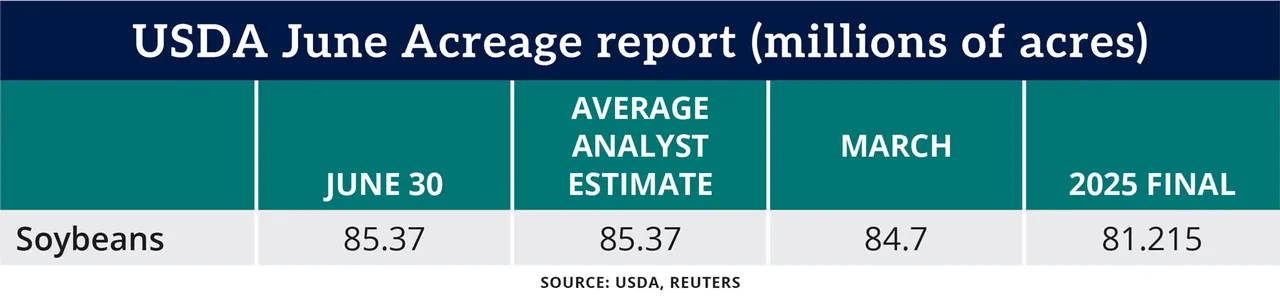
Higher soybean plantings were expected long before planting season started. The crop’s stronger profit potential amid a biofuels boom have buoyed soybean prices much of the year. Hopes for business from China also provide support. That USDA’s acreage increase wasn’t higher was a relief to bulls, who feared disruptions to global fertilizer markets from the U.S.-Iran war could push bean plantings up an additional 1 million acres or more.
Weather and trade
With acreage and supply expectations largely fixed for the next few months, focus in the soy complex turns to Midwest weather and U.S.-China trade. USDA’s acreage boost, underpinned by favorable Midwest weather, suggests record harvest potential and adequate, but not excessive, supplies in 2027.
For the soybean market, the reports “neither helped nor hurt much … removing a downside risk [but] not manufacturing an upside story,” said Iowa farmer and adviser Chase Koopmans on his Grain Ledger Rundown blog.
What could shake the market out of summer doldrums?
- extreme heat or dryness during the crop’s critical pod-setting stage
- China accelerating purchases of U.S. soybeans, as many expect
In June, USDA confirmed China’s first purchase of U.S. beans for 2026-27 delivery. Whether China ever attains the full-year purchase target (the equivalent of 919 million bushels) touted by the White House remains a matter of debate.
November soybeans hit a May peak at $12.14 per bushel before selling off, but a ramped-up Chinese buying campaign could help lift the market back near or above $12. Meantime, the $11.60 to $11.70 area seems to be a favored target to unload unpriced bushels. (November soybeans traded around $11.50 in the first week of July.)
Soybeans “are stuck between a good crop and an absent buyer,” Koopmans said. “The two things that turn them are a weather scare and China showing up.”