Growing up, summertime was my favorite. It meant no school. It did mean ball games, the pool and nearly zero responsibility. In high school, that shifted as summer became training season for cross country and track, and the miles I put in during June and July set the tone for how the whole season would go. In college, it turned into internships, summer classes, and long days helping out on the farm with my family, using that time to think seriously about my career post-graduation.
Now, summer still means work and play, but it also becomes an important checkpoint. It’s a time to sit down and honestly ask: Did I hit the goals I set at the start of the year? What targets are still in play? What do I need to do to adjust for the back half of the marketing year?
Those are the questions each of us should ask. Let’s start with this: How has the first half of the year gone?
• What percent are you sold on old and new crop?
• How did your spring input costs compare to your original projections?
• Where does your current breakeven sit? Have you adjusted it since planting?
• Are your projected yields still realistic, or is it time to adjust?
Now, plenty of questions are worth sitting with as we head into the back half of the year and those vary from operation to operation.
Current marketing year
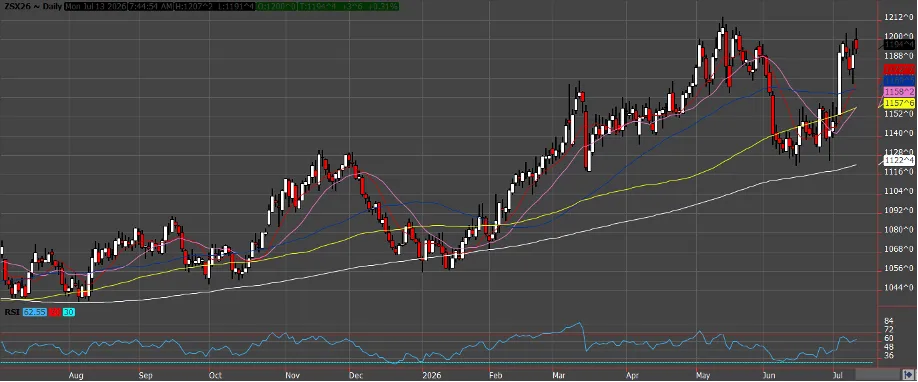
It’s been a year of real ups and downs with both corn and soybeans. Where do you sit right now in your program? If you’re being honest, do you wish you’d gotten more aggressive earlier in the year?
At the time of writing this, November soybeans not only approached but touched the $12 futures level, and China has started buying U.S. soybeans for the new crop marketing year (which has helped support the move). If you haven’t started your new crop soybean program yet — or feel like you’re behind and need to make some catch-up sales — is this the time to act?
Corn balance sheet shifted
On the corn side, December corn surpassed $5 futures earlier this year in the new crop contract. If you didn’t get sales made during that window, don’t beat yourself up over it. The goal now is to build a strategy going forward, not dwell on missed timing. Both corn and soybeans have perked up off recent lows over the last week, finishing strong after the July WASDE, where USDA tightened new crop corn ending stocks to 1.79 billion bushels, along with a tighter world carryout figure. That’s a meaningful shift in the balance sheet.
Where does that leave us?
All of this puts pressure on the U.S. farmer to produce a trend or better national crop that keeps stocks from tightening further. Both the bulls and the bears have risk.
Regardless of where your operation sits in its marketing program, a legitimate case can be made for both the bulls and the bears right now. Like any good Christmas list, it’s worth checking twice.
If you’d like to go through your operation’s marketing program together, give me a call at (309) 454-4145.
The risk of loss in trading futures and/or options is substantial and each investor and/or trader must consider whether this is a suitable investment. AgMarket.Net is the Farm Division of John Stewart and Associates (JSA). This material has been prepared by an agent of JSA or a third party and is, or is in the nature of, a solicitation. By accepting this communication, you agree that you are an experienced user of the futures markets, capable of making independent trading decisions, and agree that you are not, and will not, rely solely on this communication in making trading decisions. Past performance, whether actual or indicated by simulated historical tests of strategies, is not indicative of future results. Trading information and advice is based on information taken from 3rd party sources that are believed to be reliable. We do not guarantee that such information is accurate or complete and it should not be relied upon as such. Trading advice reflects our good faith judgment at a specific time and is subject to change without notice. There is no guarantee that the advice we give will result in profitable trades. The services provided by JSA may not be available in all jurisdictions. It is possible that the country in which you are a resident prohibits us from opening and maintaining an account for you.