One war wasn’t enough to sustain a wheat market rally last spring. Two wars combined with a weather scare, however, likely will do the trick.
Winter wheat futures soared to three-year highs in late July as hostilities escalated between the U.S. and Iran in the Middle East and Russia and Ukraine in the Black Sea region. It’s the latter conflict that’s particularly troubling because Russia and Ukraine exchanged repeated attacks that threatened shipping and port infrastructure at one of the world’s top grain-exporting hubs. Russia and Ukraine combined account for about 27% of global wheat exports.
“Grain shipments through the Black Sea region are seizing up,” said Tanner Ehmke, CoBank’s lead economist for grains and oilseeds, in late July. “The attacks have severely restricted shipping through key grain and oilseed corridors.”
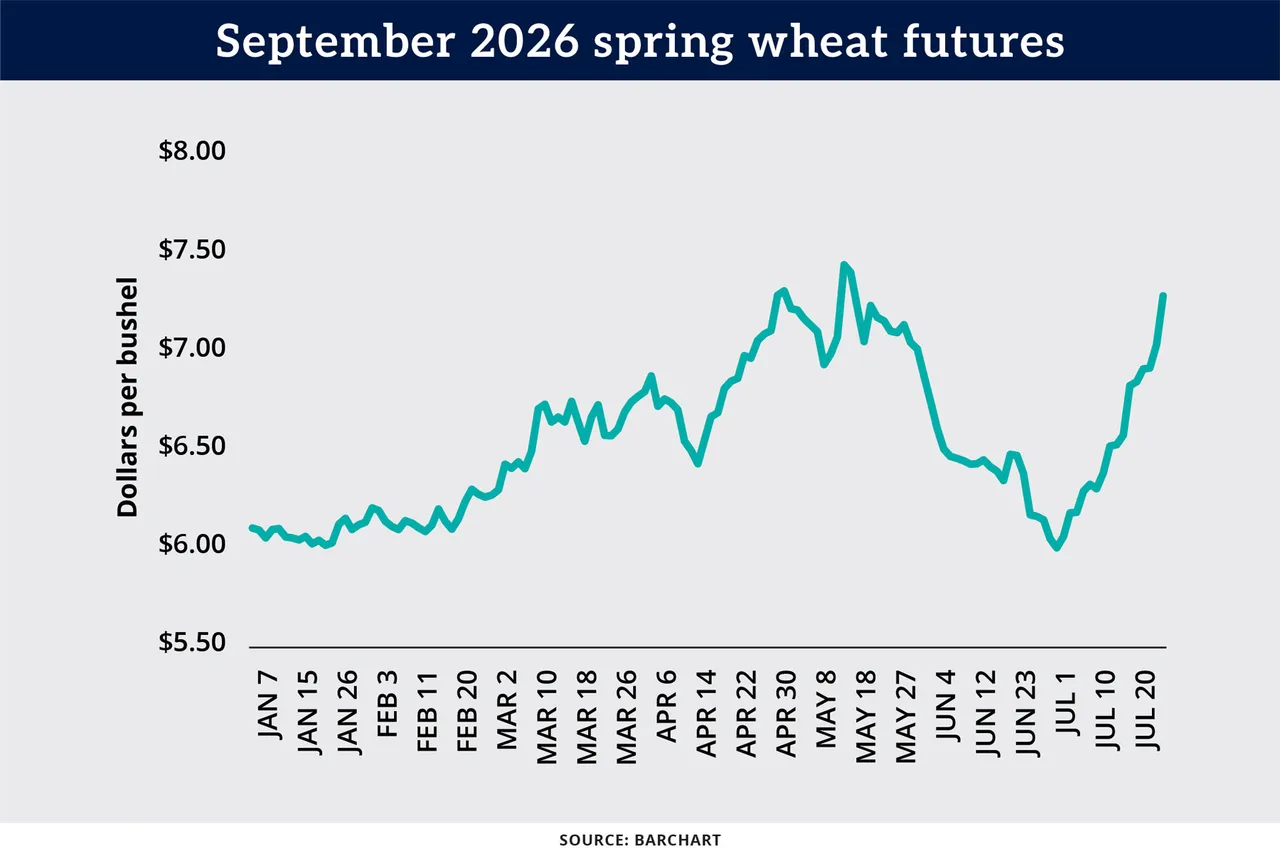
Dire as the geopolitical landscape grew over the summer, U.S. wheat growers did regain opportunities to unload this year’s harvest at much stronger prices than they saw as recently as June. They’ve also regained some hope that the market may be forming a foundation to sustain a longer-term bull market, or at least prices that can stay north of $7 per bushel, as weather woes shrink global supplies.
Here’s a brief recap of late-July market highlights:
- September soft red winter wheat futures soared near $7.06, the highest for a most-active contract since July 2023 and a 20% jump from the end of June.
- September hard red winter wheat topped $7.63, also a three-year high and a 25% surge from June 30.
- September hard red spring wheat hit $7.35, up 23% since June and the highest in over two years.
Weather also continues to be a major market driver for wheat. After severe drought in the Southern Plains slashed this year’s winter wheat harvest, weather woes have shifted north into HRS country, where extreme heat and dryness are increasingly stressing crops. HRS doesn’t typically assume and sustain leadership in the wheat complex during normal times, but these aren’t normal times.
Here are a few wheat market influencers to watch the remainder of summer:
Northern Plains and Upper Midwest weather. Extended forecasts suggest high temperatures and dry conditions will persist throughout most of the prime HRS growing region into early August. Much of Montana, South Dakota and northern Minnesota remain under drought conditions.
USDA weekly crop condition ratings. Good-to-excellent readings for spring wheat nosedived during the second half of July and may deteriorate further if weather conditions don’t improve.
USDA’s Aug. 12 Crop Production report. Can the U.S. wheat harvest get any smaller? Nothing can be ruled out. Earlier in July, USDA cut its 2026 winter wheat production estimate to 990.5 million bushels, down 29% from 2025 and the smallest since 1963. The initial spring wheat harvest estimate came in at 475 million bushels, down 4.4% from 2025 and a five-year low.
As for war, it’s impossible to say with any certainty how either the U.S.-Iran or Russia-Ukraine conflicts will play out. The most important thing is to pay attention and be ready for any pricing opportunities that arise. As long as the missiles and drones are flying, grain markets will remain on edge.
“With portions of the Black Sea grain trade offline, global grain supplies will be notably tight in the short term,” Ehmke said. Long term, the attacks will subside and trade will likely resume. “But with the export infrastructure damaged and shipping insurers likely to maintain higher risk premiums for vessels transiting through the Black Sea, future global grain export capacity will be reduced.”
Slower Black Sea shipments and shrinking global wheat harvests “are awakening the world to a higher-priced grain environment,” Ehmke added.