You’ve probably heard of Wall Street’s “Santa Claus Rally,” even if your interest in stock markets ends with feeders or lean hogs. The propensity for share prices to have happy holidays is as much a tradition as nativity scenes or Silent Night.
But gains don’t come every year. Whether 2025 is naughty or nice could have a big impact on year-end trading in corn and soybeans. Revelers may not fill stockings with grains, but volatility could spill over from stocks.
First up is the two-day meeting at the Federal Reserve that concludes Dec. 10, this Wednesday, with the central bank’s updated statement on monetary policy. Uncertainty is already high in this most unusual time as wars over trade and territory try to pause for a truce, even if short-lived. While betting on Federal Funds futures suggests an 86% chance of a one-quarter of 1% decrease from the current target range of 4% to 4.25% rate, a full point of cuts is seen as likely by the end of 2026.
Thin volumes and year-end position squaring can exacerbate tax-loss selling or buying, as traders, not to mention the Fed, grapple with data delays caused by the government shutdown.
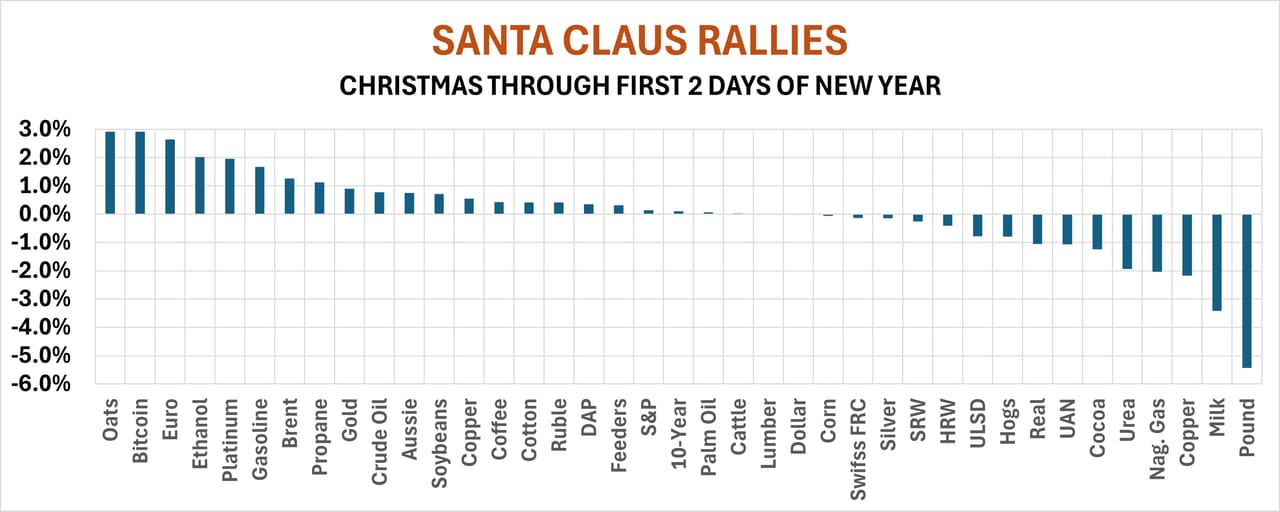
The “official” Santa Claus Rally describes the tendency for stocks to rally from Christmas through the first two trading sessions in the new year. While the trend is hyped, gains over the last 45 years are minimal, just one-tenth of 1%, at least as measured by the S&P 500 Index.
But those results are for averages of major indexes. Year-to-year variations are much larger, with losses doubled in bad times and four times higher in bull markets.
Extending the analysis to other major markets adds further complications. The S&P Index dates back to the start of the Great Depression, while other contracts have a decade or less of experience under their belt. Which locations are measured also matters – corn prices at the Gulf may vary widely from Midwest or West Coast price points. Using futures contracts instead of cash is another twist.
Aside from these holiday caveats—which aren’t a fancy cookie—traders should also avoid Christmas cliches. “Oats Know” is an old saying in the grain trade, and the hearty cereal crop was the top-ranked ag contract on the board. But corn and soybeans don’t always follow the maxim.
- Soybean gains from Santa did average seven-tenths of 1%, while corn lost one-tenth of 1%.
- Those averages conceal greater risks. Maximum losses for soybeans were eight-tenths of 1%, while corn’s worst showing was off six-tenths of 1%.
Results over the holiday period from Dec. 9 to Dec. 31 were more encouraging. Soybeans gained an average of 2.7% over the last four weeks of the year, and corn also did better—rising 2.2%.
To be sure, markets dealt with other Black Swan years in the last five decades—corn embargoes, Asian meltdowns in 1999, terrorist attacks on 9/11, the Great Financial Crisis of 2008-09, the Pandemic and the Ukraine war, to name a few from the depressing list. So, traders may be hardened to crisis
Will we whistle past the graveyard this year? Just hope the last door on your Advent calendar reveals a nice surprise.