The U.S. soybean processing industry has a message for farmers: “We want your beans — lots of them. Actually, we want even more.”
Companies like Archer Daniels Midland are putting their money where their crushers are, emboldened by an outlook for sharply higher renewable fuels blending mandates in the U.S. and elsewhere.
In July, ADM said it will upgrade four U.S. crushing facilities to expand its North American annual processing capacity by 700,000 metric tons, or about 25.7 million bushels. The plants targeted for expansion are in Frankfort, Ind.; Deerfield, Mo.; Lincoln, Neb.; and Spiritwood, N.D. The expansion would amount to about a 1% increase from last year’s total U.S. soybean crush.
“Strong demand — supported by biofuels policy in the U.S. — is driving opportunities for farmers and the broader American agricultural sector,” ADM executive Gary McGuigan said in a recent statement. “By choosing to build on our existing footprint and adopting individualized enhancement plans for each facility, we’re ensuring that we are investing wisely and preserving flexibility while ultimately delivering a meaningful increase in capacity across our North American network.”
ADM is just one of several companies latching on to the biofuels boom, with multiple new crushing plants launched across the U.S. in recent years. For farmers, escalating biofuels demand has brought a welcome antidote to the bearish impacts of year-after-year record Brazilian soybean production and the temporary loss of China as a customer. And it’s having real market impact.
Soybean futures were up 14% for the year through the first week of August, and in late July, touched a 2½-year high above $12.56 per bushel. (Perhaps not coincidentally, ADM shares have performed even better, with a nearly 36% year-to-date gain.)
Other major processors are gobbling up beans at a sharp clip amid record or near-record crushing margins much of this year. In July, Bunge Global said it had processed over 423 million bushels of soybeans during the second quarter, up 24% from the same period a year earlier. Earnings for the company’s soybean processing and refining business (which includes soybean merchandising) soared 75% to $804 million (excluding certain accounting adjustments).
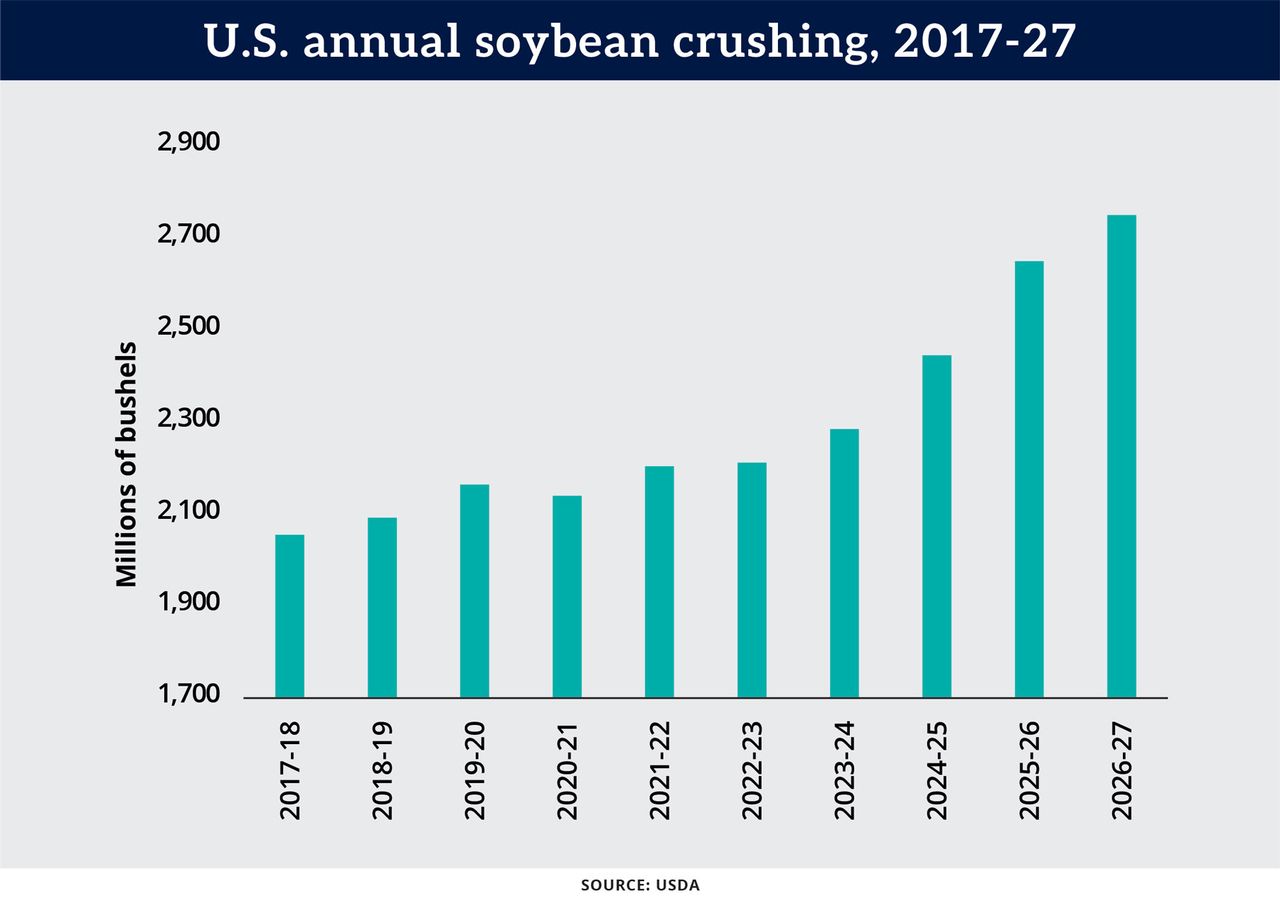
Biofuels expansion, should it prove sustainable, offers farmers reasons for longer-term optimism following a multiyear income squeeze. Could it help drive profitable breakevens in 2027, or even 2026? Consider these questions:
Will crushers continue to operate full-bore? Crushing totals seem to notch records almost every month over the last few years, based on National Oilseed Processors Association data. NOPA reports annual domestic crushing totals increased by an average of over 4.5% since 2020-21, and USDA forecasts crushing will hit 2.75 billion bushels in 2026-27, a record for the sixth year in a row.
What’s the outlook for crude oil and diesel markets? The U.S.-Iran war that sent diesel futures to four-year highs last spring contributed to rallies in soybeans and soy oil. Eventually, the war will end, Strait of Hormuz traffic will be freed up, and energy prices will come down.
Has soy oil peaked? Soy oil futures briefly jumped to four-year highs near 80 cents per pound in early June but have since pulled back, though the market remains one of the year’s strongest-performing commodities. With biofuels expected to account for 54% of total soy oil use in 2026-27, this market bears watching.
Are more beans coming from Brazil and the U.S.? Unsurprisingly, Brazil is again expected to expand soy plantings this year, putting it on track to reap a record harvest for the sixth year in a row, based on a USDA forecast. Could biofuels optimism compel U.S. farmers to hike soybean acres again in 2027? Planted acreage jumped 5.1% in 2026, to 85.37 million acres. An increase of even half that much could vault plantings above 87.5 million acres, the highest since 2018.
One thing appears to be certain: The story of the biofuels evolution is still being written, and it could hold major opportunities and upsides for farmers, but also risks that must be monitored closely.
“U.S. soybean demand is being structurally reshaped, with domestic processing emerging as the dominant force behind market growth,” StoneX analysts wrote in a recent report. “This evolution is unfolding as global competition intensifies, particularly from Brazil, which continues to expand its export dominance. As a result, U.S. soybean markets are increasingly being repriced around domestic value chains rather than international trade flows.”