Of all the days on the calendar, for grain markets, the July 4 Independence Day holiday has long been revered as the most pivotal and defining every year — the equivalent of throwing Christmas, Halloween, St. Patrick’s Day and other big to-do’s into a blender and hitting “puree.”
There are good reasons for that, all of which revolve around weather and the back end of the corn and soybean growing season. But there’s another holiday that also carries its share of weight: Labor Day.
That’s because Labor Day can be viewed as a sort of demarcation between summertime lows and subsequent harvest or postharvest rallies. (Although the holiday is on a different date every year, we’ll focus on Sept. 1 for the purposes of this article.)
In recent history, including the past two years, December corn often established lows for the summer or even the calendar year in August, and then climbed at least partway through the fall harvest or later. In 2025, December corn bottomed around $3.92 per bushel on Aug. 12 and then went on to rise as high as $4.43 by mid-November.
Harvest rally repeat of 2024-25?
This pattern suggests that by late August, the trade believes it has a decent handle on the ultimate size of the crop, and if it’s a big one, that gets factored into prices before the combines start rolling. But then the market exhausts the downside, and bargain-hunting exporters and other buyers emerge before South American supplies become available early in the following year.
For farmers, this may offer hope that beaten-down summer prices will recover, and they’ll have opportunities to sell grain higher during or after harvest.
For this article, we looked at five years comparable to 2026, all with historically high planted acreage (91 million acres or higher in all but one year) and historically high production (roughly 15 billion bushels or higher). These years saw an average rally of about 61 cents, or 14%, from the August low to a harvest or postharvest peak.
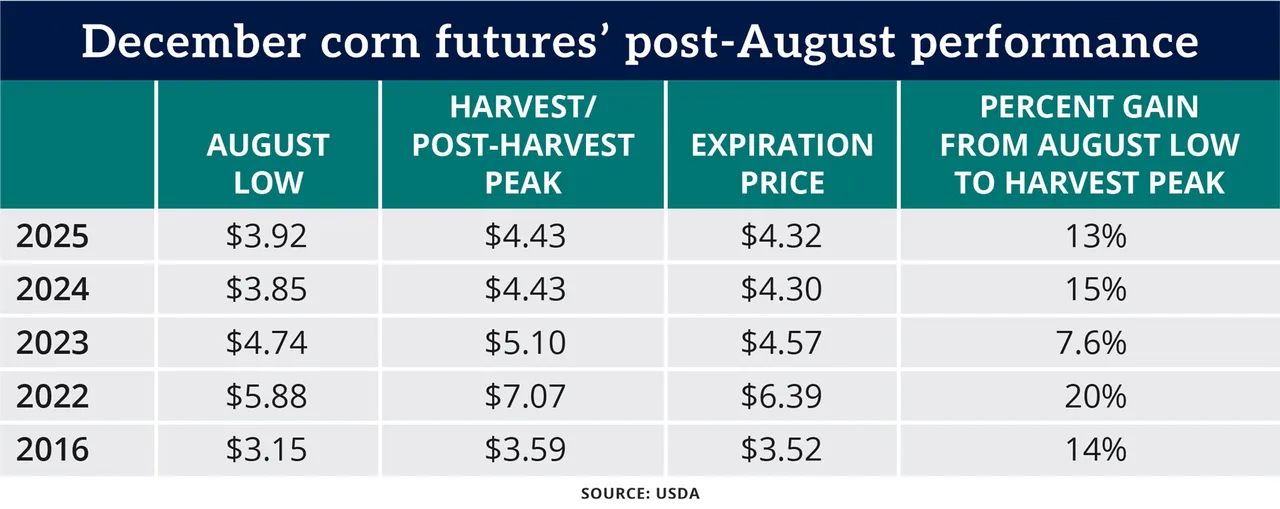
What does this mean for the rest of 2026? Is similar market behavior possible? It’s impossible to say for sure, given the unusual combination of war, adverse weather and trade turmoil that’s roiled grain markets for months.
Will this market get wilder?
This summer has been a wild, white-knuckle ride even by futures market standards, with December corn tumbling to a year-to-date low around $4.26 at the end of June, then rallying to a two-month high of $4.92 in late July, then selling off at the end of the month as weather forecasts turned friendlier for crops. It seems unlikely the June lows will be tested in August, but you can’t rule anything out.
Corn prices could finish the year strong on several supportive factors, including record export demand and strong ethanol exports. It’s also possible that heat and dryness in the western Corn Belt took a bite out of yield potential and the crop isn’t as large as USDA currently forecasts.
But sitting on your hands and waiting for a harvest rally may not be advisable, especially in light of the counter-seasonal July rally that effectively gifted farmers with opportunities to lock in near-$5 prices. And as of the start of August, December corn (at about $4.64) was trading over 30 cents higher than it was a year earlier.
If 2026 so far has taught us anything, it’s to throw out what you think you know and expect the unexpected.