In the Midwest, it’s no secret that corn and soybeans are the reigning crops. However, during these challenging years, is it time to focus on soil health to ensure your land can support high yields when prices rebound?
At the 2026 Southeast Nebraska Soil Health Conference, Trent Bohling, a farmer near Johnson, Neb., shared his experiences with improving soil health. His diversified operation, which includes row crops and cattle, has always emphasized soil health.
Bohling explained that his father has practiced no-till farming since the mid-1980s, planting crops such as vetch and rye on eroding hillsides. These practices were essential to the Bohling farm long before regenerative agriculture became a buzzword.
Using an analogy, Bohling compared corn and soybeans to Interstate 80, with the off-ramps representing the various crops and practices farmers can implement along the way.
“The interstate right now is corn and soybeans,” Bohling said. “Just like I-80, it’s not going anywhere. These are staple crops with a well-developed, and necessary, supply-and-demand infrastructure.
“But not every operation is wanting to be, or should be, in the ‘get big or get out’ mentality. We might not have enough exit ramps for that interstate right now.”
Shifting his mindset from large-scale row crops, Bohling is exploring practices that improve soil health while complementing his cattle operation. One of those practices involves planting Kernza.
“When I was researching different grasses, I saw ideas for cool-season pastures,” Bohling said. “But I kept coming across pictures of this new grain with an extensive root structure: Kernza.”
Kernza, an improved perennial intermediate wheatgrass variety trademarked by The Land Institute, produces a starched berry. This is closer to wheat grains instead of a flat, low-starch seed like a fescue or unimproved intermediate wheatgrass. Its root system can reach depths of 8 to 12 feet, and yields are improving as research advances.
Economics of Kernza
Kernza isn’t a one-size-fits-all solution for every operation, but it offers good grazing potential at a lower input cost in a cow-calf system.
“We swathed and baled in June, just shy of 3 bales per acre, and then I was able to regraze that fall,” Bohling said. “The hay sample came out to 11.6% protein and 57% [total digestible nutrients], which is good, average-quality hay. I was happy feeding the hay.”
With Kernza seed costs of about $80 per acre and a small amount of phosphorus application, Bohling calculated that he nearly broke even in his first year of planting Kernza without even factoring in the August grazing opportunity. However, the economic analysis doesn’t account for the benefits of soil health and organic matter added to the field.
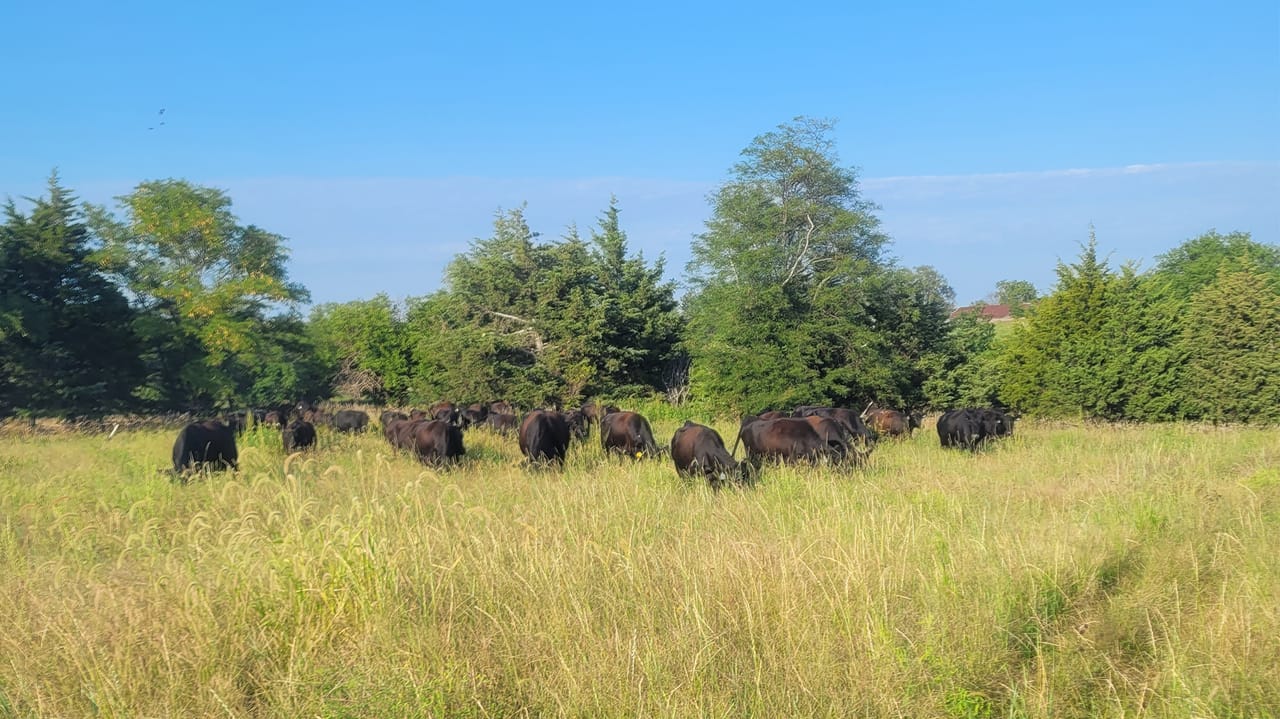
“One thing I noticed is that when I grazed this, the cows would go lay under the tree at 3 o’clock in the afternoon,” Bohling said. “I was always missing 10 calves and could never find them. I found out they went to this grass and laid down in it. I took a soil thermometer out there, and that soil was 80 degrees [F] compared to 110 degrees on bare soil.”
Bohling concluded that the combination of biological activity, biomass accumulation and improved soil health helped reduce soil temperature.
Now, in his third year of planting Kernza, Bohling’s soil samples show increased microbial activity without synthetic fertilizer. Additionally, the soil pH has remained steady at 6.5 to 6.8, despite no lime application in over a decade.
While Kernza may not be a major profit driver, Bohling has leveraged Natural Resources Conservation Service programs and received Conservation Stewardship Program enhancement funds to support his soil health efforts. He encourages farmers to reach out to their local NRCS office to explore available payments for these practices.
Opportunities ahead
This system works well for Bohling, partly because of his cow-calf operation. However, he believes Kernza can still be viable for farmers without cattle.
“Know your context,” he said. “What is my context? I have cattle available to graze, and I know that’s probably not everybody’s context. But I also feel you don’t have to have calves to make this work. You can ask around, and I bet somebody will want to work with you on the cattle side of things.”
Regardless of market conditions for livestock or crops, farmers are known for their creativity. For Bohling, Kernza is just one part of the solution that fits his operation.
“I feel like this is not the answer. It is one of many answers,” he said. “We are in an agricultural setting right now where corn and soybeans will always be the interstate, and we must embrace that. But what are some other off-ramps?”
Bohling advised producers to start small to see what a crop such as Kernza can do for their operation. He also encourages collaboration with neighbors and conservation groups like NRCS to explore available programs.
So, how can you implement a strategy that matches your context and improves your soil health?