Soybean price bulls have a lot to chew on, and farmers have reason for longer-term price optimism despite the acreage curveball that USDA threw into the Aug. 12 Crop Production report.
First, let’s talk about the acreage surprise that left many observers scratching their heads. USDA added 1.4 million acres to its planted acreage estimate for soybeans — similar to a jump it gave to planted corn. Where and how did USDA “find” an additional 2.8 million corn and bean acres compared to its June forecast? That answer is not entirely clear (more on that later).
What we do know is government crop data from this report plays a major role in market direction the rest of the year. That’s because USDA’s August report is the first of the corn and soybean growing season to incorporate information from farmer surveys. Three more such updates loom in the next three months before the “final” results in January. The numbers will change. For now, here are a few takeaways on soybeans:
Weather pinches yield potential. It’s becoming increasingly apparent that adverse weather, including extreme heat in the western corn and soybean belt during July, weighed on this year’s yield prospects. USDA estimated the average U.S. soybean yield at 52.7 bushels per acre, down from its previous 53-bpa projection and slightly under the 52.9-bpa average analysts estimated.
Biofuels boom keeps crush running hot. USDA numbers further highlighted what’s become one of farmers’ biggest allies: a biofuels boom that’s propelling soybean crush demand to unprecedented levels. Estimated U.S. crushing for 2026-27 was raised 30 million bushels to 2.78 billion bushels, up 4.7% from 2025-26 and a record for the sixth year in a row. Crushing next year is expected to account for 61% of total U.S. soybean use, up from 45% a decade ago.
Exports are bouncing back. After China shunned U.S. soybeans for much of 2025, the country’s resumption of purchases looks like it will help exports finally bottom out. USDA forecast 2026-27 U.S. soybean exports at 1.66 billion bushels, up 9.2% from a 13-year low of just 1.52 billion bushels in 2025-26. But that figure would still lag by 18% the 2.02 billion bushels per year U.S. farmers exported on average in the four years prior to President Donald Trump’s second trade war against China.
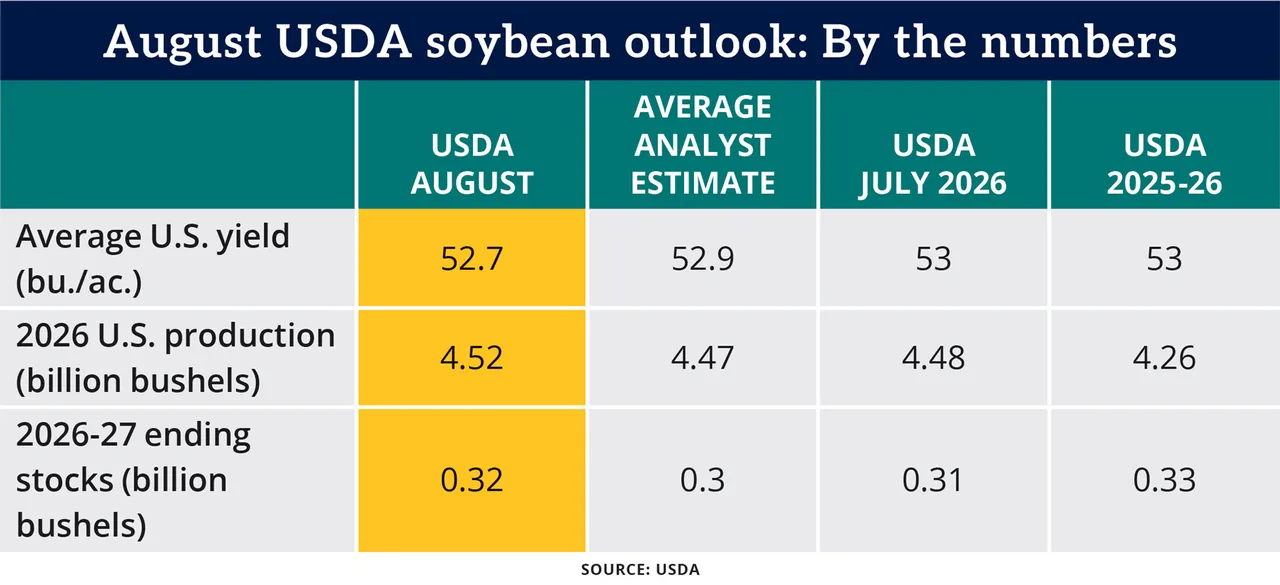
Supplies are getting tighter. A bigger crop outlook led USDA to increase estimated 2026-27 ending stocks by 10 million bushels to 320 million bushels, down 5 million bushels from 2025-26. But USDA also sees overall demand surging 6.1% to a record 4.55 billion bushels. That drops the 2026-27 stocks-to-use ratio to 7%, the lowest in four years and below the 9.5% average for the previous 10 years.
Add up the acres. The acreage hike took plantings to 86.77 million acres, a 6.8% jump from a six-year low in 2025. USDA also hiked its harvest forecast by 44 million bushels to nearly 4.52 billion bushels, which would be up 6% from 2025. Should that happen, the crop would surpass the 2021 record of 4.46 billion bushels.
Where are those acres?
USDA didn’t provide specifics on the “why” behind the higher corn and soybean acres. But it’s likely that acreage certification data collected by USDA’s Farm Service and Risk Management agencies in recent weeks showed more seedings of both crops than what was forecast in June.
The acreage and production increases blunted upside momentum in soybean futures to some extent but hardly derailed the market’s bullish track. (November 2026 futures were trading above $12.20 per bushel as of mid-August.)
A record harvest generally isn’t a recipe for $13 or $14 beans. Fortunately for farmers, the world has an expanding appetite for soybeans, and that robust demand, assuming it continues, should soak up much of what ultimately comes out of the fields.