The number of birds affected by Pennsylvania’s worst avian flu outbreak since the 1980s is close to 8 million.
USDA’s Animal and Plant Health Inspection Service recently confirmed an additional positive result on a 164,000-head Lancaster County broiler farm. There have been no positive tests on dairy farms, but there is concern the outbreak could jump to dairy herds at some point.
The outbreak has prompted the state government to surge resources to Lancaster County, the hardest-hit area and one of the densest poultry production areas in the country. But other areas of the region are also being affected. Recent positive tests have been confirmed on broiler farms in Kent County, Del., and Caroline County, Md.
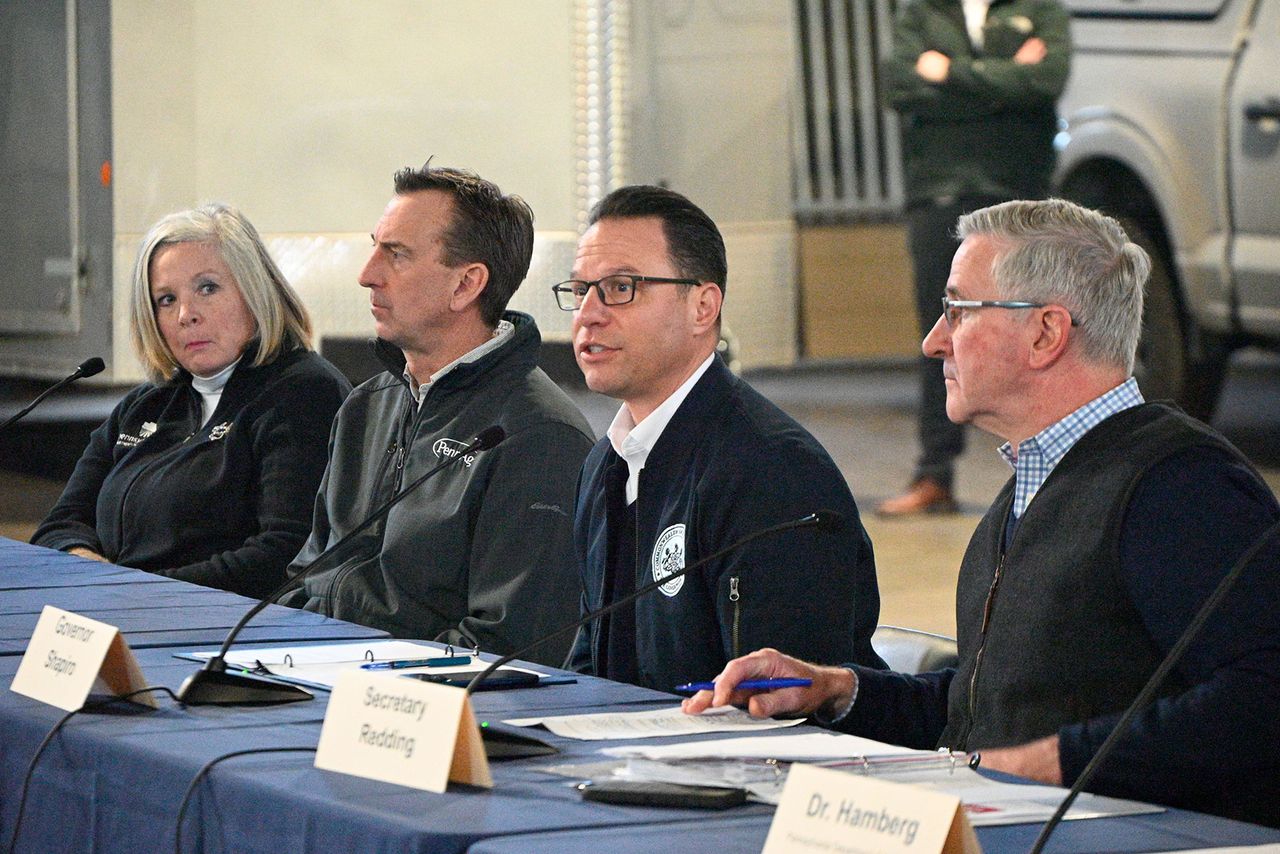
At a recent meeting of Pennsylvania state government officials, poultry integrators and farmers, Gov. Josh Shapiro said more than 100 people had been deployed to the county to assist with the outbreak, including 25 members of USDA’s “blue team” that handles disease outbreaks.
Dr. Alex Hamberg, state veterinarian, said risk of infection remains high.
“It can sometimes take a week or two from the time a house is infected until we get positives on those swabs,” he said. “It’s really key that we keep our surveillance efforts high so that any straggling cases from that deep freeze can be picked up early.”
Frozen fields a factor
Hamberg said initial testing is pointing to wild birds as the primary source of infection. The current H5N1 strain is a D1.1 type or derivative, which has been found on dairy farms in other states.
Hamberg said wild bird introduction is much earlier than previous years, and that it might have to do with the severe cold and snow the region has seen this winter.
“Normally, in a regular year, we get snow, it melts in a couple of days, and then you’ve got open fields again,” he said. “But this year, those fields and water bodies that birds normally forage in are farther away because they’re under heavy snow cover.
“So, the birds are flying farther away to find open water or fields, and then flying farther back to their roosts. That increased distance gives them more airtime, which means they’re flying over more poultry farms, increasing the risk to those farms. That may be a contributing factor here.”
More than 1,500 farms are under surveillance, including more than 200 dairy farms. Hamberg said the state’s laboratory system has done over 8,000 tests in the past month.
Vaccine talk heats up
Shapiro said his office has spoken to Ag Secretary Brooke Rollins about deploying an H5N1 vaccine. He said any mass vaccination is still months away and would only be rolled out as a pilot project.
The egg-layer industry has supported mass vaccination as it has been hardest hit by the avian flu outbreak. The broiler industry has been opposed because of fears that it could hamper international trade.
Even if USDA grants a conditional-use license on a vaccine, it must still grant approval to deploy them, a process that could take several more months.
Andrew Hoffman, dean of the School of Veterinary Medicine at the University of Pennsylvania, said it is past time for USDA to decide on vaccine deployment.
“With movement of birds, and the density of the industry, you have to weigh risks versus benefits of instituting a warp speed approach to vaccination,” he said. “We’ve done it in the past. We shouldn’t be afraid of doing it in the present. And we have the sequencies of this virus. We have unprecedented new technologies to develop vaccines.”
Mental health concerns
Jim Shirk of the Center for Poultry & Livestock Excellence said the outbreak is raising concerns over mental health.
“It takes a long time to recover from this,” he said. “You work your lifetime growing birds, trying to keep birds healthy, and all of a sudden, they’re gone. It’s a lot.”
Shirk said rural communities need more mental health resources, including people who talk to farmers one-on-one.
“The main thing is to have access to something anonymous, or even something where people can find genuine help with a simple phone call or online resource,” he said. “It should be something they can do privately, away from others. If someone doesn’t want to admit publicly that they have a problem, at least they can admit it privately and find the resources they need.”
If you need help, call or text the 24/7 988 Suicide & Crisis Lifeline at 988. Pennsylvania also has its AgriStress HelpLine for farmers at 833-897-2474. There are also regional providers such as Keystone Rural Health Consortia and Rural Mental Health Associates.
What help is available?
Pennsylvania has a dedicated HPAI Recovery Fund with $60 million available to help poultry producers stabilize and recover from losses. Shapiro said he has gotten legislative authority to increase money if needed.
These grants can help pay for biosecurity upgrades. The next round of applications are due April 30.
USDA provides HPAI financial assistance to poultry and dairy producers, including indemnity for lost birds, compensation for lost milk production and up to $10,000 for veterinary costs for infected cattle.
Programs also support biosecurity upgrades (up to $25,000 per premises) and PPE costs, aimed at offsetting losses and enhancing biosecurity.
Here are examples of available help:
Poultry Indemnity. USDA provides payments for the fair market value of birds destroyed due to HPAI, including disposal and cleaning costs.
Dairy Herd Assistance (ELAP). The Emergency Assistance for Livestock, Honeybees, and Farm-raised Fish Program helps with milk loss and veterinary expenses for confirmed H5N1 cases.
Dairy Biosecurity Support. Up to $1,500 for developing biosecurity plans is available, and $100 for in-line milk samplers and funds for PPE and laundry services.

Tips for dairy biosecurity
Cornell University has the following tips for enhancing dairy biosecurity:
- Pause or cancel nonessential farm visits.
- Assign a biosecurity manager to monitor the situation and develop a farm-specific biosecurity plan.
- Notify a vet if cows present symptoms such as discolored milk, decreased rumination and fever.
- Report findings of odd behaviors, and increased numbers of dead wild birds, cats, skunks or raccoons.
- Avoid importing cattle from affected farms.
- Discourage wild birds from entering farms, waterers and feed sources.
- Clean and disinfect waterers daily.
Tips for poultry biosecurity
Here are some tips for poultry from the Delaware Department of Agriculture:
- Limit, monitor and record any movement of people, vehicles or animals on or off your farm.
- Permit only essential workers and vehicles to enter the farm to limit the chances of bringing the virus from an outside source.
- Avoid visiting other poultry farms and any unnecessary travel off the farm.
- Disinfect equipment, vehicles, footwear and other items that come into contact with flocks.
- Keep your flock away from wild or migratory birds, especially waterfowl.
- Isolate any ill animals and contact your veterinarian.