From three hours away, Greta Halahan has turned to data and technology to not only help keep her family farm afloat, but also to transform it into a nationally recognized model of modern dairy farming.
“I stumbled upon what I think is a critical component of today’s modern dairy farms,” she said. “And that is, if you're data-driven and you control the variables you can control, it gives you a lot more confidence to make adjustments when you need to.”
The results speak for themselves. Rolling herd averages are up, cow care has improved, and the farm is primed to take advantage of the growing beef-on-dairy market.
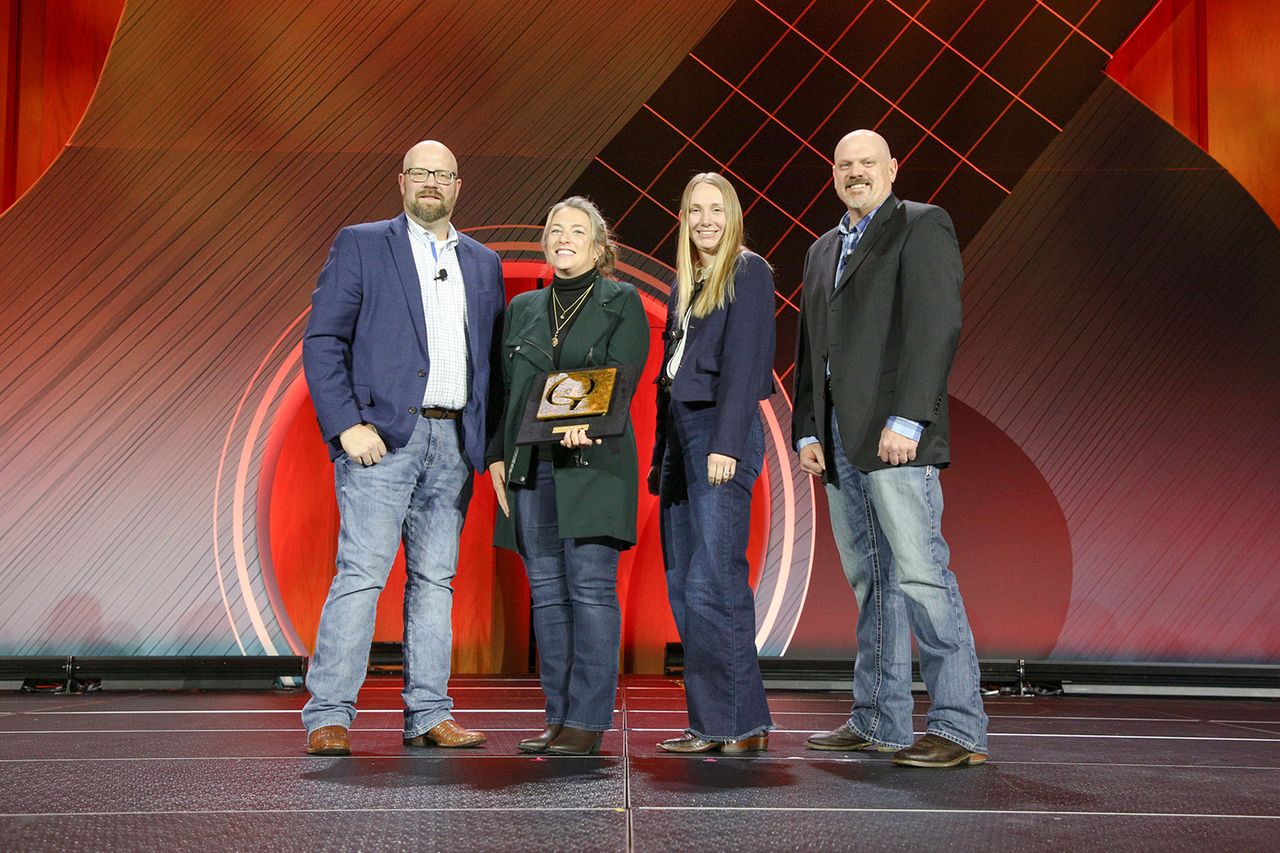
Her family’s Singing Brook Farms in Imler, Pa., was recently named a National Beef Quality Assurance (BQA) Award winner, earning national recognition for its commitment to animal care, food safety and continuous improvement in cattle management.
Presented by the National Cattlemen’s Beef Association, the awards honor producers for outstanding stewardship, leadership and adherence to science-based best practices. Singing Brook Farms was selected in the Dairy Farm category.
Halahan manages the animal side — 300 cows, 280 replacements — of the 1,100-acre farm, mostly from her home office in Lebanon, Pa. She earned a degree in ag business from Penn State and has held jobs at New Holland Agriculture and McLanahan.
Up until 2019, her late father, Bruce, ran the farm with her brother, Ross. Then, in 2019, Bruce had a heart attack. It forced Greta to take a bigger role on the farm, and it opened her eyes to issues that needed to be addressed.
“What had happened is that between my grandfather's sudden passing, and some illnesses and things that my dad had, we'd had some different herdspeople come in,” she said. “And while some of them did an absolutely tremendous job, what we were having was different people's strategies at different times. The strategy with the cows and genetics, and just our protocols and things, the synergy wasn't all going in one direction consistently.”
The decision was made to rely on data to drive decisions.
CowManager tags were placed on each cow to track behaviors and movement, and to flag problem animals sooner. In the past year, ear tags have been placed on the calves; the goal is to put them in at 7 days old.
Halahan tracks data every day and can communicate with employees if there are problems that need to be addressed.
“And so being here and having the CowManager tags and having people that were in Imler, it really forced me to trust the data and build protocols around that,” she said. “And that's kind of what we've really worked on — how can we excel in the areas that are important and keep that synergy and all of our goals heading in the same direction, working together."
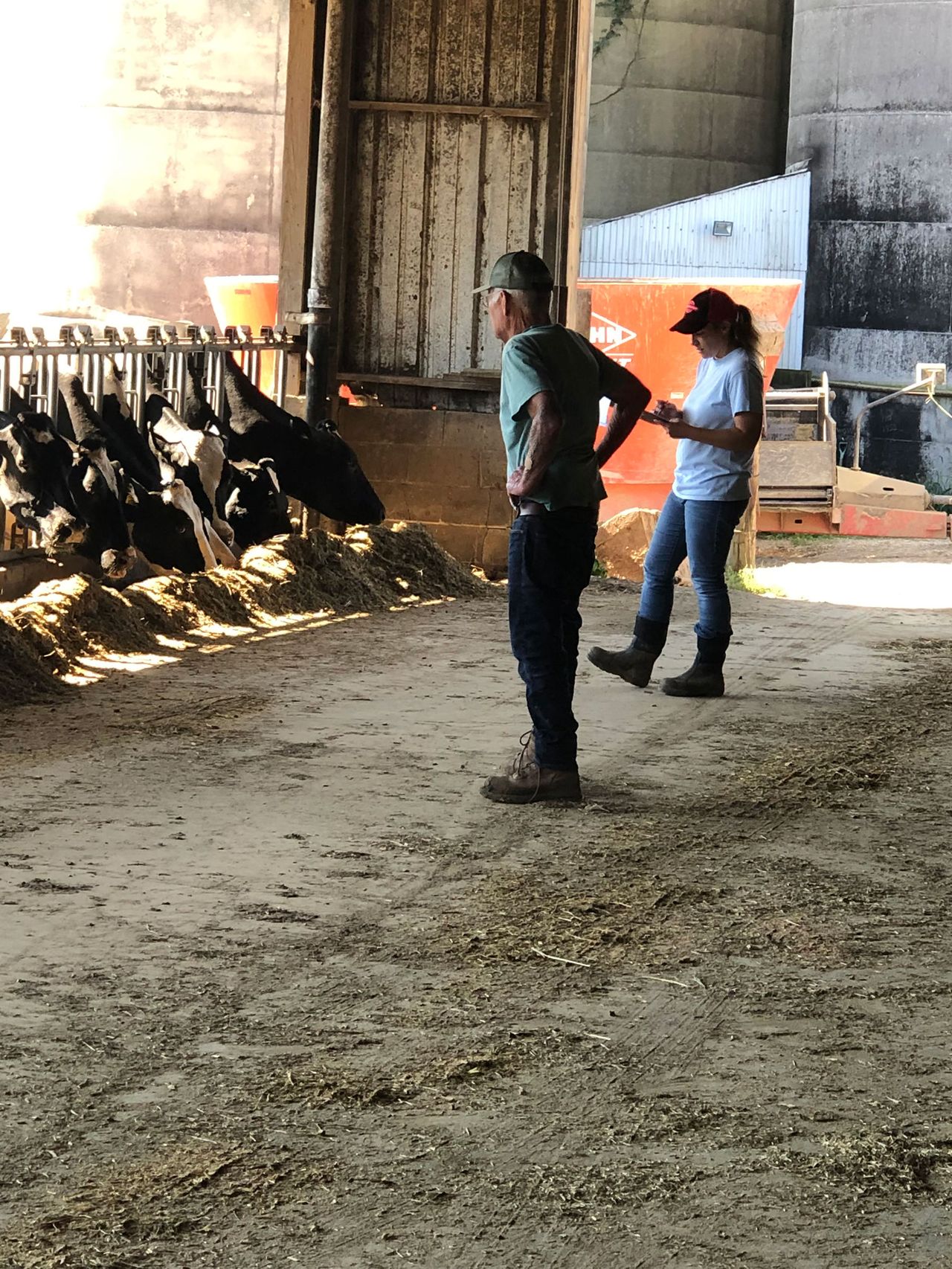
‘When the student is ready, the teacher appears’
In Halahan's case, her teacher was the data, which showed her trends that needed fixing.
The first thing was adjusting the farm’s breeding program to ensure they were getting lactating cows on time.
Second was fixing the farm’s calf-and-heifer program.
“Someone had told me that the peak milk in first-calf heifers would equal your rolling herd average, and I love a really concise, concrete thing that you can latch onto. That's simple,” Halahan said. “So, we decided we were going to try to improve the peak milk in first-calf heifers. It was about 70 pounds at that time, and we're at about 95 pounds now.”
Getting to 95 pounds required several changes. The farm’s colostrum needed to be more consistent, she said. Milkers take the first and second milk that has colostrum, and all of it gets tested. That’s the first step.
“Anything that meets our standard, it's organized into beef and bull calf bags, and then heifer bags,” Halahan said. “Then every single calf, whether it's a beef calf or not, they're all treated the exact same way. The process is the same.
“We thought it through, and they're able to administer that immediately. So, all of the prep work is done ahead of time. Our calf managers are organizing it. They just go to the freezer, pop out a bag, put it in the warmer, and then as soon as it's warm, it can be administered.”
Having that consistency, Halahan said, helps find calves needing supplements across entire groups.
“Sometimes we go through a time when the colostrum quality is poor,” she said. “It can be weather-related; it can be a lot of variables. And then we can supplement them with a booster if we need to.”
Improving the farm’s genetics program was another goal, especially with beef-on-dairy breeding — where dairy cows are bred to beef semen — becoming more popular, and profitable, than ever. Halahan's goal was to place more value-added calves on the ground using elite sires. Again, a data-driven decision.
While calf prices across the board are high right now, Halahan's plan is to ensure her calves stand out, even when prices come back down.
“And genetics and calf care will be the differentiator for us,” she said. “We’re poised to able to document the colostrum, what they’ve been given, what quality they’ve been given.”
Bad legs, a bad udder and difficulty calving are the main reasons cows get culled from the herd. Using data, Halahan said the farm catches cows at the peak of production and at the beginning of their decline — the goal is to reduce stress and to provide a more marketable animal.
“It’s really just a spacing thing and making way for new animals,” she said. “But I want her to be feeling her best, so when she gets on that truck, she’s not already experiencing fear and pain, and those kinds of things.”
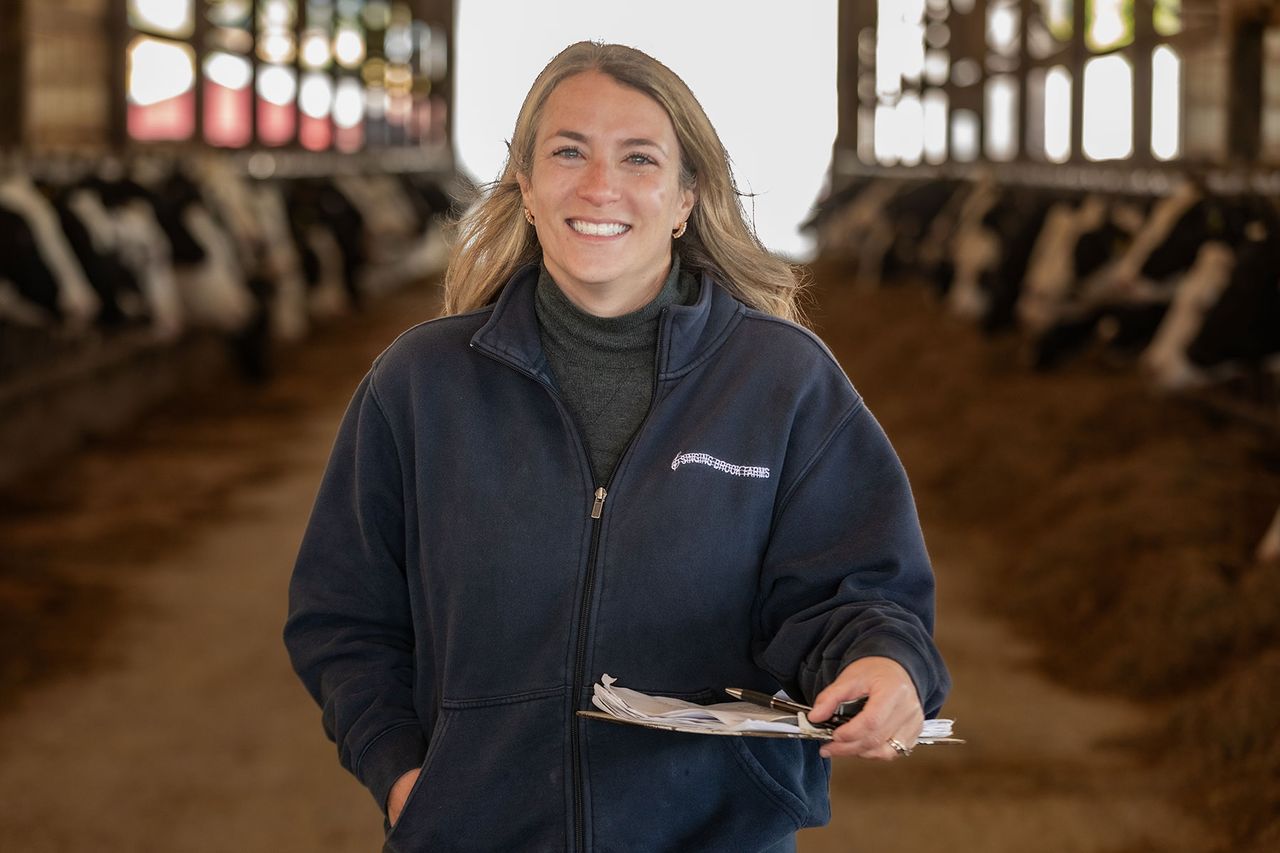
Results and communication matter
The farm’s rolling herd average is just over 28,000 pounds. Cows are milked twice a day in a double-16 parlor. They live on mattresses in a freestall barn.
Halahan drives back and forth every two weeks, spending a few days on the farm doing herd checks and working with the farm’s vet. She knows she can’t do everything from a distance. This is where having good, trusted employees, and good data, are critical.
“My job is prominent, but it is so insignificant to what those people do every day,” she said of her employees. “If you don’t have the team that’s following all those protocols and doing these things, it doesn’t mean anything.”
Continuing the tradition
And it’s worth it, Halahan said, to keep her family’s farm going.
Many dairy farmers in Pennsylvania likely know the farm’s history. It was founded by her grandparents, Marion and Obie Snider, in 1951. Obie was a former chairman of the Penn State board of trustees and is considered one of the founding fathers of the All-American Dairy Show. He died in 2003.
Last November, Bruce Snider died. Greta; her mother, Lori; and her brother, Ross, now run the farm together. Ross handles the cropping side of the farm and helps with cow management. Greta describes her mother as the “glue that holds everyone together. She prays for, cares for and feeds everyone,” she said.
Filling her late father’s shoes was a challenge. Halahan said she used to call him twice a day with all sorts of questions — from breeding, to calving and milk production, anything animal related. “He did everything,” she said.
But he allowed her to learn alongside him, something Halahan said she cherishes.
“He let me make really big mistakes and a lot of them quickly, and he just trusted me, and I recognize that not everybody has that,” she said. “You have to fail … and sometimes you have to learn some of things and say, 'I’m not doing that again.'”
Halahan lives in Lebanon, Pa., with her husband, a dairy nutritionist, and two sons.
Farming from a distance isn’t easy. Halahan said she often feels disconnected from day-to-day operations, leading to miscommunication. But technology has allowed her to come back and have a role. She hopes it inspires her sons, and Ross’s children, to come back to the farm, even from a distance.
“That’s the essence of who we are and the reason for my role. If I can be a part of making the next generation part of the story, then it’s worth it for me," Halahan said.