Brazil’s weather and planting conditions historically come into market focus at this time of year. But this time around, the world’s biggest soybean producer is serving up something equally, or perhaps even more, unpredictable: its politics.
It started in early October when conservative Flávio Bolsonaro won a surprising 47% of the vote in the first round of Brazil’s presidential elections, while incumbent president Luiz Inácio Lula da Silva won 45%.
The initial election results created heightened market volatility because Bolsonaro is a fiscal conservative who pledged to control spending and cut taxes, and his electoral performance sparked a sharp strengthening of Brazil’s currency, the real, which in turn briefly lifted U.S. soybean prices.
“The value of the real historically has been tied closely to prices of soybeans and other Brazilian exports like corn, cotton, rice and sugar,” said Tanner Ehmke, CoBank’s lead economist for grains and oilseeds. “A stronger real raises the cost of Brazilian exports for global buyers, shifting some demand to competitors like the U.S.”
As of mid-October, the real traded at roughly 5.06 to the U.S. dollar, up about 8% from year-earlier levels.
The real story: Massive harvest
The real-related boost for soybean futures turned out to be short-lived, as prices soon sank near eight-week lows amid expectations for a record U.S. crop.
But Brazil will still, as usual, be key to market direction into the new year. Brazil’s election and the direction of the real are two influencers, but the country’s crop production is the biggest influencer of them all.
Brazil is likely to reap another massive, possibly record, soybean harvest in 2027. Planting is ahead of schedule so far, and key growing areas have benefited from ample rains. But the country’s rapid expansion of recent years appears to be slowing.
Brazil’s National Supply Co., known as CONAB, recently forecast the country’s 2026-27 soybean crop at 181.6 million metric tons (6.67 billion bushels), up just 0.7% from 2025-26 and sharply below USDA’s 186 MMT estimate. The unusually small increase reflects a slowdown in planted area expansion. CONAB pegged plantings at the equivalent of 121.8 million acres, up 1.4% and the smallest annual increase since 2011-12.
Biofuels drive demand
Continued strength in the real could help U.S. exports, but whether it would be enough to make a meaningful dent in Brazil’s dominant share of China’s soybean imports is debatable. Fortunately for U.S. farmers, continued expansion of the domestic biofuels industry should soak up much of this year’s big crop.
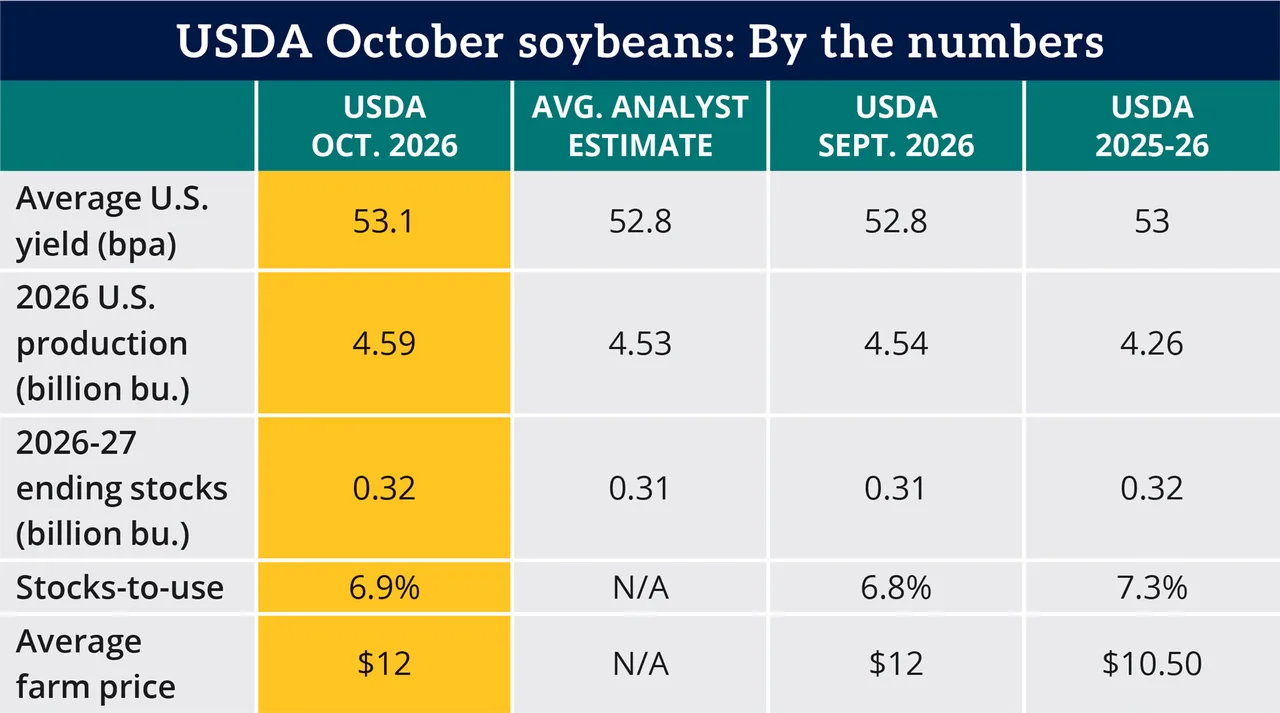
It will need to. Earlier this month, USDA unexpectedly raised its U.S. soybean yield estimate to an average of 53.1 bushels per acre and hiked production to 4.59 billion bushels, both records.
The dollar remains almighty, but the Brazilian real and its home country will have a say in soybean market direction.
“With the value of the Brazilian real tied closely to soybean prices, Brazil’s fiscal and economic trajectory plays an outsized role in market volatility,” Ehmke said. “Brazil’s forthcoming runoff election on Oct. 25 bears watching for impact on the nation’s currency and soybean price direction.”