In September, Iowa nearly set a statewide record for September rainfall, and a wet month led to serious harvest delays. These harvest delays, in turn, led to a useful lesson on basis.
Basis is simply the difference between cash and futures prices. Basis is the link between the general price level (aka the futures price) and the cash price at a specific location. Local cash prices reflect not only the big picture of world supply and demand, but also local supply and demand, transportation costs, and the availability of storage. I like to say that futures are global and basis is local.
For grain and oilseed buyers at processing facilities — wheat flour mills, ethanol plants and crushing facilities — the harvest transition from old-crop to new-crop supplies is tricky. At the end of a crop year, grain supplies are diminished, and costs, as reflected in basis, are generally higher. A new harvest promises replenished supplies and generally lower costs, again reflected in basis. Buyers know this, and the trick is to get through the transition with minimal old crop on hand when harvest begins.
Earlier in my career, I bought wheat for flour mills and managed this tricky situation many times. I can say with certainty that grain buyers at processing plants live by two rules:
- Never run the plant out of grain (or the crush facility out of soybeans). If the processing facility shuts down for lack of raw material, that is the buyer’s last day on the job.
- If prices are too high, quality is poor, railroad workers go on strike, a snowstorm closes highways or the harvest is late, refer to Rule No. 1 for guidance.
This bit of background information brings me to our recent lesson on basis, with the example provided by soybean-crushing facilities in the western Corn Belt.
In mid-September, with harvest just a week away in my home state, several southern Minnesota crushers were bidding option price to 10 cents over the November soybean futures contract. The cash price of soybeans was at a respectable three-year high. Then the rain delayed harvest; then more rain fell and harvest was delayed again, followed by more rain and more delays.
With persistent harvest delays and Rule No. 1 in mind, soybean buyers responded with a higher basis to bring in hard-to-find soybeans to keep the plants running. During the last half of September, the soybean basis in southern Minnesota reached as high as 70 cents over the November contract. Several plants in Iowa were bidding 100 cents over. These incredible premiums for nearby delivery lasted about two weeks.
When harvest finally resumed in early October, the basis at these plants collapsed to a level of 10 to 25 cents under the November contract.
I do not personally know any soybean buyers who work at those crush facilities. However, based on following Rule No. 1 for buyers, I can say with certainty that none of them had a single good night’s sleep in the last half of September.
Which brings me to a quirky aspect of grain buying concerning volume discounts and premiums:
Volume discount. We are all buyers of goods for our homes and families. We are familiar with and expect volume discounts. For example, we buy one shirt for $40, and the second shirt is 50% off, or we buy a six-box package of tissues and the per-unit cost is less than the price for one box, etc. When companies invite me to speak to local grain producers, I charge a fee. But if you want two presentations on back-to-back days, I’ll offer a per-presentation discount.
Volume premium. Grain buyers live in a different world where they may offer a volume premium. If my ethanol plant is running short of corn, a producer offering me two truckloads of corn does not solve my problem at a plant that processes 60,000 bushels each day. However, an elevator with 100,000 bushels of corn available for quick delivery can solve my problem, and that elevator can negotiate for a “push” above the posted basis quote.
It would not surprise me to learn that some of these crush plants paid a premium over the posted basis to secure larger quantities of soybeans.
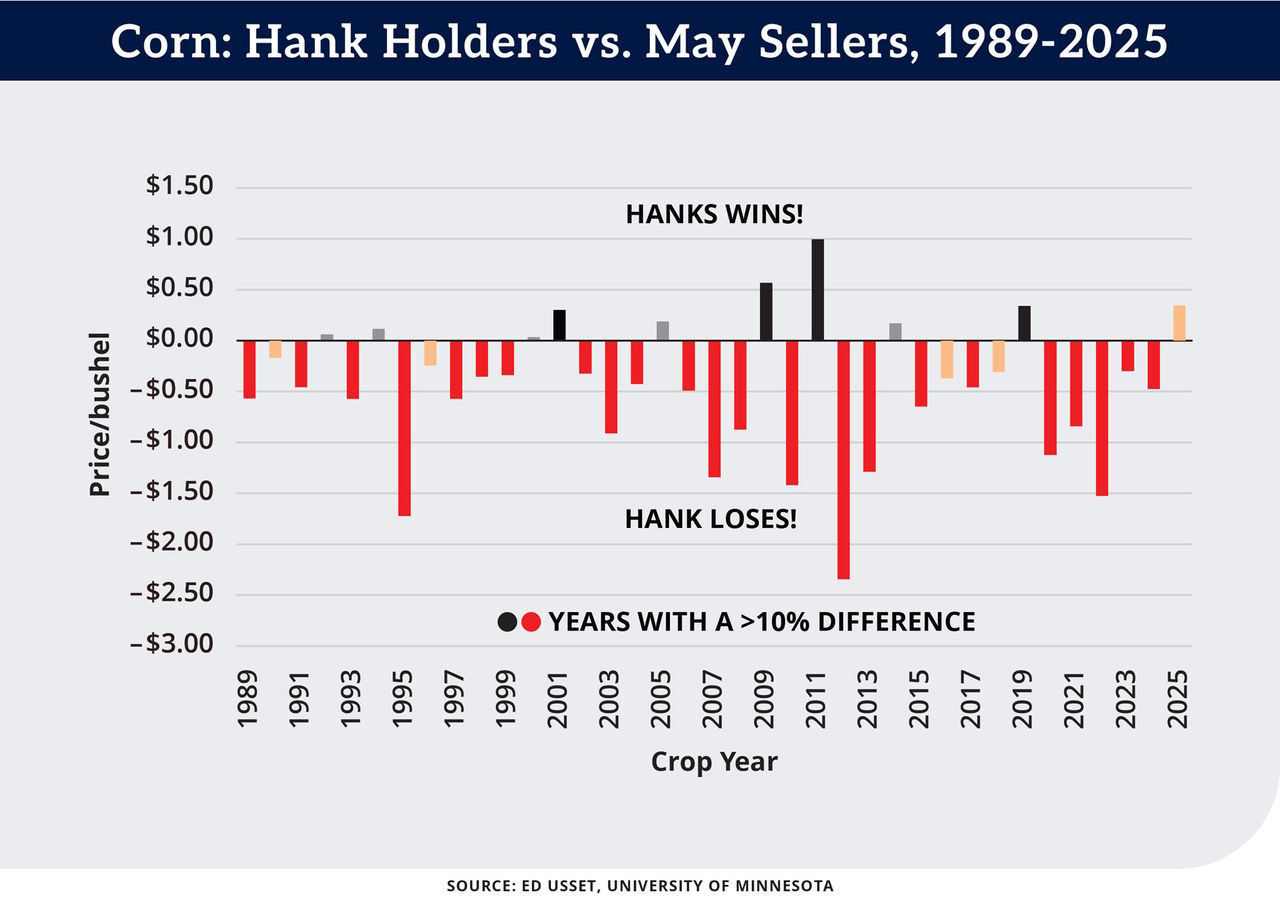
My guess is there were a few — very few — Hank Holders who still had 2025 soybeans in storage. The result was a rare win for Hank and a reminder of the potential for wild basis swings in a difficult harvest transition.
The 4 basics of basis
Basis is the foundation for all successful grain marketing strategies. To use basis to widen your margins, lean into these four basic practices:
- Track seasonal patterns. Develop an opinion on when your local basis is strong or weak. Befriending folks at the local elevator helps.
- Choose the right tools. Select between forward contracts when basis is favorable, or hedge-to-arrive or futures contracts when basis is poor.
- Avoid common mistakes. One of the top five marketing errors made by farmers is failing to understand basis.
- Start today. Consistently track your local basis.