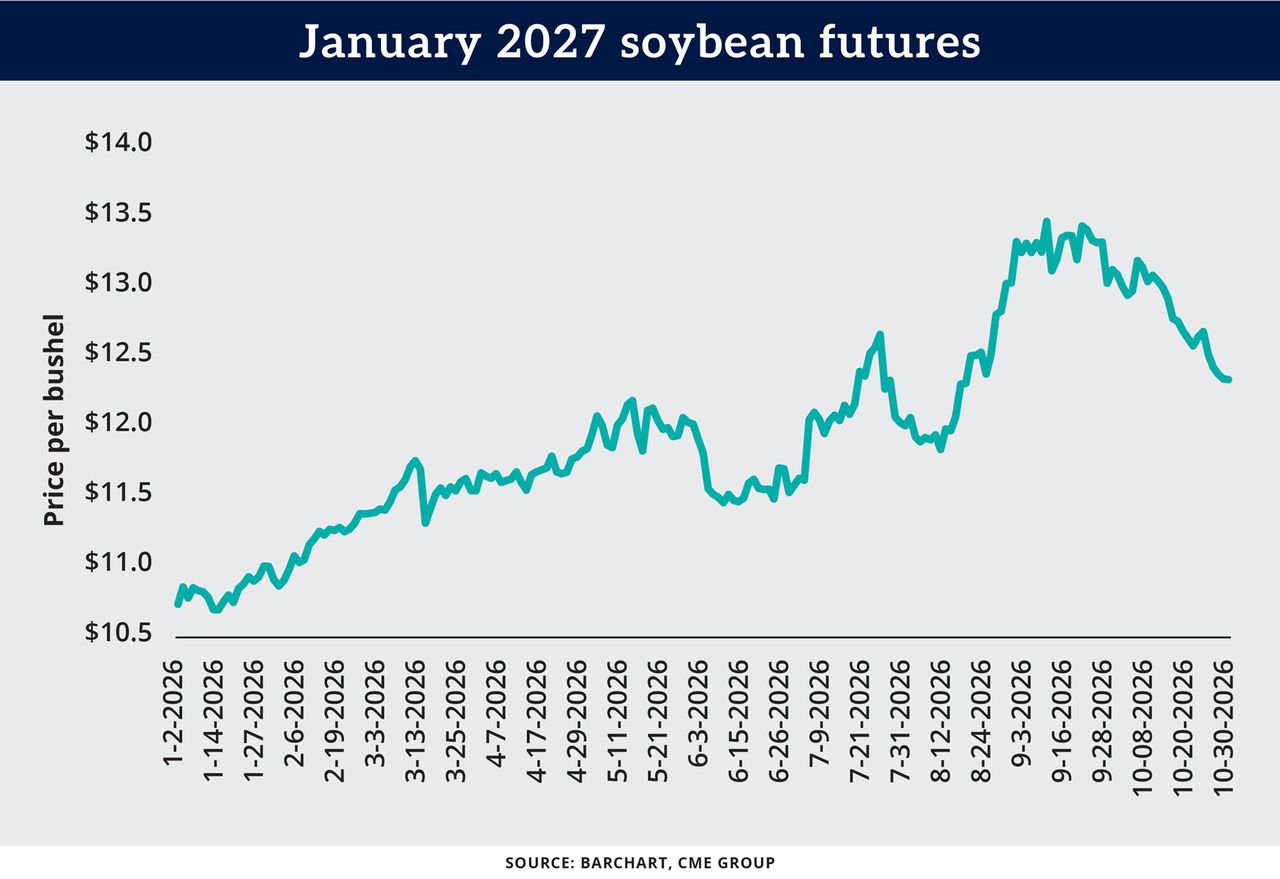
October delivered a beat-down for soybean bulls, as futures prices tumbled almost 6% to record the market’s worst month of 2026. Could November bring a reprieve, or more downside woes?
USDA’s Nov. 9 Crop Production and Supply and Demand updates will have something to say about that, and anecdotal reports from a mostly finished U.S. harvest don’t appear to favor the bulls. The U.S. average soybean yield is already pegged at a record 53.1 bushels per acre, and at least a few analysts expect USDA to nudge that number up slightly.
A record crop isn’t guaranteed but feels close to a lock at this point. In October, USDA estimated production at 4.56 billion bushels, up 7% from 2025 and topping 2021, the current title holder, by almost 100 million bushels.
November is shaping up to be a pivotal month for U.S. soybean growers, and not just because of the USDA reports. Record domestic crushing demand and a sharp China-driven rebound in soybean exports would seem to suggest the October slump will have run its course soon, and prices retain longer-term upside.
The bad boys from Brazil
But other, less price-friendly market dynamics also have emerged: namely, Brazil, where politics and weather have both moved into the bears’ camp.
The October soybean sell-off gained momentum following Brazil’s election, with President Luiz Inácio Lula da Silva’s surprise defeat of Flávio Bolsonaro in a runoff sending the country’s currency, the real, down sharply versus the U.S. dollar. Extended real weakness could give Brazilian ag exports, including soybeans, an edge on the global market. Not that Brazil soybean growers need it. Brazil already accounted for about 80% of China’s soybean imports so far this year.
Lula is believed to prioritize pragmatic trade engagement with China, and that could further solidify Brazil’s dominance as the Asian nation’s top soybean supplier.
Lula’s win “raises the prospect of cheaper Brazilian farm exports,” said Wesley Davis, chief ag economist at Meridian Ag Advisors. “A weaker real lowers the dollar price of Brazilian soybeans, corn and beef that compete with U.S. exports. It also raises costs for Brazilian growers, who import more than 80% of their fertilizer and agrichemicals.”
Meanwhile, Brazil’s soybean planting is running ahead of schedule, and weather has favored early crop development, with key growing areas receiving ample rains. At the end of October, the country’s crop was about 56% planted, ahead of the 47% five-year average, according to consultant Safras & Mercado.
Strong demand keeps rally prospects alive
South American weather so far has defied predictions for crop disruptions related to the ongoing strong El Niño. If that continues, another record harvest in Brazil is likely.
“I’m concerned that it’s going to take a South American scare to turn this ship completely around,” said John Zanker, senior analyst at Farmer’s Keeper, referring to the soybean market. “That’s certainly possible, and perhaps more than usual, given the super El Niño. But at this point, things are off to a strong start south of the equator.”
Farmers can still take encouragement from soybean futures that, even after the October sell-off, are still up over 10% from year-ago levels and not far removed from the 2½-year highs above $13 reached in early September. China has been loading up on U.S. beans, and biofuels producers are increasingly hungry. Keep a close eye on the markets to capitalize on potential postharvest rallies.
“Demand remains very strong, and if production can be kept in check, we could see a healthy rally over the next couple of months,” Zanker said.