Soybean futures have backed off after reaching their highest level since December 2023. Over the past six weeks, a fast U.S. harvest and steady competition from Brazil pushed November futures below $12 per bushel, a two-month low.
With harvest wrapping up, the focus now shifts to the bushels in the bin. Weather talk from South America may give the market a lift later, but that is not a plan. Getting control of 2026 production is.
How the rally was built
In mid-June, the November contract dipped below $11.25. By July, it had bounced back above $12.50.
Three things drove that climb. Traders were unsure about the size of the 2026 U.S. crop. Domestic crush was running at a historically strong pace. And there was hope that China would step in with big purchases.
After a short pullback into mid-August, November futures surged above $13.30 by mid-September. Much like corn, managed money (large speculative funds) bought soybeans aggressively, reaching an all-time high net long position by early September. By the start of harvest, prices sat at their best level in nearly three years.
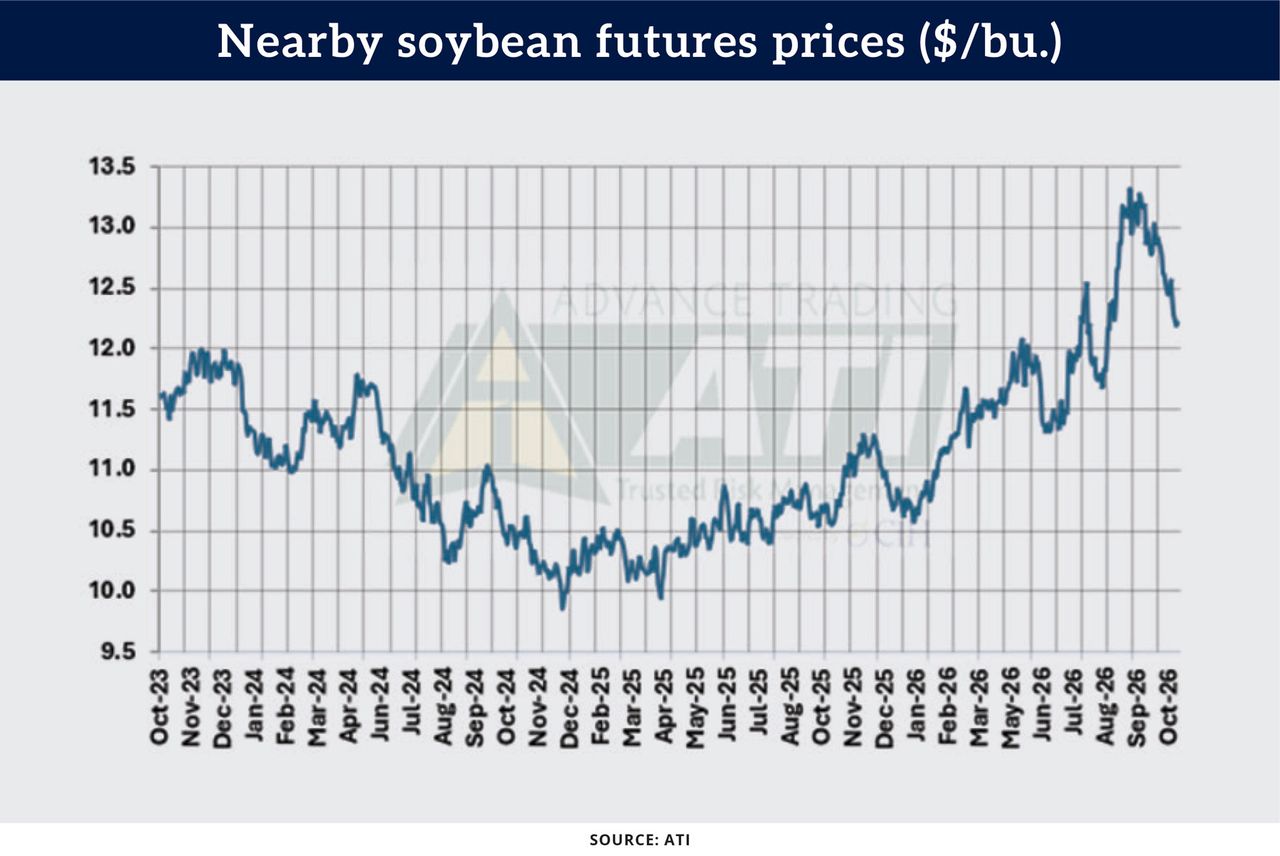
What changed in 6 weeks
After a rain-delayed start, nearly ideal weather let combines roll. According to USDA Crop Progress reports, farmers harvested 54% of the soybean crop between Sept. 27 and Oct. 18. The five-year average for that same stretch is just 44%.
The pace has held up. In USDA’s latest Crop Progress report, soybean harvest jumped 9 points in a week to 88% complete. That is 4 points ahead of the five-year average of 84%. Only a few states trail: Kansas is 72% done, 6 points behind average, and Nebraska is at 84%, 4 points behind. States that had been lagging have caught up to or passed their usual pace.
The crop may also be bigger than expected. Some analysts already suggest the average soybean yield could come in almost 2 bushels per acre above USDA’s October estimate of 53.1. More bushels mean more beans looking for a home.
With prices well above where they were earlier in 2026, some producers sold right off the combine. That selling added hedge pressure to the market. At the same time, funds began cashing out of that record long position, which pushed prices lower too.
The last piece of the puzzle was Brazil.
Brazil keeps the ships moving
Earlier this year, Brazil harvested its largest soybean crop ever. Conab, Brazil’s national crop agency, puts the crop at 180.4 million metric tons. USDA says 180.5 MMT. That is about 6.63 billion bushels, compared with the latest U.S. estimate of 4.56 billion.
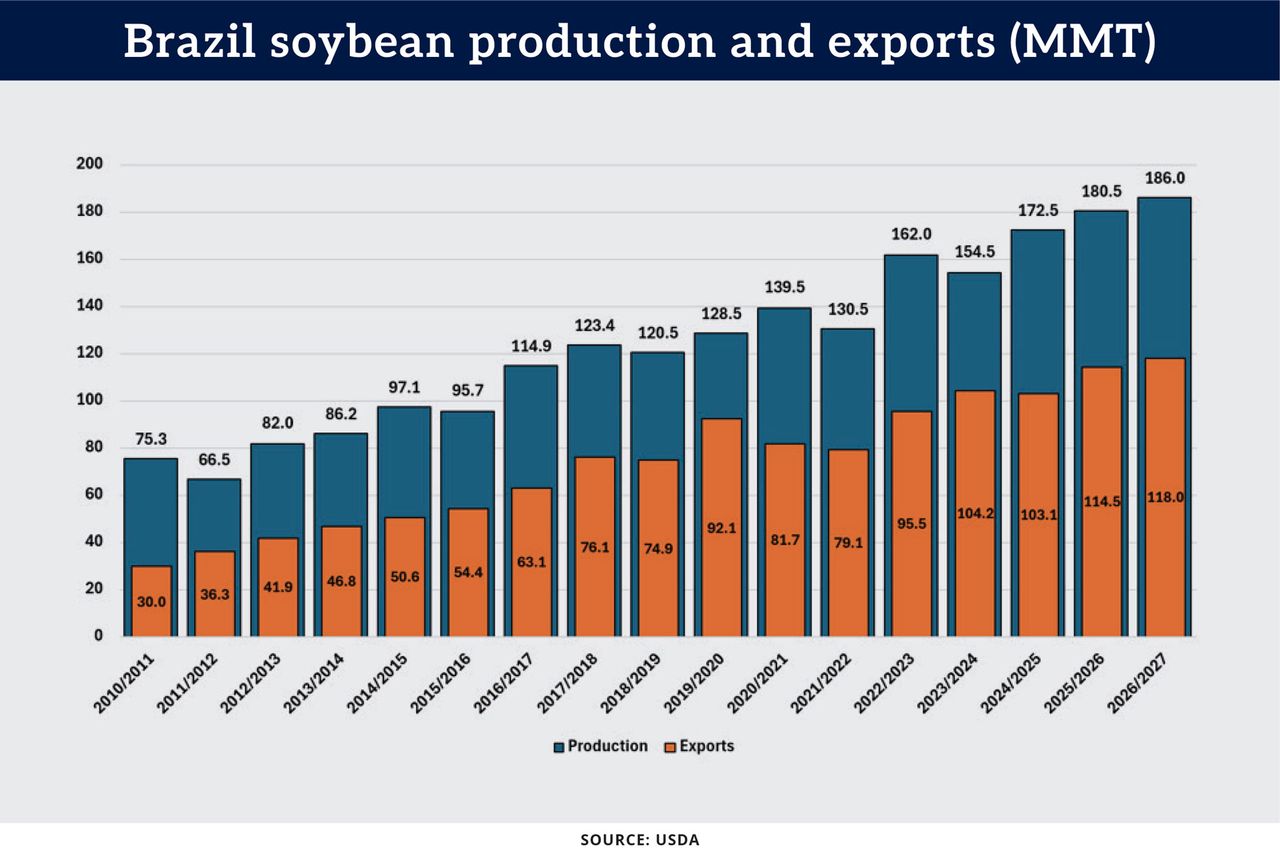
The chart above shows how far Brazil has come. In 2010-11, it grew 75 MMT and exported 30 MMT. USDA now pegs 2025-26 production at 180.5 MMT, and exports have nearly quadrupled since 2010-11 (chart values are rounded).
Those beans are moving fast. Brazil shipped a record 7.36 MMT in September. That pushed exports for the October-September marketing year to a record 114.46 MMT.
For 2026-27, USDA projects record production and exports at 186 MMT and 118 MMT, respectively.
China’s buying is spreading out
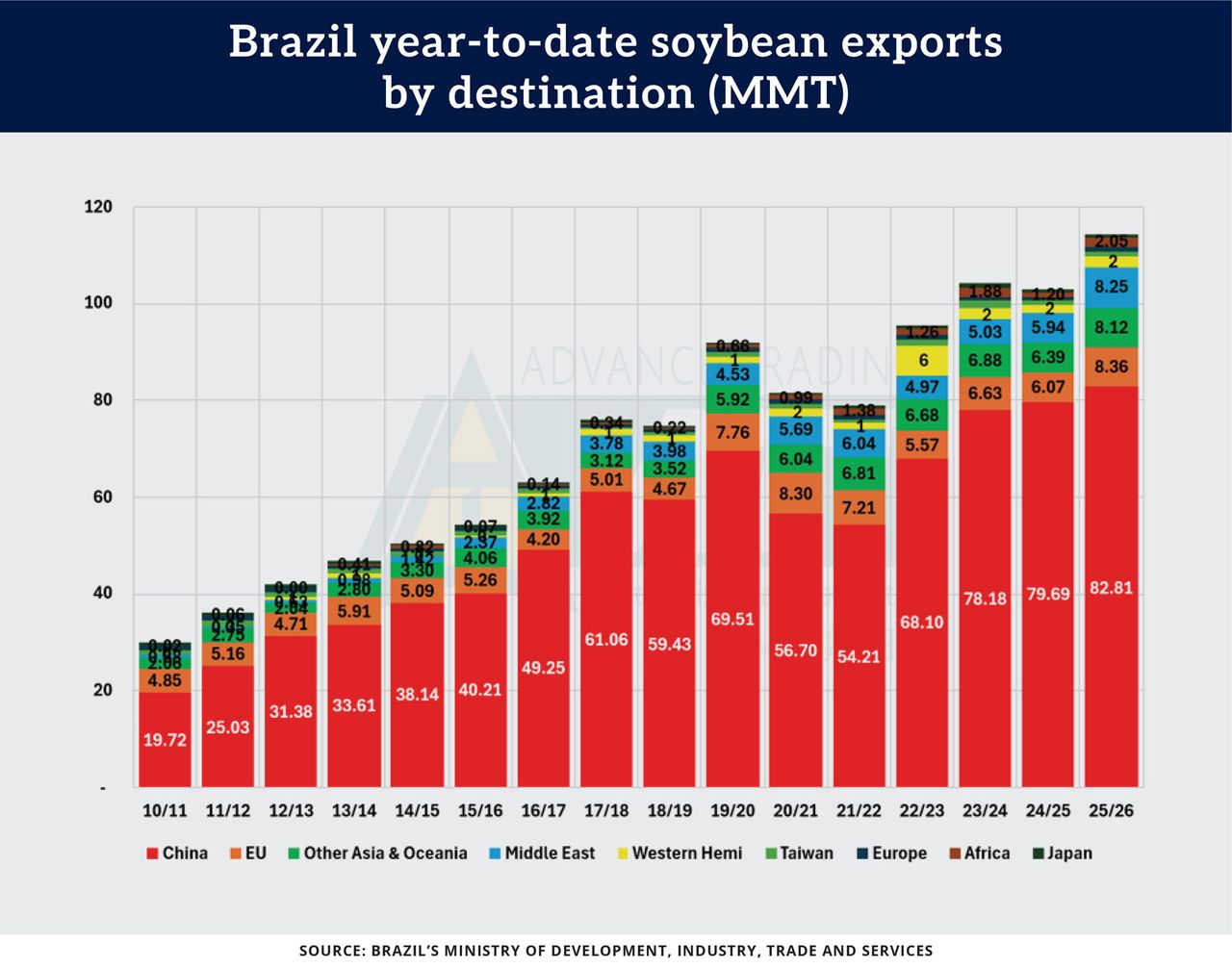
China is still Brazil’s biggest customer by far, taking a record 82.8 MMT of Brazilian soybeans in 2025-26. But its share of Brazil’s exports, at 72.3%, is the lowest in three years. In September, China took 72% of Brazil’s shipments, down from 92% a year earlier.
That tells us two things. First, Brazil is finding new buyers. It set shipment records in the 2025-26 season to the European Union, the Middle East, Africa, and other parts of Asia and Oceania. Those are markets U.S. farmers count on, too.
Second, China is splitting its purchases. It returned to the U.S. market in a big way this fall. In mid-October, weekly U.S. export sales hit their highest level since November 2023, led by China. China now accounts for more than half of all U.S. soybean export commitments. That is good news for U.S. demand, but Brazil remains a tough competitor everywhere else.
Brazil’s next crop: a fast start and big questions
The 2026-27 crop is off to a quick start. As of Oct. 30, Conab pegged planting at 54.3% complete nationwide. That compares with 42.8% a week earlier, 47.7% last year and a five-year average of 51.8%.
Progress varies by state. In some states, planting sped up after a slow start and is now running ahead of recent seasons.
Mato Grosso, Brazil’s top soybean state, is nearly finished. An early start doesn’t guarantee a big crop, but it gives Brazil a head start.
How big will this crop be? USDA and Conab largely agree on the crop Brazil just harvested, but they part ways on this one. The table below shows current estimates from both agencies according to their October reports.
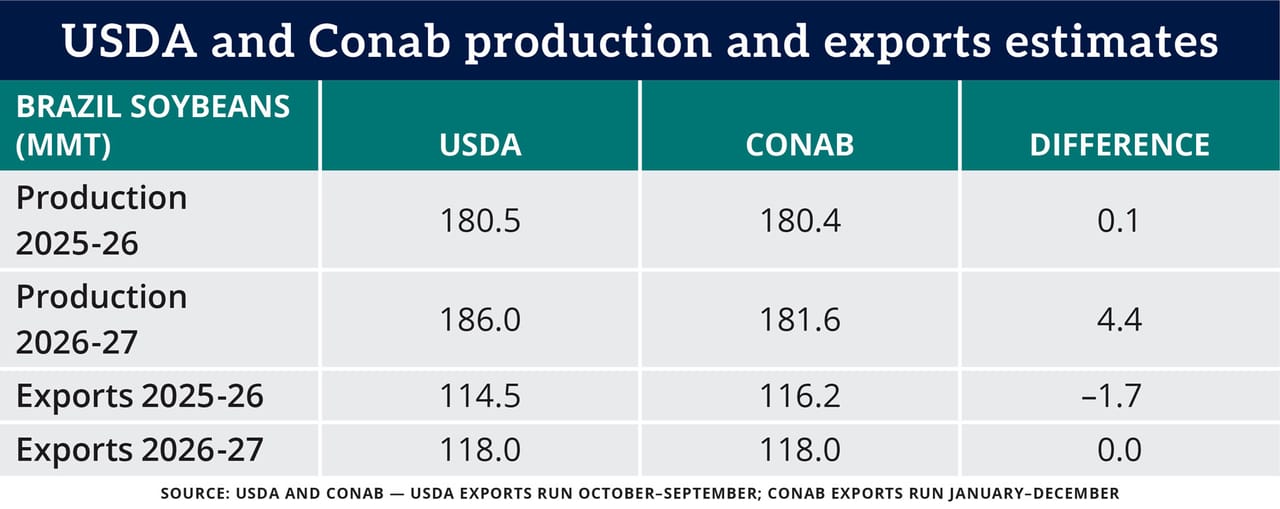
USDA expects Brazil’s 2026-27 crop to grow about 3% from this year. Conab sees growth of less than 1%. The 4.4 MMT gap equals roughly 160 million bushels, or about 3.5% of the entire U.S. crop.
Both agencies see 2026-27 exports near 118 MMT, which would be a record.
Weather is the other big unknown. Some in the market believe the current El Niño weather pattern could hurt South American crops. In past El Niño years, parts of northern Brazil have turned drier while areas farther south have turned wetter. But every season is different, and Brazil’s crop is still months from harvest.
If weather does cause problems, prices could rally. If it doesn’t, Brazil could harvest another record crop. That would add to the pressure U.S. farmers are already feeling.
That is why it pays to get control of 2026 production now. Know your break-even. Set price targets for unsold bushels. Be ready to act on rallies instead of hoping for one. The market has already shown it can drop more than $1 per bushel in six weeks.
Advance Trading, ATI, and ATI ProMedia are DBAs of CIH Trading, LLC, a CFTC registered Introducing Broker and NFA Member. The risk of trading futures and options can be substantial. All information, publications, and material used and distributed by Advance Trading shall be construed as a solicitation. ATI does not maintain an independent research department as defined in CFTC Regulation 1.71. Information obtained from third-party sources is believed to be reliable, but its accuracy is not guaranteed by Advance Trading. Past performance is not necessarily indicative of future results. Insurance services provided by CIH Insurance Services, LLC (DBA ATI Agency). Issuance of insurance coverage is subject to underwriting review and approval. Coverage not available in all states. Please see the policy for the full terms, conditions and exclusions. CIH Insurance Services, LLC is an insurance agency licensed to sell certain insurance products and may receive compensation from insurance companies for such sales. Policy obligations are the sole responsibility of the issuing insurance company. Coverage scenarios are hypothetical and shown for illustrative purposes only. Coverage is dependent on the actual facts and circumstances giving rise to a claim. CIH is an equal opportunity employer and provider.