U.S. farmers are locked in for a record 2026 soybean harvest. Fortunately, demand is breaking records too, keeping hopes alive for strong 2027 prices.
USDA’s recent November Crop Production and Supply and Demand reports further underscored the likelihood of an all-time crop, and the soybean market’s response could be summed up in three words: Bring it on.
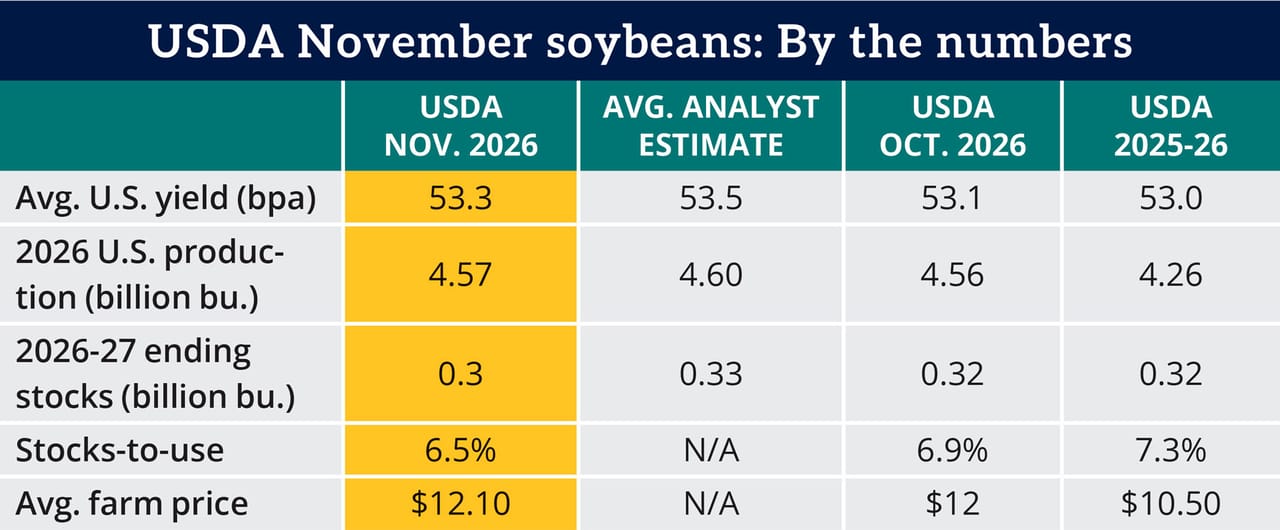
USDA’s November data dump showed that this year’s soybean crop could easily top 2021’s, the current title holder, but it isn’t as big of a bin-buster as once thought. USDA raised its average yield by just 0.2 bushel per acre to 53.3 bpa, about half the increase analysts projected. Production was bumped up a modest 12 million bushels to 4.57 billion bushels.
Farmers welcomed the bullish November surprise. After watching soybean futures tumble much of the fall, the news shot futures above $12. But as farmers contemplate 2027 plans, the sustainability of late-2026 market strength is among key considerations for marketing this year’s harvest. Here are a few takeaways:
Supply outlook tightens. USDA cut its forecast for 2026-27 U.S. ending stocks by 15 million bushels to 300 million bushels, a four-year low that clashed with expectations for an increase. The reduction lowered the closely followed stocks-to-use ratio to 6.5%, down from 7.3% in 2025-26 and also a four-year low.
Bean oil goes boom. But keep an eye on diesel. Biofuels-driven demand for soy oil should remain a key demand pillar for another year, with USDA projecting 2026-27 soy oil use for biofuels at 17.8 billion pounds, a record for the seventh year in a row. (This year, biofuels will, for the first time, surpass the food, feed and other industrial category as the top consumer of soy oil.)
One caution: Diesel futures falling from record September highs puts pressure on soy oil. A U.S.-Iran peace ceasefire or peace deal that sends crude oil tumbling could pose a headwind for the soy complex.
Exports are improving. China, as always, is an enigma. USDA boosted U.S. soybean exports by 25 million bushels to 1.72 billion bushels, which would be a jump of nearly 14% from 2025-26. Much of that increase is being driven by China, of course, but the country’s purchases were predictably tapering off late in the year. By mid-November, China had purchased a little over two-thirds of a 25 million-metric-ton full-year target that was part of a trade truce with the U.S. Will China finish off that final third? If so, when?
Weather is still a wild card for South America. USDA held its Brazil soybean harvest forecast unchanged at a record 186 MMT (6.83 billion bushels), up 3% from last year. A strong El Niño remains in effect, but unlike previous years, a weather threat has yet to emerge in South America.
The last two strong El Niño seasons, 2015-16 and 2023-24, coincided with substantial soybean yield losses in Mato Grosso, Brazil’s top-producing state, noted Karen Braun, chief market analyst at Zaner Ag Hedge. However, the relationship between El Niño and soybean yields “varies considerably across Brazil, and similar historical outcomes don’t necessarily develop under identical weather conditions,” Braun wrote recently.
USDA has final word
So, what’s next? USDA’s annual summary report in mid-January will serve as the “final” word on the 2026 corn and soybean crops. It’s possible for USDA to boost soybean yield and production figures again.
Meantime, farmers should keep eyes open for postharvest rallies and outside factors that could produce sharp price swings, including South American weather, the Russia-Ukraine and U.S.-Iran wars, and trade relations with China.
Joe Fallico, president of Insignia Futures & Options, cautioned against going overboard on bullishness.
“The recent rally is encouraging, but it is too early to conclude that the downtrend has ended,” Fallico said. “Producers holding unpriced soybeans should consider using price rallies to evaluate incremental sales or protective hedging strategies rather than relying on a sustained recovery.”
Blythe is senior editor of commodity markets.