Even after a friendly November USDA World Agricultural Supply and Demand Estimates report, corn and soybean futures have struggled to gain much positive price momentum. Will there be any sort of price rally as the calendar flips to December?
What’s happened
Corn and soybean futures have been trading in a grind recently. While a friendly USDA report dropped on Nov. 10, prices have been mostly lackluster since.
The combination of a lower Brazilian currency, uncertainty regarding global trade deals, and a swift planting pace in South America is keeping U.S. corn and soybean futures on the defensive.
The expression “Pull yourself up from your bootstraps” is something that might apply to corn and soybean futures prices. However, in this case, we may need a little help from Santa’s bootstraps.
From a marketing perspective
If you have followed my blogs over the years, you are likely familiar with the expression “The bears get Thanksgiving and the bulls get Christmas.” Meaning, might grain prices trade lower in early to mid-November, to then potentially see a price rebound after Thanksgiving and into year-end?
Two years ago, this comment warranted my attention, and I was eager to see if there was any truth to this saying. And, while past performance is not indicative of future results, the results were quite compelling then and still are today.
For the purpose of my simple research project, I looked over the past 12 years for any type of rally for corn and soybean futures from Thanksgiving until the end of the year.
I used the March corn and March soybean futures contracts. (The January soybean contract and December corn futures contracts would be tangled in their delivery periods during this time frame.)
Also, since the date of Thanksgiving changes, I used Nov. 20 as my “start date” annually.
While each year over the past decade has provided unique fundamental supply-and-demand perspectives, in each year over the past decade, March corn and March soybean futures have some sort of rally between Nov. 20 and the end of the calendar year.
The average soybean rally was 83 cents, and the average corn rally was 32 cents!
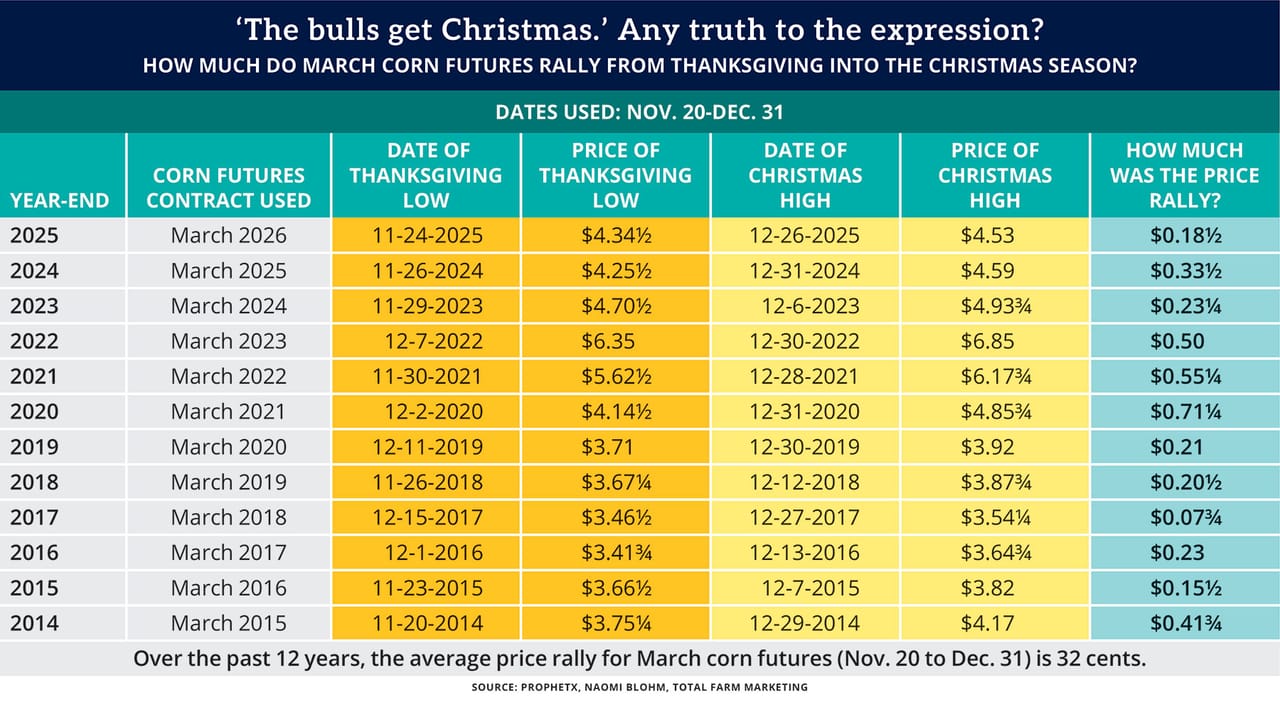
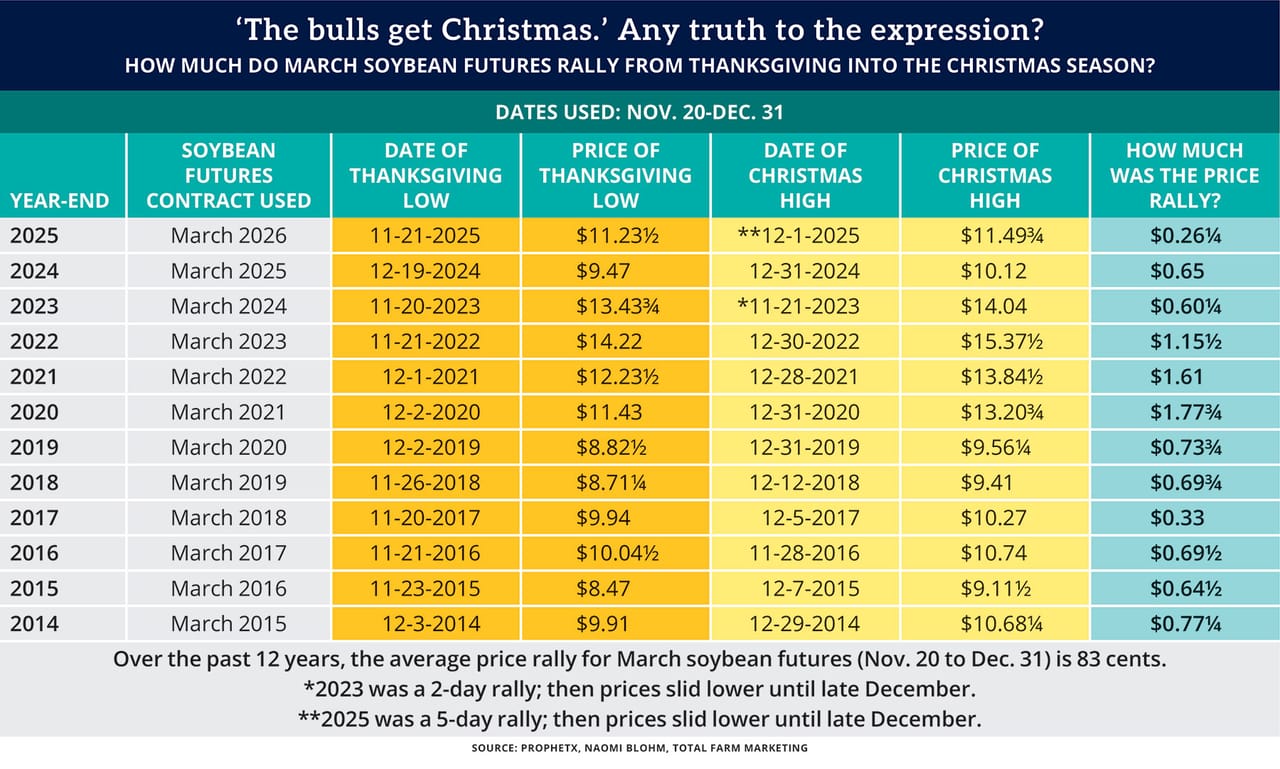
In some instances, the Thanksgiving-to-year-end rally lasted only days. Other times, it lasted for weeks. Be prepared for anything.
Prepare yourself
My resounding takeaway was that a farmer who pays attention to the markets during that time frame — rather than being lulled by holiday cheer — likely has an opportunity to take part in some sort of pricing rally opportunity between late November and the end of December.
Again, I only looked at the past 12 years, and these results may not necessarily repeat this year, but the information is eye-opening.
Things to be aware of:
- The rally can quickly come and go (2023 and 2025 were prime examples, especially for soybeans), followed by a punishing price sell-off, with a “lump of coal” instead by Christmas.
- The December USDA WASDE report seems to draw a rally. Prices historically peak in conjunction with that time frame.
- The rally can go until year-end. Sometimes. Much of a potential rally depends on weather in South America, fund trader activity, export demand, an upcoming USDA report and geopolitics.
- If a rally occurs, consider using it to enhance your cash sales.
Disclaimer: The data contained herein is believed to be drawn from reliable sources but cannot be guaranteed. Individuals acting on this information are responsible for their own actions. Commodity trading may not be suitable for all recipients of this report. Futures and options trading involve significant risk of loss and may not be suitable for everyone. Therefore, carefully consider whether such trading is suitable for you in light of your financial condition. Examples of seasonal price moves or extreme market conditions are not meant to imply that such moves or conditions are common occurrences or likely to occur. Futures prices have already factored in the seasonal aspects of supply and demand. No representation is being made that scenario planning, strategy or discipline will guarantee success or profits. Any decisions you may make to buy, sell or hold a futures or options position on such research are entirely your own and not in any way deemed to be endorsed by or attributed to Total Farm Marketing. Total Farm Marketing and TFM refer to Stewart-Peterson Group Inc., Stewart-Peterson Inc., and SP Risk Services LLC. Stewart-Peterson Group Inc. is registered with the Commodity Futures Trading Commission (CFTC) as an introducing broker and is a member of National Futures Association. SP Risk Services, LLC is an insurance agency and an equal opportunity provider. Stewart-Peterson Inc. is a publishing company. A customer may have relationships with all three companies. SP Risk Services LLC and Stewart-Peterson Inc. are wholly owned by Stewart-Peterson Group Inc. unless otherwise noted, services referenced are services of Stewart-Peterson Group Inc. Presented for solicitation