With a lot of new processing coming on line soon, New York's dairy industry is poised for growth. But environmental and land-use challenges loom as farmers prepare to meet rising milk demand.
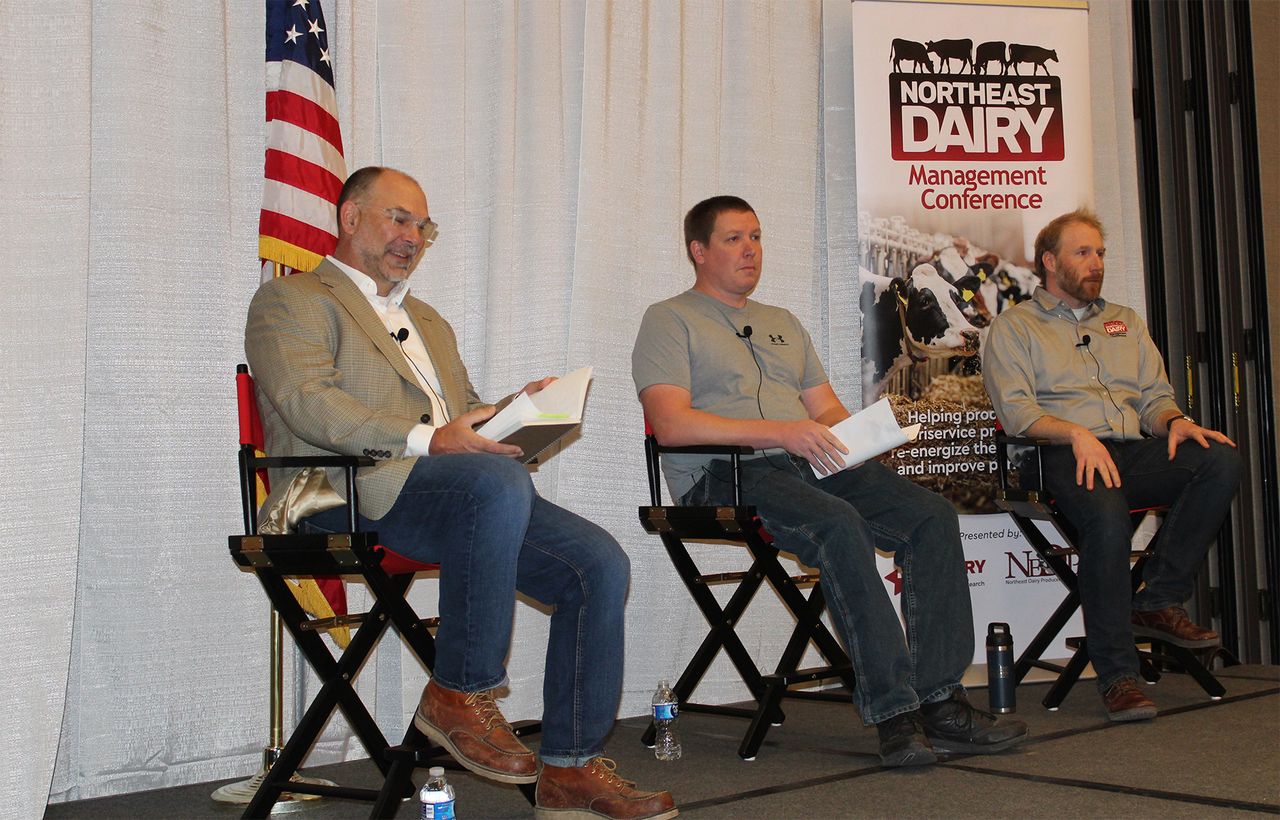
It was a big topic at the recent Northeast Dairy Management Conference.
A challenge to growing dairy is the increased amount of manure and nutrients that come from it, especially phosphorus. New York has been able to balance phosphorus levels on land thus far, said Kirsten Workman, senior Extension associate with Cornell Pro-Dairy.
But the state’s abundance of water poses unique challenges. Algae blooms in lakes and rivers signal excessive fertilizer runoff, threatening ecosystems and water quality.
Extreme weather events in New York have surged by 55% since 1958, according to Cornell Pro-Dairy. This alarming trend underscores the need for sustainable farming practices.
Feeding the dairy boom
Farmers polled at the conference — 72% — said they were planning to expand their dairy herds in the next two years.
Several new milk processing plants, including Chobani and Fairlife, are expected to go on line by the end of this year, and those plants will need a lot of additional milk.
Chobani is building a 1.4-million-square-foot plant in Rome, N.Y., that will produce its signature yogurt flips, coffee creamers and more. Nishant Roy, Chobani’s chief impact officer, said the plant will use up to 6 billion pounds of milk at full capacity. Right now, the state produces 16 billion pounds of milk.
“We’ve done the math and estimate that we’ll need an additional 180,000 cows in the system to meet demand,” Roy said at the recent New York Agricultural Society Forum. “This year alone, we’re purchasing 4 billion pounds of dairy between New York and Idaho, with nearly half of that sourced from New York. Once the Rome facility is fully operational, we’ll need 12 million pounds of dairy daily, an additional 4 million pounds per day compared to current levels.”
The company is planning another expansion at its plant in Twin Falls, Idaho.
“By the time everything is on line, we’ll be sourcing 8 billion pounds of dairy annually, which represents 3.5% of all milk produced in the United States,” Roy said.
He said the company is working with more than 400 farms in the state to prepare for the increased milk demand. It’s also collaborating with Cornell University and Cooperative Extension on ways to increase milk yields by 20% to 30% without increasing herd sizes.
Growing pains and solutions
Don Janssen, who runs Green Hill Dairy in Scipio Center, N.Y., said he fears too much herd growth might lead to tougher state regulations.
“I don’t want to see new regulations,” he said. “It’s crazy to see how people have exceeded their means. You have to be able to feed your cows and have someplace to spread your manure.”
Workman said animal density can be used as a planning tool for farm growth.
Cows vary in size and have different needs for grazing and manure. An accurate way of calculating animal density, rather than just measuring density by number of animals, is counting 1,000 pounds of animal weight as one “animal unit.” Multiply the number of animals by weight and divide by 1,000 to derive the number of “animal units.”
“Divide the total animal units by number of cropland acres,” Workman explained, to come up with animal units per acre. She said this can help determine the density capacity the land can support.
Based on farmer self-reporting, the number of regulated confined animal feeding operations in the state has risen substantially in the past few years, said Brian Boerman of Agricultural Consulting Services in Ithaca, N.Y. Stocking density, though, has only slightly increased or even decreased in some cases.
Janssen said his farm is at 1.2 animal units per acre. Access to cropland plays a critical role in his farm’s ability to succeed, but getting land is more competitive than ever.
“We were turning acres down since 2014, and they weren’t there in 2021,” he said. “It’s like musical chairs. If you get up, you lose it. You may have to take forage before you need it.”
Boerman said he knows of at least two farmers who were recently outbid for land by developers.
“Prime farmland is going to solar panels,” he said.
With more cows comes more manure. Jason Oliver of Cornell Pro-Dairy said manure storage is a farm’s best management practice.
“Have that capacity before expanding your herd,” he said. “As we expand, we get storage built ahead of getting cows. We had a wet, cold spring, and it got cold fast. It was a tough year. Many farms are at full capacity.”
Possible workarounds of manure-capacity problems include primary separation, which can reduce 10% to 20% volume, and researching advanced manure treatments.
The more forms of manure present, the more types of storage must be present.
“And these costs need to be accounted for,” Workman said, “because they help reduce risk.”
Despite the challenges of growth, Oliver said he remains optimistic about dairy.
“I love this region and farms,” he said. “I want to see all of us grow in a sustainable way.”