The U.S. farmer is off to a good start this spring. Corn and soybean seeds are flying into the ground in the south. Tennessee is over 30% ahead of the 5-year average on corn and soybean planting, Kentucky is up 15%, and Illinois is up 3% to 5%. My good friends in Southeastern Illinois completed their planting by April 10 for the first time ever.
Most of my Illinois farmer friends tell me that being done the first week of May is the earliest they can remember. To be a full three weeks ahead of schedule just seems nuts — or perhaps a little alarming, depending on how you look at it. Keep in mind though that early planting typically means favorable prospects for a big crop. The market knows this, and yet we seem to have support at levels higher than forecasted earlier this year. What could be the reasoning for that? And how long might these levels stick around?
Investors are back
One explanation for corn and soybean price support is the resurgence of investment funds. The war in the Middle East brought a great deal of uncertainty to the supply of crude oil and liquefied natural gas. Everything we do in today’s world depends on energy — either to make our products or transport them. So typically, when energy prices go up, so do corn and soybean prices. The last two months are proof of that. On Feb. 27, May crude oil was trading around $67 per barrel. By April 7 it had skyrocketed $50 higher to $117 a barrel.
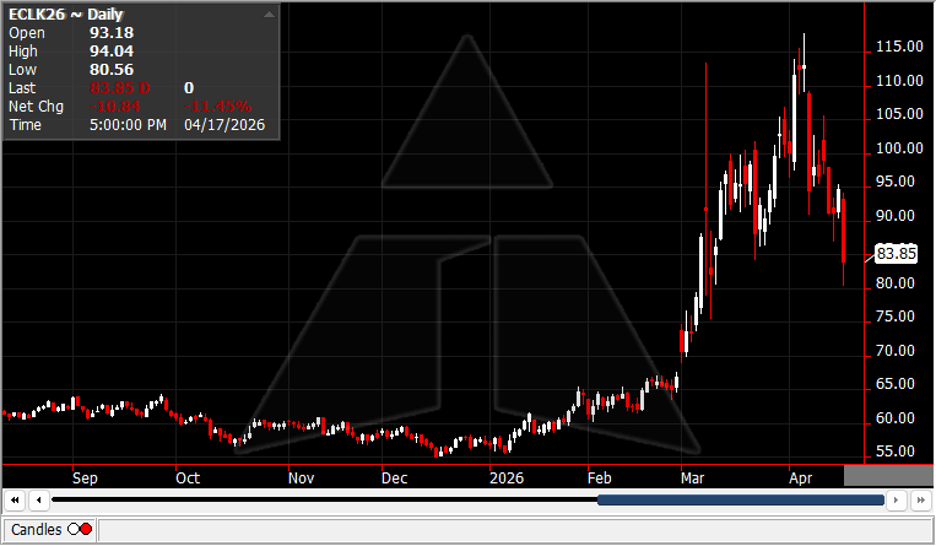
Corn rallied 30 cents and soybeans 70 cents during that timeframe. However, there didn’t seem to be a direct correlation between grains and energy. Crude oil, for example, rallied steadily before topping out on April 7. Corn and soybeans had a much choppier experience. They both shot out of a cannon on March 9 before dropping hard on March 16 when President Trump announced he was postponing his upcoming meeting with China.
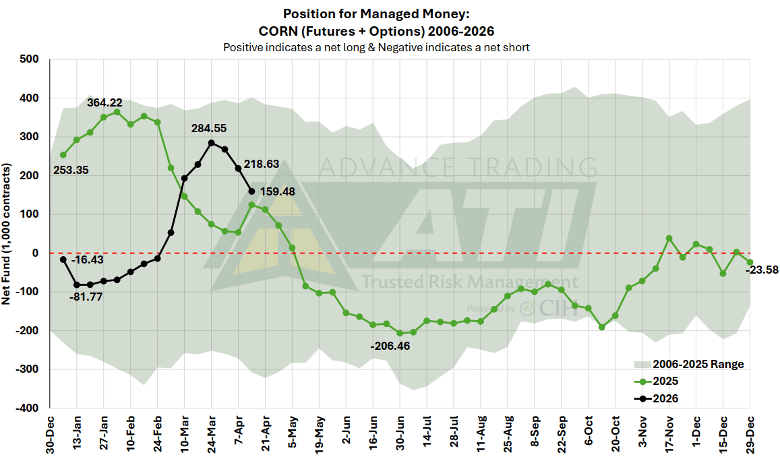
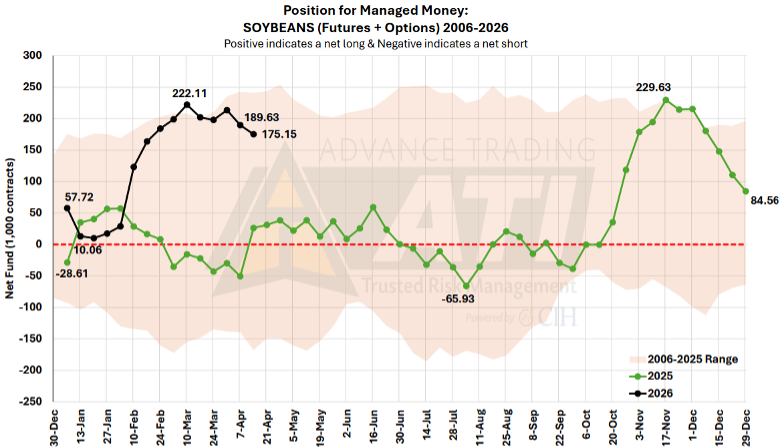
And after all of that, July corn and soybean futures today sit within a penny of where they were before the entire Iran conflict started. Regardless, it’s obvious from the below charts that the funds were willing to place “buy” bets on both crops during the last two months. The funds were essentially neutral in both corn and soybeans at the beginning of February. Today, however, they sit long 159,000 corn contracts and 175,000 soybean contracts.
Filter out the chaos
The University of Illinois forecasted a 2026 corn price of $4.15 and a soybean price of $10.30 back in August when doom and gloom was the prevailing sentiment among the farm community. But now the market is trading 60 cents higher on corn and $1.25 higher on soybeans. Those seem like levels we should be selling and protecting, right? So why isn’t my phone ringing off the hook?
My guess is that a couple of things are holding back sales decisions.
- First: The cost of putting the 2026 crop in the ground. With the disruption in the world supply chain, prices for products like nitrogen and dry fertilizer are off the rails. Many in the industry think soybean acres could increase because of these higher costs. We all know we must generate more dollars from our harvest this year.
- Another reason people are holding back is that the world seems to be in a state of chaos. President Trump changes the course of history with every tweet that he posts, making it impossible for traders to get a strong feeling about future direction. Most people respond to chaos by pulling back and doing nothing. And honestly that is my initial reaction as well. None of us want to invest our hard-earned dollars in something that we don’t completely understand.
Four steps to solid crop pricing
But with this chaos comes opportunity. If you told me back in August that December new crop corn would trade close to $5 this spring, I would have thought you were crazy. But that’s exactly what happened when it touched $4.98½ back on March 9.
The key to all of this is to stay flexible in your approach:
- Keep your break-even projections in front of you
- Market large percentages when you get the chance
- Stay consistent with your marketing, checking off important goals like planting, emergence, pollination, and grain fill.
- With each checklist item, close your eyes and sell/protect another percentage.
None of us can predict the future, but we can use these chaotic times to make good, sound decisions on prices that just might be the best we see in 2026.
Advance Trading, ATI, and ATI ProMedia are DBAs of CIH Trading, LLC, a CFTC registered Introducing Broker and NFA Member. The risk of trading futures and options can be substantial. All information, publications, and material used and distributed by Advance Trading shall be construed as a solicitation. ATI does not maintain an independent research department as defined in CFTC Regulation 1.71. Information obtained from third-party sources is believed to be reliable, but its accuracy is not guaranteed by Advance Trading. Past performance is not necessarily indicative of future results.