“You voted for this.” In January 2025, the ag community began hearing that from those who don’t support President Donald Trump’s administration. It isn’t praise.
For his part, Trump moved forward expeditiously and with great fervor on all of the things he promised on the campaign trail. And then some. It’s the over-the-top elements that seem to be weighing on the agricultural community now.
In our Farm Futures Q1 survey, farmers told us their biggest concerns are Trump and tariffs. In an unusual twist, the two T’s ranked higher than weather in the list of worries. Overall, slightly more than half of the farmer-respondents said the president is performing as expected, 27% gave him lower scores, and 21% said his work is better than expected.
Those numbers reflect a 10-point drop in farmer confidence in this administration.
In a year marked by a concern for affordability across the U.S., more than two-thirds expect market losses to weigh heavier than any government payment can make up for. In fact, 81% expect that market losses from Trump policies, including tariffs, will cut their income.
In last year’s survey at the same time, most farmers expected a tariff strategy to level the global market playing field. Two-thirds of them expected the disruption to last less than a year. That year is up.
Iowa farmer Ed Swinger is one of the farmers who voted for Trump twice, and then went another direction in the last election. “I figured this was exactly what was going to happen: We’d have chaos,” Swinger said in mid-April. “He says he loves the farmers but yet he turns around and does things that aren’t in our best interest sometimes. … He cuts and slashes before he thinks about what the ramifications of it are.”
The ramification, as reflected in our survey, is fewer than half of the farmers surveyed expect to be profitable over the next five years. Swinger, too, is concerned about the financial toll on farmers. Seeing neighboring piles of harvested corn disappear gave him a bit of hope. But he worries about the economic hill that next-gen farmers will have to climb.
“As we say: Farmers want trade, not aid,” Swinger said. “The next generation is going to come in, and you’d like to have a good solid base for them to come in.”
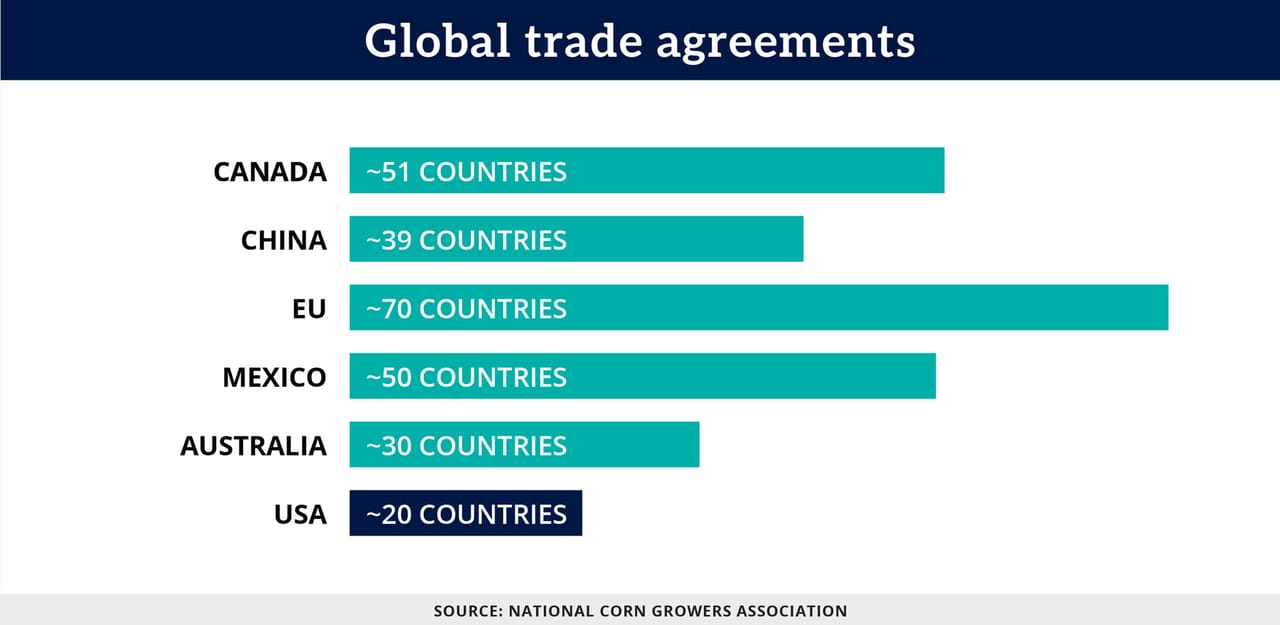
That trade element riled farmers, particularly in regard to a lack of administration support for USMCA, the U.S.-Mexico-Canada Agreement. Trade with our neighbors is the base for a North America Strong strategy. Canada and Mexico are our most consistent trade partners. And we need buyers globally. Comparing the U.S. trade opportunity to that of other countries, the National Corn Growers Association points out that the European Union has 70 global trade agreements, Canada and Mexico have around 50, and the U.S. has about 20.
On the domestic side, action to improve market demand through alternative fuel policy, particularly a higher ethanol mandate, is lacking in this administration and Congress, the survey said. Trade and domestic demand weigh heavily on farm gate opportunities.
So, where does that leave us? With an off-farm public that’s unsympathetic to agriculture’s economic needs. With a Congress and an administration that acts — or doesn’t — without weighing the consequences.
With a federal aptitude for writing checks rather than good policy, ag’s reputation is damaged. And yet government aid isn’t enough to repair the financial damage to family farmers. Essentially, farmers join those waiting at the mailbox for government checks that never quite stretch far enough or simply get passed on to input providers and landowners.
Ultimately, we’re looking at a practice that’s turning one of the last bastions of U.S. production — agriculture — into an entitlement industry. No, the ag community did not vote for that.