Soybean futures briefly spiked to two-year highs after USDA forecast stronger use and tighter-than-expected supplies in the upcoming 2026-27 marketing year, indicating booming biofuels demand will continue to buoy prices even as exports lag recent historical trends.
Wheat futures soared to two-year highs after USDA slashed its outlook for the U.S. winter crop to a six-decade low as extended drought in the key Southern Plains growing region cut yield potential. Corn futures sustained early gains near two-year highs even as USDA signaled ample supplies into 2027.
USDA, in its monthly supply and demand update, projected U.S. soybean stockpiles at the end of the 2026-27 marketing year at 310 million bushels, down 30 million bushels from 2025-26 and clashing with analysts’ expectations for an increase of about 15 million bushels. Today’s report included the agency’s initial estimates for the 2026-27 marketing year.
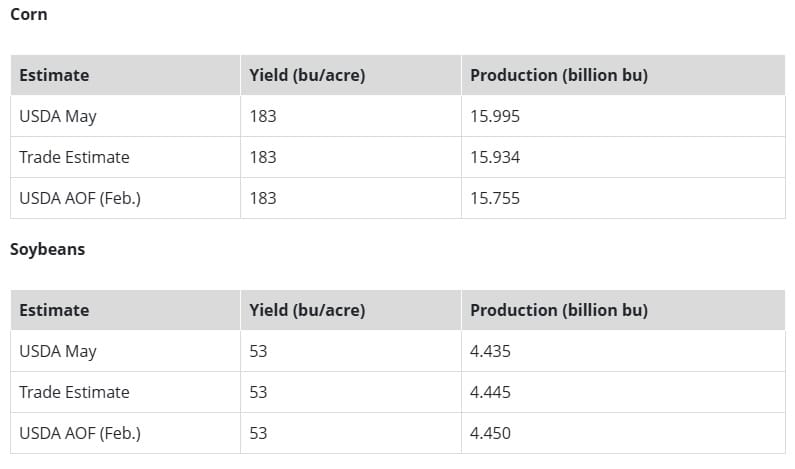
Corn numbers weren’t quite as bullish as those for soybeans. USDA forecast 2026-27 ending U.S. stocks at 1.957 billion bushels, down 185 million bushels from 2025-26 but about 35 million bushels above expectations. U.S. production is seen at 15.995 billion bushels, down 6% from a record 17.021 billion bushels this year but still the second-biggest harvest ever, while exports are forecast to drop 150 million bushels to 3.15 billion bushels.
Taken as a whole, USDA’s numbers reinforced a strong demand, tighter supply outlook that’s combined with $100 crude oil and Iran war disruptions to push grain prices higher much of this year.
“Today we got our first look at the 2026-27 balance sheet and it painted an overall bullish picture,” Jeremy McCann of Farmer’s Keeper said. “Overall, this does not change market sentiment. It only fuels the fire allowing these markets to push higher. Much hangs in the balance with President Trump scheduled to meet with China’s Xi Jinping to discuss all things trade and push Iran into a peace deal.”
In a separate report, USDA estimated the 2026-27 total winter wheat crop at 1.048 million bushels, down, 25% from the 2025-26 crop and the smallest since 1965. Analysts expected a figure closer to 1.208 billion bushels. The hard red winter crop, which has been hit hardest by drought, was pegged at 514.8 million bushels, down almost 290 million bushels, or 36%, from last year.
November soybeans surged 10.25 cents to $12.05 per bushel, the highest close for a nearby new-crop contract since May 2024. December corn gained 4.25 cents to $5.02, a one-week high. July HRW wheat soared the daily trading limit of 45 cents to $7.3125, a two-year high.
Quick take from Brady Huck, Empower Ag Trading: Market “at risk” of long liquidation
“Today's numbers will certainly change as the year ahead unfolds. The USDA used a lofty trendline corn yield at 183 bpa. The crop has gone in the ground without a hiccup thus far and looks to be set up for success in the year ahead, but as we know, weather patterns can change. USDA remains optimistic that both ethanol and export demand for corn will remain robust. Carry-in levels of 2.141 billion bushels from 2024-25 keep stocks cushy for the moment at just under 2 billion bushels for 2026-27.”
“December corn trading at the $5 level and November soybeans above $12 are rewardable levels producers need to be taking advantage of. I would encourage marketing strategies that enable producers to confidently execute in a broad enough manner to make a financial impact to their farm’s bottom line.”
“Call options against cash or futures sales are a great strategy to use here. Look at September short-dated call options, as this time frame gives producers upside through key production months for both the U.S. crop, as well as the Brazil safrinha corn crop. Next, put options, or even put spreads strategies, can help producers cover more bushels while leaving the ‘sales bullet’ in the chamber to reward a rally higher. Producers need to maintain discipline managing the gap between their spring crop insurance floor price and the current market.”
“With the funds holding sizeable net-long positions in both corn and soybeans, the market is at risk of an unpredictable long liquidation event at any point. Crude oil has supported the recent run-up. After today’s reports, the market will digest the numbers and get back to trading war headlines and any news from the U.S.-China summit later this week.”
Biofuels boom supports bullish demand case, lifts farmer hopes
Today’s USDA numbers offered several reasons for optimism for U.S. farmers who’ve been squeezed by at least three years of weak crop prices, excess grain supplies, trade disruptions and high costs for fertilizer and other inputs. Corn and soybean futures have already rallied 9% and 17% so far this year, respectively, and continued gains could lift farm-level cash prices back near or possibly back above break-even levels for many producers.
USDA forecast the average 2026-27 farm price for corn at $4.40, up 6% from $4.15 in 2025-26. Farm prices for soybeans are expected to average $11.40, up almost 10% from $10.40 this year. Cash wheat is seen jumping 30% to an average of $6.50.
Part of the stronger price outlook revolves around expectations for a sharp acceleration in demand for biofuels both in the U.S. and other parts of the world. The Trump administration has proposed steep increases in biofuels blending mandates for diesel and other fuels, much of which would be met by soybean oil. Additionally, disruptions to global oil supplies from the U.S.-Iran war have prompted countries such as Indonesia to ramp up efforts to reduce dependence on fossil fuels.
U.S. soybean processors have been running full bore to keep pace with demand, a trend that’s likely to continue another year. Strong crushing demand has helped offset a slump in exports, which may remain depressed next year in the wake of another massive crop from Brazil.
USDA forecast 2026-27 crushing at 2.75 billion bushels, which would be up 4.6% from 2025-26 and a record for the sixth year in a row, and exports at 1.63 billion bushels, up 100 million bushels from a 13-year low estimated for 2025-26. Ending soybean stocks for 2025-26 were lowered 10 million bushels to 340 million bushels, slightly more than analysts expected.
Global numbers for 2026-27 also appeared to support a bullish case. USDA pegged corn stockpiles at the end of next year at 277.54 million metric tons (10.9 billion bushels), down 6.5% from 2025-26 and the lowest since 2013-14. Soybean stocks may shrink to 124.78 MMT (4.58 billion bushels), down 0.3%.