Corn futures extended earlier declines after USDA unexpectedly hiked its forecast for U.S. stockpiles at the end of the 2025-26 marketing year, as an upgrade to exports was offset by smaller ethanol demand. Soybean futures also extended initial weakness after USDA’s supply forecast exceeded expectations and the agency made another cut to U.S. exports.
Hard red winter wheat futures climbed after USDA’s larger-than-expected harvest reduction for the drought-ravaged crop, which was already forecast to be the smallest in 62 years.
USDA’s monthly Supply and Demand report, released at 11 a.m. CT, carried few major surprises for corn, soybeans or wheat. But the generally bearish near-term supply picture conveyed by the numbers was enough to keep futures prices trading near the multi-month lows hit during the past two weeks’ selloff.
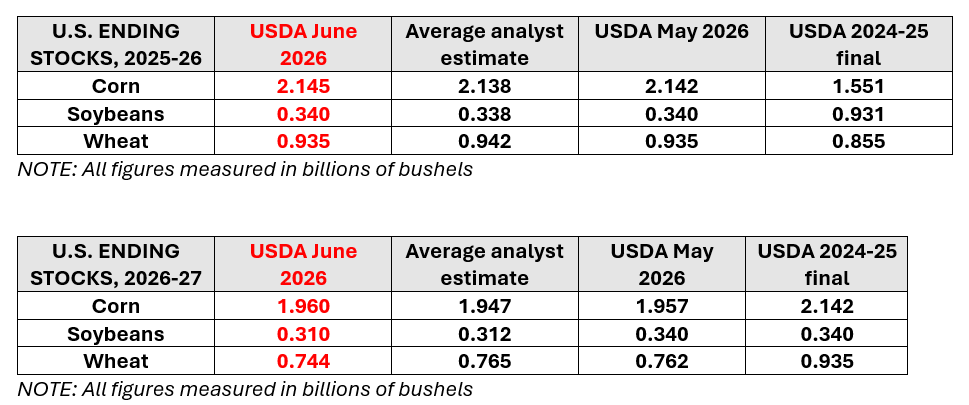
Corn stockpiles at the end of the 2025-26 marketing year were raised 3 million bushels to an estimated 2.145 billion bushels, a seven-year high and contrary to expectations for a small cut. USDA also lifted 2026-27 ending stocks 3 million bushels to 1.96 billion bushels. Exports for 2025-26 were raised 25 million bushels to a record 3.325 billion bushels. But USDA also lowered ethanol use by the same amount, to 5.575 billion bushels.
For soybeans, USDA kept 2025-26 U.S. ending stocks unchanged at 340 million bushels, contrary to expectations for a small cut, while 2026-27 ending stocks were also held steady, at 310 million bushels. USDA also lowered 2025-26 soybean exports for the second month in a low, dropping its estimate 20 million bushels to 1.51 billion bushels, a 13-year low. Crushing was raised slightly.
Among global numbers, USDA kept 2026 soybean harvest estimates for Argentina and Brazil unchanged at 50 million metric tons (MMT) and 180 MMT, respectively. But USDA hiked Brazil’s corn harvest estimate 3 MMT, or 2.2%, from a May estimate, and boosted Argentina’s crop 2 MMT to 61 MMT.
“This report typically pales in comparison to the June 30 acreage report, and this remains true today” Jeremy McCann, Farmer Relations Manager at Farmer’s Keeper, said in a report. “There were no sizable changes to our old-crop end stocks, and the new-crop end stocks were mostly unchanged. Now all eyes are shifting towards the acreage report at the end of this month.”
USDA will update its corn and soybean plantings estimates in its June 30 Acreage report, which promises to be a key price influencer for the summer.
In a separate report, USDA estimated the 2026-27 total winter wheat crop at 1.03 million bushels, down 18 million bushels from its initial forecast in May, down almost 27% from the 2025-26 crop and the smallest since 1965. Analysts expected a figure closer to 1.041 billion bushels. The hard red winter crop, which has been hit hardest by drought, was estimated at 496.9 million bushels, down 18 million bushels from May and down 38% from last year.
At midday, December corn futures fell 6 cents to $4.4075 per bushel, while November soybeans dropped 7 cents to $11.3150. July HRW wheat futures rose 3.5 cents to $6.34.
Below are summaries of several key USDA numbers for South American crops and for U.S. wheat:
