The ag markets have not been a fun topic for the last couple of years. We are well off the high corn and soybean prices seen in 2021-23.
Margins continue to be squeezed at these low price levels coupled with high input costs. There have been months at a time when farmers didn’t see breakeven prices and were not motivated to sell their crops. But it may not all be doom and gloom, especially when it comes to the soybean markets.
November 2026 soybean futures are currently over the $11 mark for the second time in the last 16 months. We had a rally up to $11.30 in November after a Chinese trade agreement was announced. That rally was short lived, and the market broke 85 cents by the new year. Since then, we have been able to climb back to $11.13, a number that many farms can pencil a profit on, given APH yields. A few questions may be bouncing back and forth with this rally.
- How high will this go?
- How long will the $11 figure be around?
- What are we going to do about it?
That last question is most important. If the last few years taught us anything, it is to act when you are at prices you can stomach.
For the last two bean crops, some of the best prices were in this January/February timeframe. It may be nerve racking this far out to be too aggressive, but strategies available that allow you to act and remain flexible. Let’s look at four strategies to take advantage of today’s price but still partake in some of the rally if this continues. With basis levels being different at all locations, we will just focus on futures. For this example, we’re using recent numbers. Check today’s to price-validate your plan.
1. Straight sale
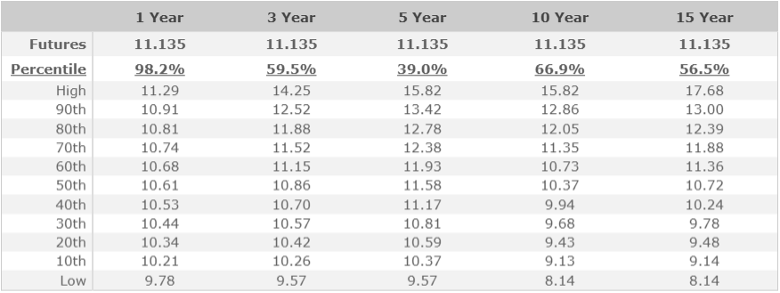
On the first 25% of your bean crop, let’s just make a straight sale. $11.13 is not a bad price. Over the last year, it’s in the 98th percentile. Over the last 10, it’s in the 67th percentile. It seems like the world has plenty of beans after a great U.S. crop in 2025 and what seems to be a solid South American crop in 2026. Take the momentum from this Chinese trade news and make a sale!
2. Sale with a November $11.60 call
On the next 25%, make another sale and this time buy an $11.60 November call costing 40 cents. This strategy gives you a floor of $10.73 ($11.13 minus 40 cents) and also gives you upside coverage until the call expires on Oct. 23. If the market explodes due to a growing season rally, your call will gain in value and let you partake in the rally. If the market does nothing but go down between now and harvest, your call will lose its value but at least you made the sale.
3. Buy a November $10.80 put
For another 25%, let’s look at the simple strategy of buying a November $10.80 put costing 40 cents. A put gives you downside protection and you use it on unsold bushels. You would have a floor price of $10.40 ($10.80 minus 40 cents) and have unlimited upside on the unsold bushels. If the market goes down between now and fall, you know where your floor is. If the market rallies to higher levels, you will lose the value of your put but be able to sell at better prices.
4. Buy a November $11.10 put and sell a $12.10 call
On the last 25%, we will use a “put/call spread,” similar to a min/max contract at an elevator. To build this strategy you buy an $11.10 put and sell a $12.10 call at a net cost of 27 cents. This gives you a floor of $10.83 and a ceiling of $11.83. Selling the call allows you to have a higher floor than just buying a put but it comes with the tradeoff of having a ceiling on this portion of your crop. This position in a brokerage account does have margin risk if the market climbs higher.
Each of these positions comes with pros and cons but what do they look like all together? The chart below shows what your net price would be at different future levels on Oct. 23, when the options expire.
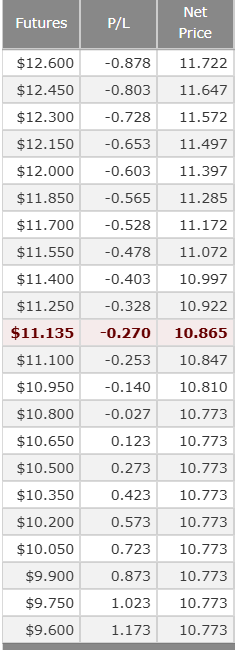
So, if futures stay flat at $11.13 and you did nothing else, your net price would be $10.86. If futures rally by fall and we are at $12.60, your net price will be $11.72. This shows that you participated in the rally, but not penny for penny. If futures were $9.60 come fall, your net price would be $10.77. More than $1 above where it fell to! You’ll notice that once futures get below $10.80, it doesn’t matter how low they go. Your floor on your whole portfolio is set at $10.77.
This is just an example of positions that can be put on today. The great thing about options is they are extremely flexible and can be modified to match your bias. If you think better prices are ahead, you can adjust these strategies to allow for more participation in a rally. If you are overall bearish on soybeans, you can adjust these strategies to have your worse case scenario be higher than $10.77. Using options is all about tradeoffs and what risks you are willing to accept. Working with someone who can give you ideas and help you visualize what strategies mean at different price levels is important. Don’t just cheer for higher prices and have no plans if they don’t materialize. Work with someone you trust, compare different strategies, and take some action today!
Advance Trading, ATI, and ATI ProMedia are DBAs of CIH Trading, LLC, a CFTC registered Introducing Broker and NFA Member. The risk of trading futures and options can be substantial. All information, publications, and material used and distributed by Advance Trading shall be construed as a solicitation. ATI does not maintain an independent research department as defined in CFTC Regulation 1.71. Information obtained from third-party sources is believed to be reliable, but its accuracy is not guaranteed by Advance Trading. Past performance is not necessarily indicative of future results.