Growers have plenty of choices for marketing crops after harvest, from selling off the combine to storage alternatives including futures, options and grain bins. But picking the right formula for your business likely means more than holding and hoping.
One-size-fits-all strategies may work for some. Others must account for individual characteristics of their location, including basis patterns, yields and end user demand. And what works for corn may be unsuitable for soybeans, doubling the difficulty of the decision.
History can provide guidance, so the Farm Futures Storage Strategies Study looks back all the way to the 1985 crop, when agricultural options started trading again after a 50-year ban. Long-term averages and year-by-year analysis from terminals around the growing region illustrate both the promise and perils of these decisions. Here are some factors to consider:
On-farm or in town? Storing grain on-farm is a popular choice for good reasons. Prices tend to be weak at harvest, for one. Putting corn and soybeans in the bin is also the most profitable strategy on average because prices normally rise after farmers seal bin doors tightly.
Taking crops to town pales by comparison due to costs for commercial storage, which ate into soybean profits and made corn little more than a breakeven proposition, according to the study.
On-farm soybean storage netted more than the harvest price 2 of every 3 years in the study, the most for any of the nine strategies considered for the crop. Storing 2025 soybeans earned 88 cents a bushel, 35 cents better than any other tactic.
But no strategy is foolproof; storing last fall’s corn on-farm lost 12 cents, and that doesn’t include costs for depreciation on facilities, which vary widely from farm to farm.
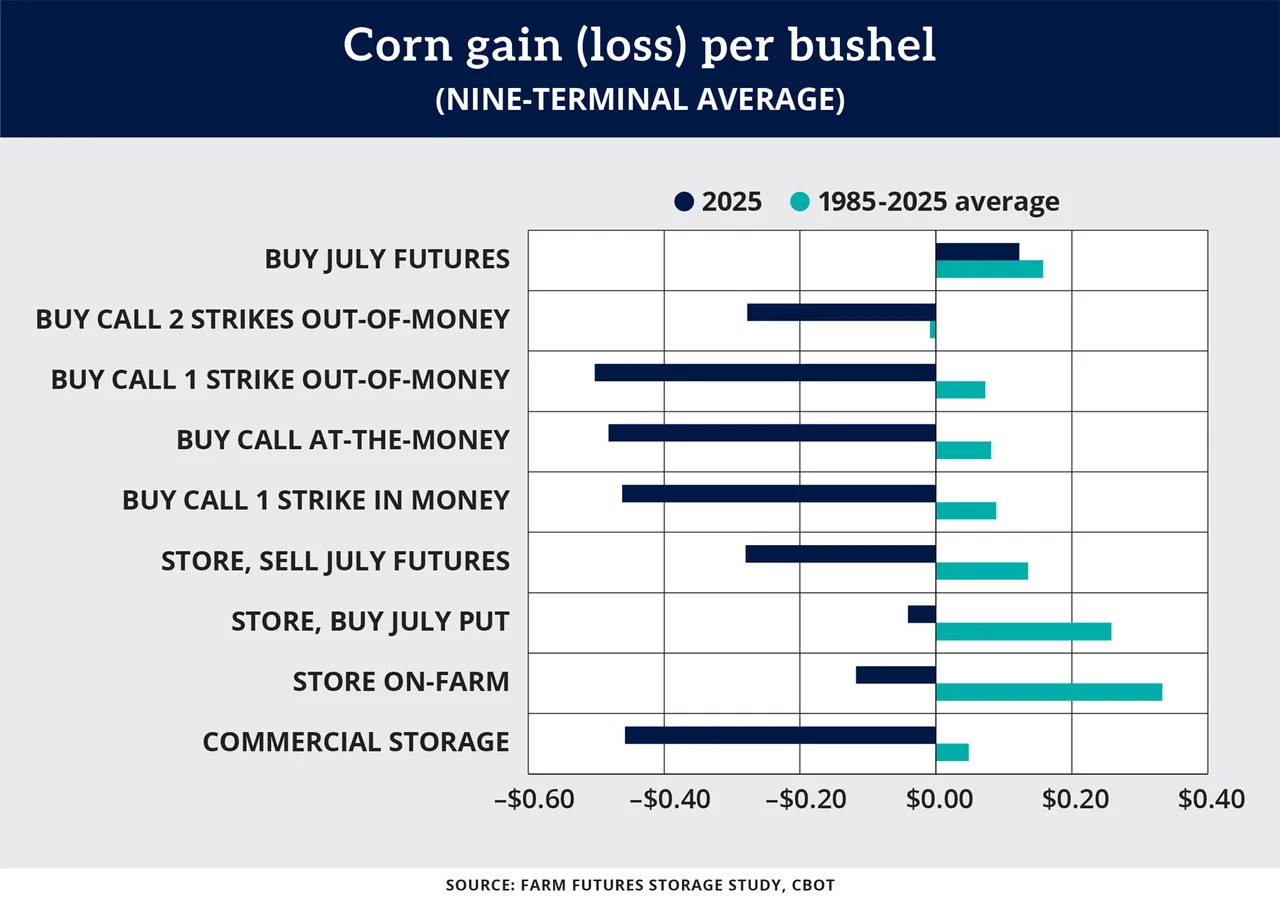
Sell the carry. The most consistent storage performer for corn beat the harvest price nearly 3 of every 4 years since 1985. Selling July futures to hedge inventory makes money if futures fall or the basis between cash and futures narrows enough. Most years, basis does indeed improve to persuade farms to open bin doors. Still, futures rose more than cash for 2025 corn, the exception that proves the rule.
Selling soybean futures doesn’t work as well. On average, that strategy lost a penny compared to the harvest price, though it posted gains in 25 years since 1985.
The soybean market doesn’t build carry all the way to July because the market wants inventory fairly quickly after harvest — before another wave hits the world from South America.
Buy the board. Only one 2025 corn strategy ended in the black: selling grain off the combine and replacing it with futures. Buying corn on the board last fall worked because the most consistent method for that crop, the storage hedge, had an off year.
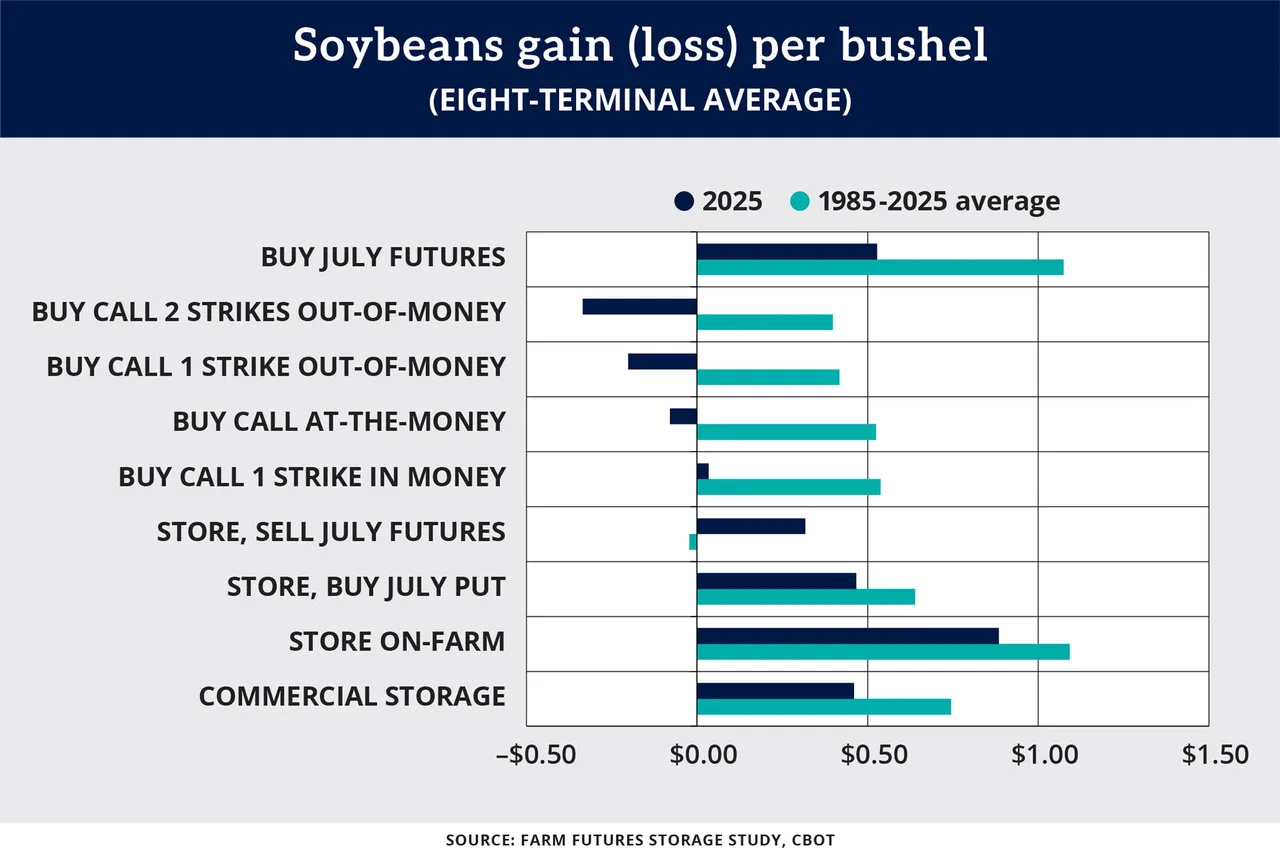
Buying soybean futures is normally better, and that was the case for 2025-26, because basis gains in soybeans tend to come earlier after harvest.
Lottery tickets. Storing crops in hopes of a big rally can be a gamble, so one storage alternative recognizes this risk. Selling crops at harvest fixes the price, but buying call options can help keep a leg in the market if it later takes off.
Calls convey the right, but not the obligation, to buy futures, and can gain in value if prices rise enough. The study considers calls that are at-the-money, conveying the right to buy near the harvest price, as well as those that are out-of-the-money, with higher “strike” prices that cost less but have lower odds of success.
Over time these options performed as expected, with those at-the-money capturing about half the gains of underlying July futures. But they’re more profitable than merely selling at harvest less than half the time — another risk to consider too.
Puts for the bin. Holding grain at harvest is not without risk, because prices can stagnate or fall instead of rallying. One way to protect inventory is with put options that convey the right to sell futures — in this case, July — for about the harvest price.
Puts do cost money, premiums paid up front, that can be lost if the options expire with less or no value at all. But if the market falls, these options can gain in value, offsetting some of the losses in futures.
Combining a put with storage creates the equivalent of a call option, but this strategy, on average, worked better than calls on both corn and soybeans. This is because positions posted gains on both futures and basis, on average.