Remember corded drills? Those now-antiquated power tools once crowded farm shop shelves. Now, battery-operated handhelds ratchet off tires and secure fasteners. It’s a testament to the speed at which technology has advanced. Could agricultural machines be next? Possibly. But the jury is out on what that evolution might look like and which technologies could someday usurp fossil fuel-powered engines.
“There's no clear winner across the board when it comes to alternative fuels,” said Warren Morris, senior manager of product management at Agco. “We're investing in multiple technologies to help farmers make informed decisions about various fuel options.”
To that end, Agco opened a $70 million to $80 million clean energy facility last year in Finland next to an existing engine lab that tests alternative fuels. It’s part of the ag machinery brand’s “future proof” approach to research and development.
Future focused
John Deere is likewise betting on agricultural tech’s clean energy future. A 130 equivalent-hp electric tractor prototype showcased this focus at Agritechnica 2025 in Germany. With field tests ongoing, it’s expected to launch with limited availability next year.
“It's not all about reducing emissions. For some customers, that matters. For others, this is a significant reduction in operating costs from fuel alone,” said Derek Muller, business manager for John Deere's electric tractor segment. "It still needs to work all day long, and that's what we're going to prove."
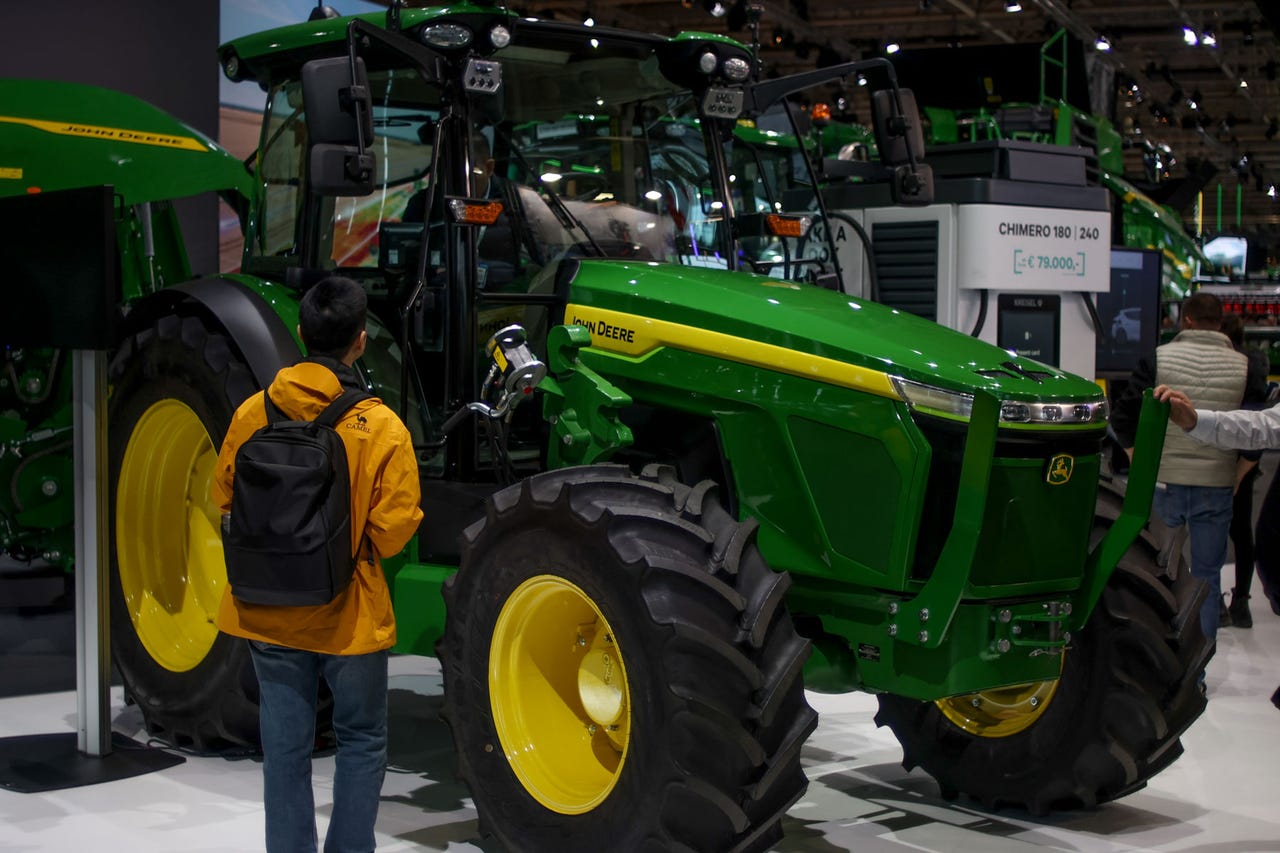
There are other advantages besides its electrically powered fuel savings. The tractor's PTO is completely ground speed-independent, the power transfer is immediate, and it drives like an automatic car with only gas and brake pedals.
But while these advantages are clear, electric machines have downsides. For one, like corded power tools before them, they’re limited by battery technology. And for the foreseeable future, Muller doesn’t think they’ll get much more powerful.
"At 130 horsepower, this may be where the technology limit is for full battery-electric from John Deere,” he continued.
Electric combine?
Other machinery brands might disagree. Powered by 12 small electric motors and a diesel generator, Chinese equipment manufacturer Zoomlion’s world-first hybrid-electric autonomous combine harvester supposedly boasts 450 horsepower. The concept machine was likewise on display at the Hannover ag tech show.
“We can keep working for two days, up to 60 hours,” touted Kevin Song, a brand rep at the booth. If those remarkable claims prove true, and its battery motors survive fieldwork, an electric combine could be a technological breakthrough. Then again, not every power source is suited to every operation.
Each clean energy power option has different attributes, both good and bad. Electric power has drawbacks. Renewable diesel, for example, is a drop-in replacement for traditional diesel, requiring minimal engine modifications. But it’s expensive to produce. Ethanol, while widely available, requires engine modifications and doesn't perform well in the cold. Soybean-based biofuels require refinery processing; hydrogen power is extremely expensive.
Eventually, Warren foresees gradual and market-driven adoption of technologically diverse clean power options. Electric-drive machines will probably remain smaller, with higher-horsepower needs met by clean energy fuels. He remains optimistic about this future, although clean energy’s adoption timeline is unknown. In the end, determining winners will boil down to return on investment.
“That's the $1 million question. It's hard to gauge exactly what the adoption rate will be because it really does come back to that affordability piece and the availability piece,” he said. “Until all of these stars align, adoption will continue to remain low."