Corn futures plunged to the lowest levels since August after USDA stunned the market by boosting its estimate for the 2025 U.S. crop above 17 billion bushels for the first time, signaling a heavy supply outlook that likely will burden prices this year even amid record demand. Soybean futures also tumbled after USDA held its yield figure steady.
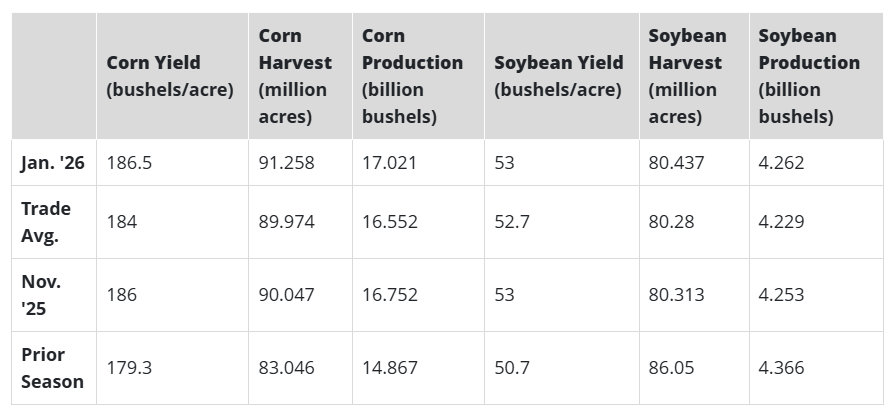
Last year’s U.S. corn crop averaged a record 186.5 bushels per acre, up 0.5 bushel from a previous estimate, according to USDA’s annual Crop Production Annual Summary released today. The average marked a 4% improvement over 179.3 bpa in 2024 and clashed with trade expectations for a downward revision of about 2 bpa.
USDA also raised harvested acreage 1.3 million acres to 91.3 million acres, resulting a U.S. crop totaling an all-time high 17.021 billion bushels, up 269 million bushels from USDA’s previous estimate in November and up over 2 billion bushels, or 14%, from 2024. USDA also raised its forecast for U.S. corn stocks at the end of the 2025-26 marketing year by 198 million bushels to 2.227 billion bushels, a seven-year high.
“Very surprising numbers today… and very ugly for corn,” said Jon Prischmann of Blue Creek Commodities and Hedging LLC in Fergus Falls, Minnesota. Heavy supplies and slumping prices “will make hedging going into summer very difficult for the rest of old crop and also new-crop December 2026,” he said.
“Overall this is exactly what the market did not need today and we will have to go back to the drawing board for 2026 hedge ideas to try and make some numbers work,” Prischmann said in an email. “It’s been a while since we have seen a bad January report like this.”
In late trading, March corn tumbled 25 cents at $4.2075 per bushel after earlier touching $4.2025, the contract’s lowest intraday price since mid-August. March soybeans sank 14.5 cents to $10.48, while March SRW wheat dropped 7.25 cents to $5.10.
USDA hikes soybean stocks, slashes exports
USDA’s unexpectedly bearish numbers for both corn and soybeans pose further challenges for U.S. farmers already squeezed by three years of weak crop prices and high costs for fertilizer and other inputs. The abundant supply outlook likely will keep grain prices under pressure, further dimming profit prospects in 2026 and throwing greater uncertainty into spring planting decisions.
The corn production boost reflected several factors. In addition to the harvested acreage increase, USDA also hiked 2025 plantings by 60,000 acres to 97.788 million acres, the highest in nearly 90 years. Since July, USDA’s harvested acreage estimate has surged 4.5 million acres, the agency said today. USDA also raised average yields for a few top Midwest states, including Indiana and Minnesota.
Today’s soybean numbers received a similarly bearish reception. USDA pegged the average 2025 U.S. soybean yield at 53 bpa, unchanged from the November estimate and contrary to trade expectations for a reduction of about 0.3 bpa. Production increased 9 million bushels to 4.262 billion bushels, down 112 million bushels, or 2.6%, from 2024’s crop but against expectations for a drop of about 24 million acres.
USDA also slashed its outlook for U.S. soybean exports, reflecting recent U.S.-China trade tensions that prompted the Chinese to avoid buying U.S. beans much of last year. Soybean exports for 2025-26 were lowered 60 million bushels to 1.575 billion bushels, down 16% from 2024-25 and a 13-year low.
U.S. soybean ending stocks for 2025-26 were raised 60 million bushels to an estimated 350 million bushels, up 25 million bushels from 2024-25 and a six-year high.
“No good news here at all but it could have been worse,” Prischmann said, noting that heavy bear-spreading (selling nearby futures while buying deferred contracts), “is a bad sign that this one will be hard to reverse quickly. Everyone is throwing in the towel in the front today.”
The Crop Production Annual Summary typically includes “final” 2025 estimates for U.S. corn and soybean production and yields, though USDA occasionally will revise the figures later in the year. Today’s reports also included USDA’s monthly Supply and Demand and quarterly Grain Stocks updates and Winter Wheat and Canola Seedings.
