Corn futures had traded in a monotone, sideways price pattern for nearly three months prior to the January USDA report. Charts suggested a dramatic price breakout was likely, however which direction the price breakout occurred, higher or lower, was subject to the information from the Jan. 12 report. With a bearish report, the price breakout was indeed large at 30 cents, and the breakout direction was to the downside.
What’s happened
A quick summary of the report shows the bearish surprise came from multiple points. USDA increased old-crop carryover, which raised beginning stocks by 19 million bushels, up to 1.551 billion bushels.
The negative news for corn came in on the production side. Corn production for the 2025-26 crop year is now pegged at a record 17.02 billion bushels with yield forecast higher than expectations at 186.5 bushels per acre. Harvested acres were also increased up to 91.3 million acres.

Thankfully, demand for corn continues to remain strong in all categories. Total domestic use is forecast at 13.17 billion bushels, up 90 million bushels from last month.
On the demand side, feed and residual use came in at 6.2 billion bushels, up 100 million bushels from December. Food, seed, residual use and industrial use are projected at 6.97 bbu, only down a modest 10 million bushels from December. Ethanol use is pegged at 5.6 billion bushels, unchanged from December.
And export demand remains stellar as well. U.S. exports for corn are pegged at a record 3.2 billion bushels, unchanged from December. Total demand for U.S. corn is now marked at 16.37 billion bushels.
However, even though demand remains strong, the production increase more than offset the demand increase pushing ending stocks for the 2025-26 crop up to 2.227 billion bushels. This was an increase of 198 million bushels from last month. A surprise since trade was expecting a reduction of ending stocks.
From a marketing perspective
So where to from here? Will corn prices stay low during 2026? Besides a dramatic change in weather, what might spur an increase in corn prices? Demand for corn is already strong, might there be more possible demand improvement ahead?
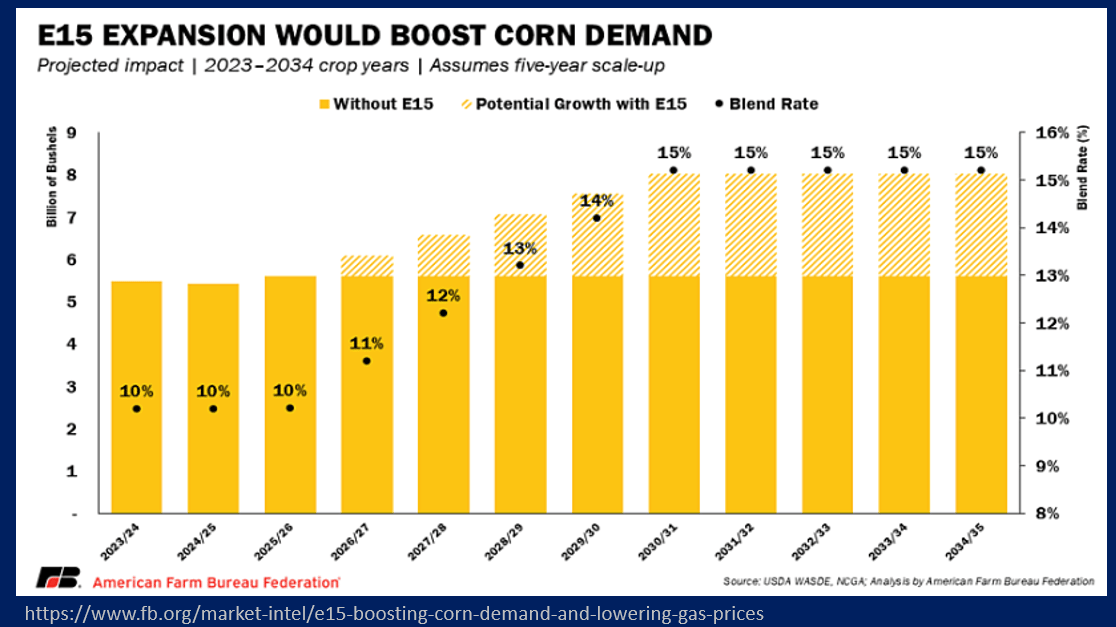
One possible glimmer of light comes from continued potential increased demand for ethanol. We are talking about year-round E15.
In a recent article, American Farm Bureau said: “Nationwide, year-round E15 authorization presents the most straightforward path to preserve existing ethanol demand and create new growth. Even a modest increase in the national blend rate could have a measurable impact. According to NCGA (National Corn Growers Association), a 1% increase in the average ethanol blend rate would add 1.36 billion gallons of ethanol, equal to about 486 million bushels of corn. A 5% increase, to move from E10 to E15, would translate to 6.8 billion gallons of ethanol, or roughly 2.4 billion bushels of corn a year.”
Wow! A modest 1 percent increase in the current blend rate would increase corn demand for ethanol by 486 million bushels! That alone would help prop up corn futures prices without a dramatic price increase. A win-win for both farmers and the ag industry.
Prepare yourself
Currently, with prospects of a 2-billion-bushel U.S. corn carryout, it might be tricky for corn prices to rally much, without a global weather event (more on that next week). However, a simple solution that may benefit farmers would be an increase in corn ethanol demand.
Keep an eye on this in the news in the coming months, it might be a glimmer of hope for corn.
Reach Naomi Blohm at 800-334-9779, on X: @naomiblohm, and at naomi@totalfarmmarketing.com.
Disclaimer: The data contained herein is believed to be drawn from reliable sources but cannot be guaranteed. Individuals acting on this information are responsible for their own actions. Commodity trading may not be suitable for all recipients of this report. Futures and options trading involve significant risk of loss and may not be suitable for everyone. Therefore, carefully consider whether such trading is suitable for you in light of your financial condition. Examples of seasonal price moves or extreme market conditions are not meant to imply that such moves or conditions are common occurrences or likely to occur. Futures prices have already factored in the seasonal aspects of supply and demand. No representation is being made that scenario planning, strategy or discipline will guarantee success or profits. Any decisions you may make to buy, sell or hold a futures or options position on such research are entirely your own and not in any way deemed to be endorsed by or attributed to Total Farm Marketing. Total Farm Marketing and TFM refer to Stewart-Peterson Group Inc., Stewart-Peterson Inc., and SP Risk Services LLC. Stewart-Peterson Group Inc. is registered with the Commodity Futures Trading Commission (CFTC) as an introducing broker and is a member of National Futures Association. SP Risk Services, LLC is an insurance agency and an equal opportunity provider. Stewart-Peterson Inc. is a publishing company. A customer may have relationships with all three companies. SP Risk Services LLC and Stewart-Peterson Inc. are wholly owned by Stewart-Peterson Group Inc. unless otherwise noted, services referenced are services of Stewart-Peterson Group Inc. Presented for solicitation.