Earlier this year, I wrote about what doesn’t show up on your farm’s balance sheet. Many have heard of phantom yield loss, but not phantom growth drag, a term I thought of one day while meeting with a fifth-generation farm family.
Three of five generations of this farm had to borrow money to buy out family members. Think about that: the same land bought and paid for, generation after generation. The farm survives but it doesn’t grow.
Phantom growth drag is the silent, compounding effect of lost equity and drained cash flow every time a new generation must repurchase assets the family already owned.
If your farm has multiple heirs, there’s a number every family needs to know. I call it your farm’s transition number — what it will cost the successor to buy out the siblings and keep farming or keep the farm in the family.
Run the numbers
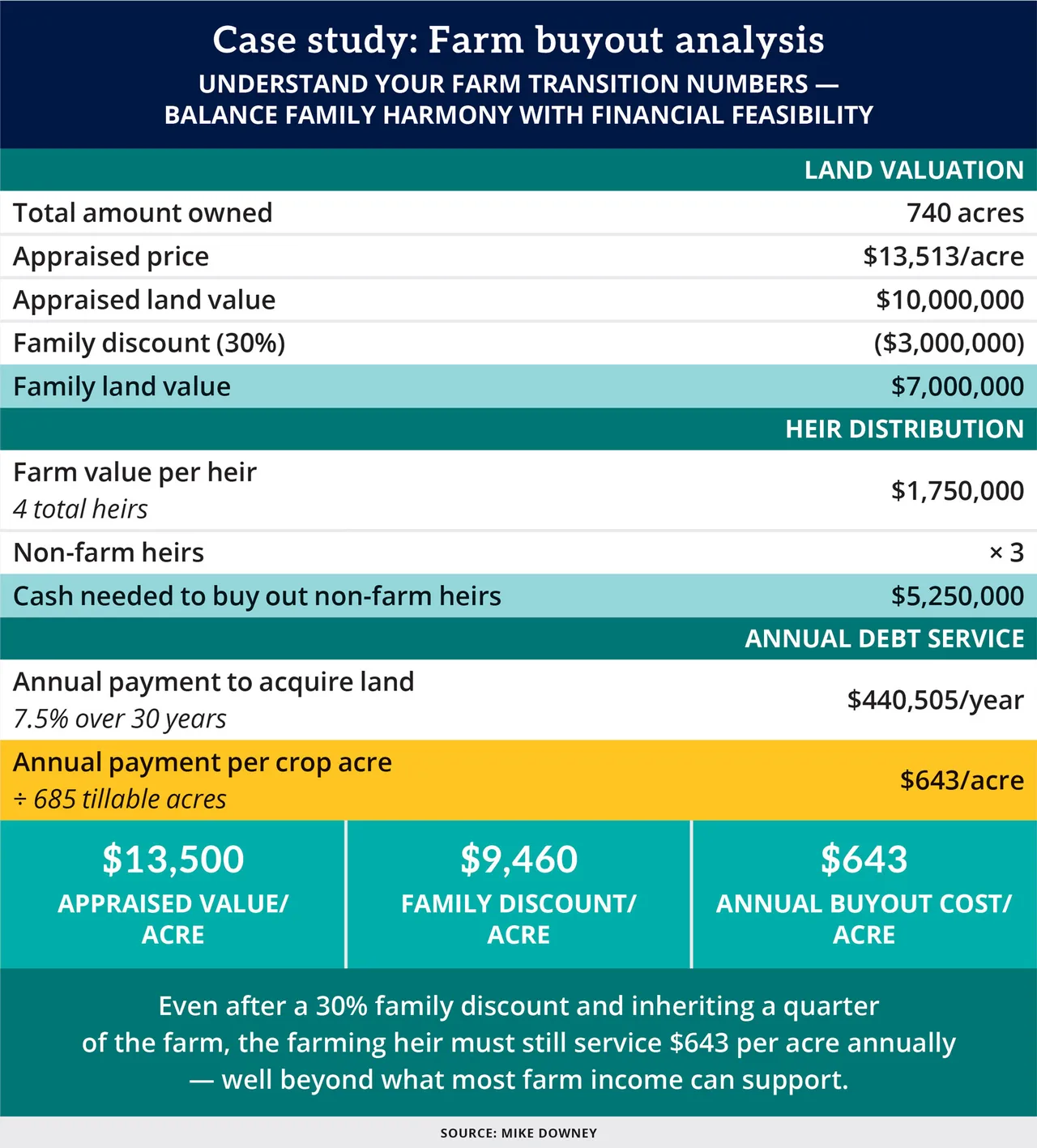
Let’s say your farm appraises at $13,153 per acre. You own 740 acres. That’s a land value of $10 million. Mom and Dad want to apply a 30% family discount — a meaningful concession — bringing the family land value to $7 million.
Divide that by four heirs: Each child’s share is worth $1.75 million. Three of those children won’t be farming. The farming heir uses their own inheritance, $1.75 million, as a down payment toward the buyout. That means the farming heir needs to buy out three siblings: a $5.25 million cash need before a single acre changes hands.
Financed at 7.5% over 30 years, the annual payment comes to about $440,000 per year, or around $640 per tillable acre, every year, just to buy the land the family already owns.
Let’s say the family rental rate is $250 per acre. At $640 per acre in debt service, the farm needs to subsidize nearly $400 per acre, or $265,000 annually.
Even with a generous family discount and the farming heir contributing their own inheritance toward the buyout, the math doesn’t work.
That’s the trap. The farm looks wealthy on paper but is financially strangling the next generation before they ever plant their first crop as the owner.
Now multiply that scenario across multiple generations. When the same land gets bought over and over again by each successive heir, the farm never truly gets ahead. It pays its way into the family’s hands, and then pays its way again and again.
Capital that could have funded expansion, technology or retirement security instead flows out of the operation and into the estate.
That’s phantom growth drag. The farm “grows” in appraised value while the operating business struggles to get ahead. The family tree survives. The farming business barely does.
3 options for transition
The transition number is not a death sentence. It’s a planning tool. Knowing the number before the estate plan is finalized gives you time to act. Here are three actions to take now:
- Buy life insurance. That can fund a sibling buyout at a fraction of the cost of a 30-year land loan.
- Outline installment sales, long-term land contracts or gifting programs to reduce the annual payment load.
- Restructure ownership while the senior generation is alive and engaged. This creates flexibility that a will simply cannot.
Most importantly, this conversation needs to happen at the kitchen table, not in an attorney’s office after a funeral.
The question to ask this week
If your farm is appraised today, what would the farming heir owe to buy out the non-farming heirs?
Run the worksheet. Find your number. Then ask whether the farm’s income can actually support that payment.
If the answer is no — and for most farms at today’s land values, the answer is no — then you have work to do. Not someday. Now.
Because the farms that survive five generations aren’t the ones with the most land. They’re the ones whose families had the hard conversations early enough to do something about it.