Since mid-August, November 2026 soybean futures have gained nearly $1.50 in value thanks to concerns about U.S. soybean production and strong domestic demand. But as you likely know, bull markets need to be fed constantly. Here is what to monitor in the weeks ahead.
What’s happened
The most recent World Agricultural Supply and Demand Estimates report has, as of this writing, put a short-term high in the soybean market. Heading into the report, traders expected supportive news, with modest tweaks on both supply and demand line items. The USDA report results came largely within pre-report expectations. Therefore, because much of the report came out as expected, the numbers were already priced into the market. The market did not receive fresh bullish news for soybeans, so soybean prices finished lower on the day of the report.
Quickly reviewing the September USDA report, there was a modest increase to yield, now pegged at 52.8 bushels per acre, up from 52.7 bpa the month prior. Total production is now marked at nearly 4.54 billion bushels, up from nearly 4.52 billion bushels the month prior.
On the demand side, USDA left crush demand unchanged, estimated at 2.78 billion bushels, and slightly increased exports from the month prior. Soybean exports are now pegged at nearly 1.69 billion bushels. Seed use, forecast at 73 million bushels, is unchanged. Residual use, now estimated at 38 million bushels, is up 1 million bushels.
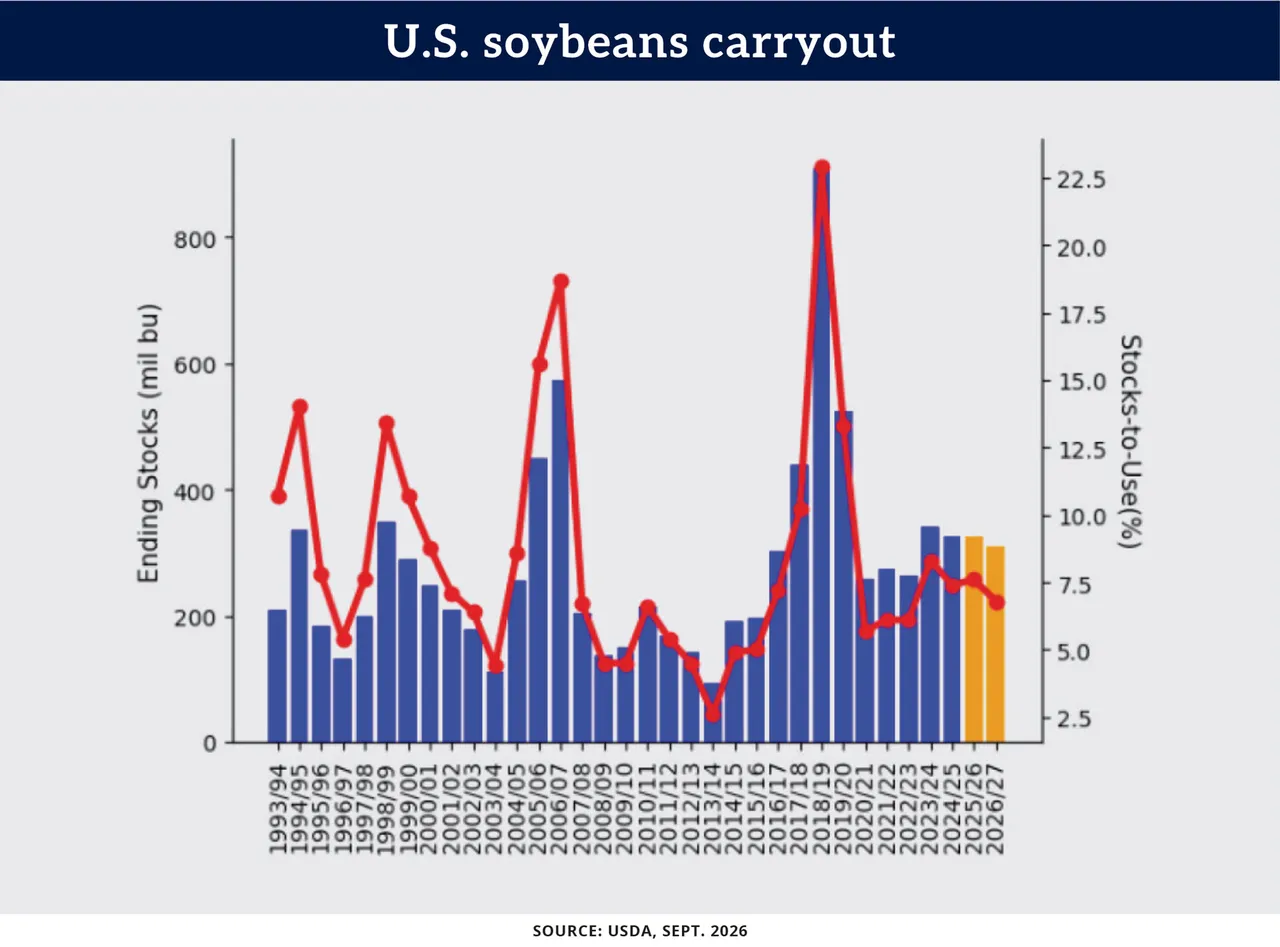
The net result is an ending stocks estimate of 310 million bushels, down from 320 million bushels in August. While a 310 million-bushel carryout it supportive for the big picture, it was expected.
From a marketing perspective
With a lack of fresh new bullish news from the USDA report, traders took profits on long positions, with soybean futures posting a bearish key reversal on daily charts. As of this Wednesday, November 2026 soybeans have solid support at $13, with overhead chart resistance at $13.35.
U.S. ending stocks at 310 million bushels is not a bearish statistic. U.S. ending stock supplies are historically on the smaller side, and demand remains strong. This will likely keep prices supported for now. Harvest pressure may keep prices in check in the short term.
Looking at global supplies, keep in mind the U.S. is the second-largest soybean producer. Brazil is the world’s largest grower of soybeans, Argentina is the world’s third largest, and the South American crop is just getting planted.
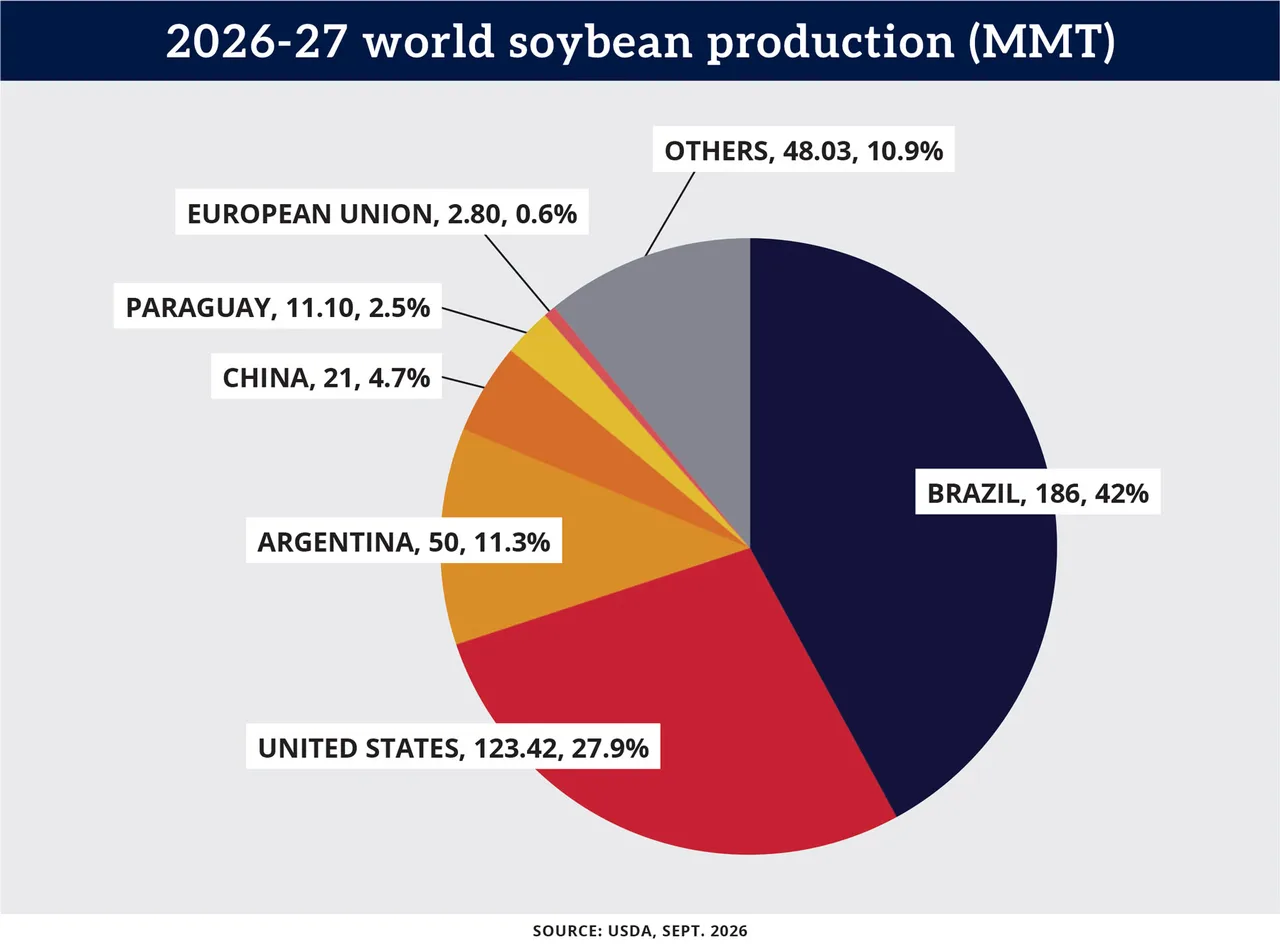
USDA has Brazil’s soybean production for 2026-27 pegged at 186 million metric tons. In Brazil, the national crop forecasting agency Conab has a slightly smaller estimate forecast. Conab believes Brazil’s soybean acreage is set to grow 1.4% for the new 2026-27 season, with total soybean acreage seen at 49.3 million hectares. It projects that Brazil will produce 181.6 million tons of soybeans in the new-crop year, which is up slightly from the 2025-26 season.
Here is where it gets sticky. The world needs Brazil to produce all those soybeans. Brazil’s soybean exports are pegged at 118 MMT, with the bulk of those going to China. If Brazilian soybeans experience a production hiccup in the coming months, soybean futures prices would have reason to rally.
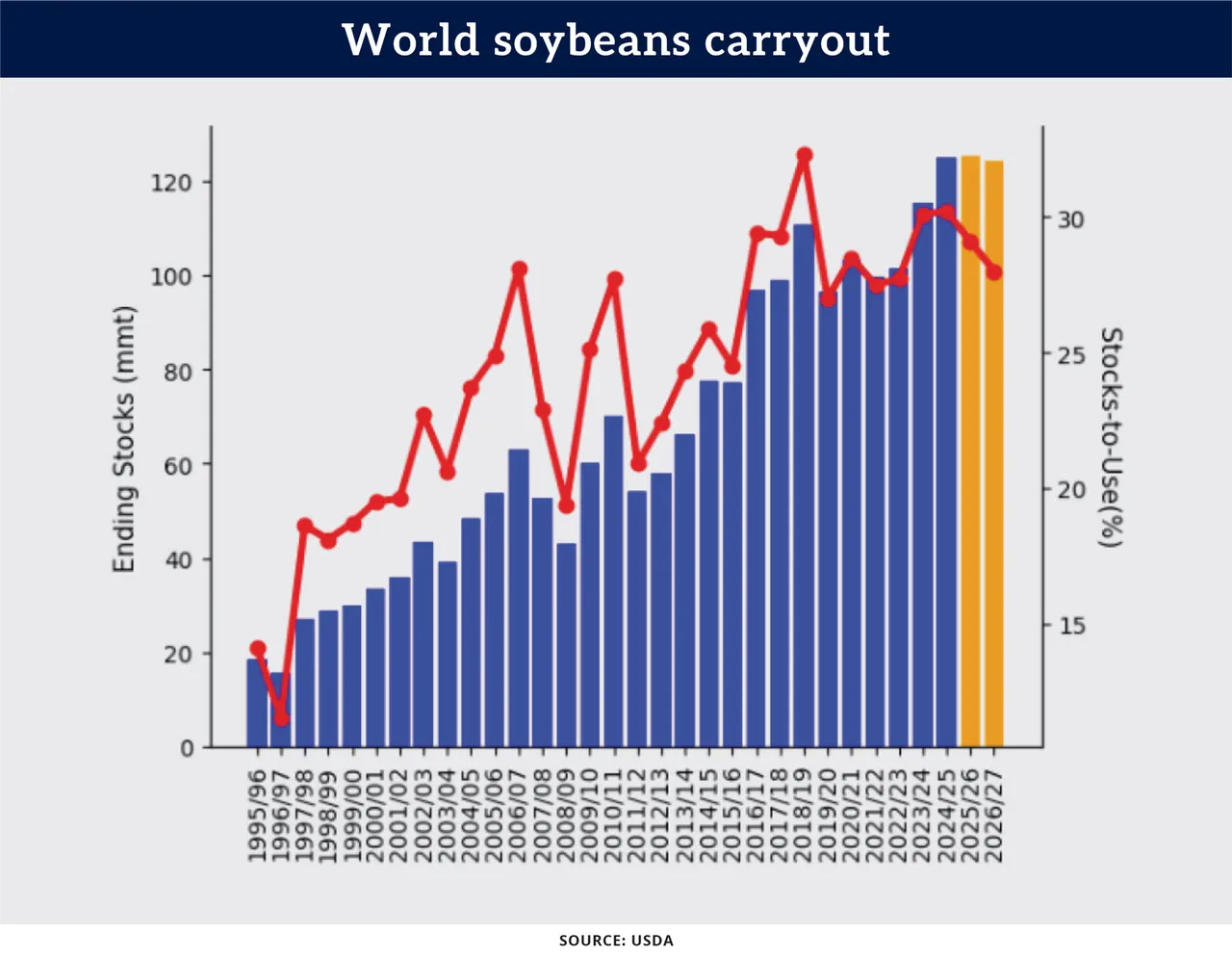
However, if soybean production in Brazil doesn’t have a weather scare and meets expectations, then global ending stocks would likely be viewed as sufficient. According to the September 2026 USDA report, global ending stocks for 2026-27 are pegged at 124.02 mmt, which is a comfortable number, historically. (Yet, take note that the stocks-to-use ratio number is trending lower.)
Prepare yourself
Where to from here? Traders will eagerly watch the upcoming visit of Chinese President Xi Jinping to the U.S. Will China make additional soybean purchases ahead of this visit? Will a last-minute spat lead to the meeting being called off?
Harvest pressure may affect nearby November 2026 futures prices, keeping a rally in check. Funds are estimated to be record long in the soybean complex. Will they hold that long position, or will they take profits into the end of third quarter, which is just weeks away?
A USDA Quarterly Stocks report lands on Sept. 30. How will that ultimately play into the balance sheet? Finally, traders will eye South American weather daily from now until March.
There is no way to outguess this market. A strategic approach must be used. A quiet, cautious tone may potentially be ahead in the short term. Or a voracious rally might be in the works heading into 2027, depending on weather in South America.
Disclaimer: The data contained herein is believed to be drawn from reliable sources but cannot be guaranteed. Individuals acting on this information are responsible for their own actions. Commodity trading may not be suitable for all recipients of this report. Futures and options trading involve significant risk of loss and may not be suitable for everyone. Therefore, carefully consider whether such trading is suitable for you in light of your financial condition. Examples of seasonal price moves or extreme market conditions are not meant to imply that such moves or conditions are common occurrences or likely to occur. Futures prices have already factored in the seasonal aspects of supply and demand. No representation is being made that scenario planning, strategy or discipline will guarantee success or profits. Any decisions you may make to buy, sell or hold a futures or options position on such research are entirely your own and not in any way deemed to be endorsed by or attributed to Total Farm Marketing. Total Farm Marketing and TFM refer to Stewart-Peterson Group Inc., Stewart-Peterson Inc., and SP Risk Services LLC. Stewart-Peterson Group Inc. is registered with the Commodity Futures Trading Commission (CFTC) as an introducing broker and is a member of National Futures Association. SP Risk Services, LLC is an insurance agency and an equal opportunity provider. Stewart-Peterson Inc. is a publishing company. A customer may have relationships with all three companies. SP Risk Services LLC and Stewart-Peterson Inc. are wholly owned by Stewart-Peterson Group Inc. unless otherwise noted, services referenced are services of Stewart-Peterson Group Inc. Presented for solicitation