As machine learning and artificial intelligence become more powerful, the technology’s use cases in farming are expanding by leaps and bounds to boost profits. Fourth-generation rancher Carrie Richards, co-founder of the logistics platform HarvestPath and the first woman to run her family’s legacy farm, is using it to solve some of agriculture’s most pressing challenges.
“We think it’s huge because every single person we talk to has the same problem we did,” Richards said about HarvestPath, referring the problem of tracking spending during meat processing. HarvestPath uses Salesforce’s digital infrastructure to simplify agribusiness expense and revenue tracking.
Having returned to the farm in 2016, she helped add a finishing component to her family’s cow-calf operation by launching Richards Regenerative Meat Company, which sells meat directly to consumers, and wholesale to restaurants and supermarkets, including the Sprouts Farmers Market chain. Developed with Richards’ brother, Tom, HarvestPath is a solution to a problem they encountered while scaling up their meat business.
“If you are not JBS, Tyson or Cargill and own the whole supply chain, the middle part of meat production is very hard to track,” Richards said. “Our costs fluctuate from month to month. Overnight, gas prices could change, and my hauling costs could go from $3,000 to $4,000 real quick.”

Solving problems
When setting their prices, ranchers need to consider cost variables, including an animal’s purchase price, labor, fuel, processing fees, yield loss when the animal becomes a carcass, bone buyback and waste disposal just in the first stage of harvest.
After that, there are many more expenses, like further transportation, labeling and packaging, storage, shipping to the store and marketplace subscriptions when selling online. These prices fluctuate quickly based on cattle market prices, diesel and gas, and myriad other outside variables.
“We have complex spreadsheets where you track each stage of the process. It is very complex,” Richards said. “You get an invoice from here and one from there. Some are paper, others are digital. Then, you try to figure out what your ribeye is worth. It is very hard to track. HarvestPath (which has been live for about a year) can give the small, medium and large companies that don’t have big systems the ability to play in a bigger field.”
The technology’s application isn’t limited to livestock. For row crop farmers, Richards said HarvestPath’s platform, which is still under development, can help farmers understand their costs and revenue by tracking input prices, equipment usage and maintenance expenses, then calculate per-acre profitability based on yield.
Likewise, dairy or specialty crop farmers can use the system to track their specific production costs. Richards said they’re integrating generative artificial intelligence capabilities that can quickly streamline production costs and optimally price products based on expense fluctuations.
Financial challenges
The financial repercussions of getting ag technology and its adoption wrong can be damaging. Underpricing can lose money, while overpricing can drive customers away. Minnesota row crop farmer Adrian Crawford, senior director of global forecasting at Agco, understands these implications from personal experience by implementing technology on her family’s machines.
“You get one shot a year to get it right, and there’s a lot that you don’t control with the weather and a variety of factors that happen throughout the growing season. It’s a big risk,” she said about farming with modern machines.
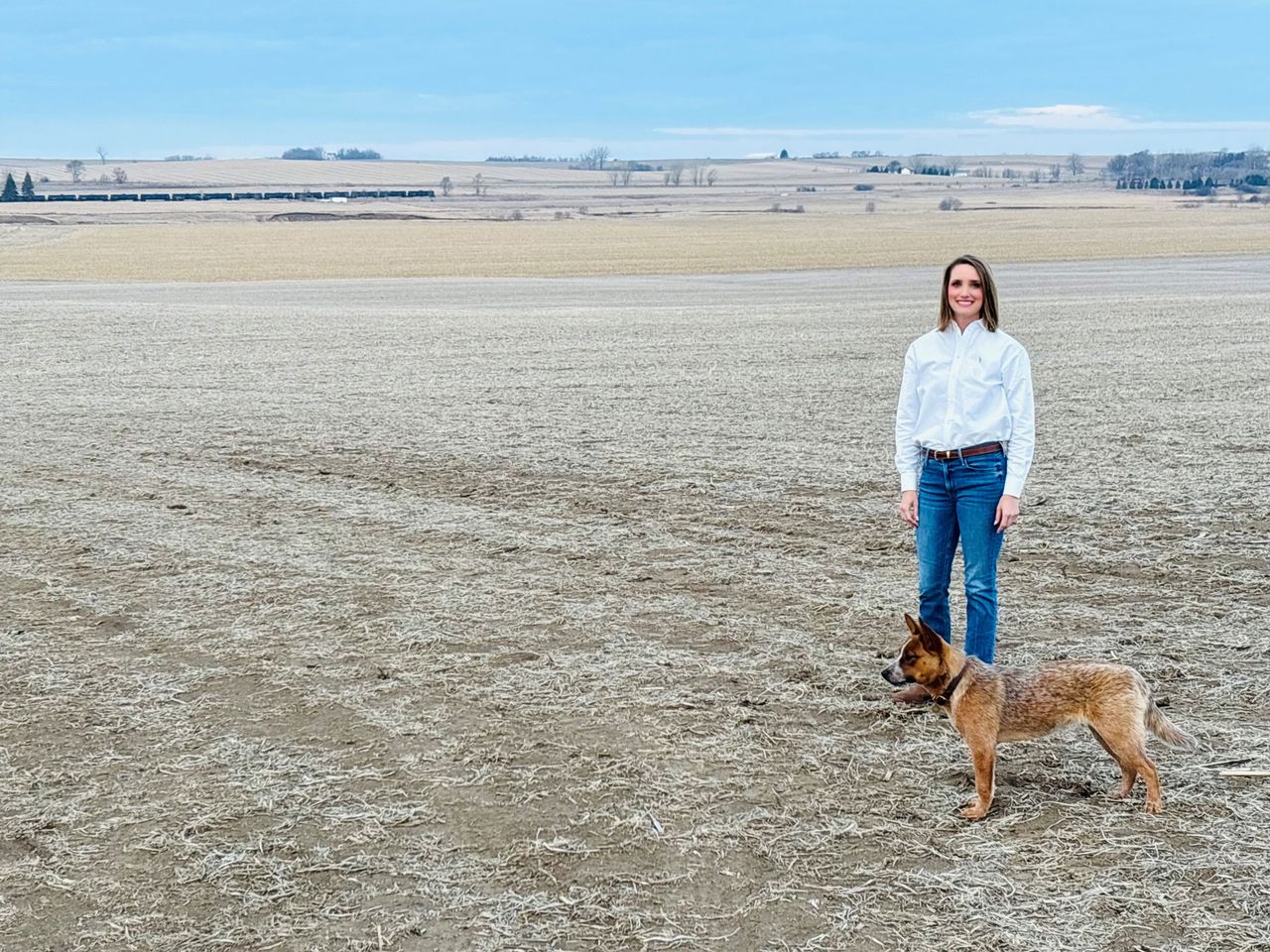
Crawford, who holds an undergraduate degree in art and mathematics, and a master’s degree in statistics from the University of Iowa, believes that AI can help reduce those risks. Over five years working with data, analytics and AI at Agco, Crawford oversaw the integration of an AI-driven voice assistant technology into tractors and helped develop a tool that can synthesize farmer needs to get the right equipment where it’s needed.
“Generative AI has made artificial intelligence a lot more approachable to a wider variety of farmers. You don’t have to be a data scientist to interact with AI,” she said. “AI is embedded in the technology that my 79-year-old father-in-law is using on a regular basis, and it helps him continue to be able to farm because the equipment is easier to use. It’s more convenient. It allows for capabilities that just didn’t exist when he started decades ago.”
How AI works
Crawford explained AI as “a big bucket” of capabilities. Machine learning finds patterns in data, identifies outliers and makes predictions about the future, while generative AI can translate inputs like text and generate new content, including text, images, audio, video and more.
When answering a spoken question for applications like the talking tractor, Crawford said AI translates a farmer’s question into a prompt for a large language model to “query information that [the AI] has been allowed to know, and then it returns that information back to the farmer.”

Although the mathematical models that enable AI have existed for decades, its sudden expansion across agriculture is because computing power has increased and continues to. But no matter how powerful AI becomes, Crawford stressed that farmers’ needs must remain at the center of its application, as exemplified by Richards’ HarvestPath, which was designed to solve a real-world problem.
“AI without a use case in mind is a hypothetical exercise,” Crawford said. “By understanding what farmers are going through day to day and making a connection to their operational needs, pain points and opportunities, that’s where I think AI is going to have the biggest impact.”
Why is Richards’ and Crawford’s work so important?
“Agronomic optimization — doing more with less,” Crawford said. “The earth is not gaining more acres of land. We have to be able to be more efficient, and technology can help enable that efficiency and [increase] outcomes. That’s the part I like the most about working in this space.”