It’s official: American farmers can no longer brag about producing a 17 billion-bushel corn crop. (Not that any of them ever did.)
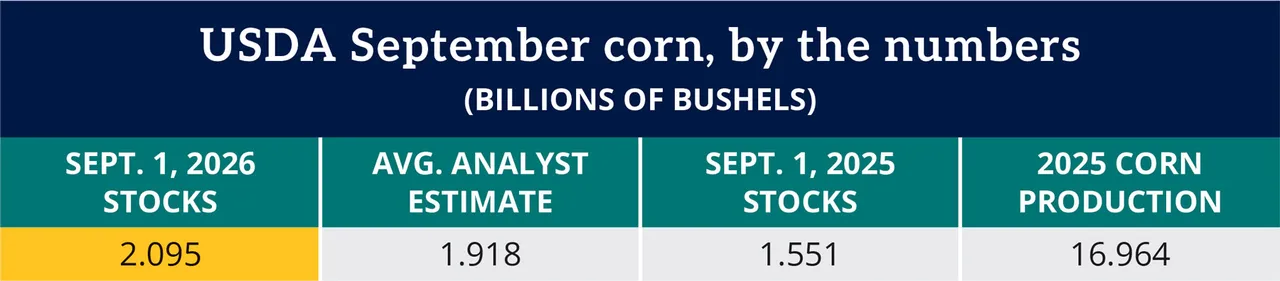
USDA put the kibosh on that in its recently released quarterly Grain Stocks report, in which the agency trimmed 57 million bushels off its previous estimate for the 2025 harvest, dropping it to a still-record 16.96 billion bushels. (USDA’s September stocks reports often include revisions to the prior year’s corn and soybean crops.)
But that was hardly the biggest headline of the day. USDA also estimated Sept. 1 U.S. corn stocks at a surprising 2.095 billion bushels, up 35% from a year earlier and a seven-year high. Analysts expected a figure closer to 1.92 billion bushels, down just a few million bushels from USDA’s current ending stocks figure.
USDA also defied expectations by leaving last year’s U.S. average yield unchanged at a record 186.5 bushels per acre.
The report almost immediately sent the corn market into a tailspin, with December futures tumbling below $5 per bushel for the first time in six weeks. Prices have since stabilized, but USDA left farmers with a larger conundrum that may hang over the market through harvest and beyond.
Historically high supply
That 2025 was a monster harvest was never really in question, even amid months of speculation that USDA eventually would revise down both production and yield. Instead, USDA delivered only modest downward tweaks in planted and harvested acres, along with the small production cut.
As a result, the market faces a historically high supply overhang at the start of the 2026-27 marketing year, despite record demand. The news came in the early stages of this year’s harvest, which is expected to be down sharply from 2025 but still among the biggest on record.
Abundant Sept. 1 stocks provide a supply buffer for the 2026-27 balance sheet, effectively adding a couple of bushels per acre to this year’s average yield, analysts noted. Instead of USDA’s current estimate of 178.5 bushels per acre, the market “feels” more like it’s trading something like 180.4 bpa, as StoneX analyst Bevan Everett wrote.
USDA’s Oct. 9 Crop Production and Supply and Demand reports will further shape market expectations and direction.
Upside potential lingers
Does the latest USDA data dump also serve as the obituary for the 2026 corn rally that sent December futures to a three-year high around $5.50 per bushel in early September? Not necessarily — not with demand expected to remain strong and weather problems in the U.S. and elsewhere wreaking havoc with crops.
Jon Scheve, an adviser and owner of Minnesota-based Scheve Grain, says corn prices likely have peaked for now and could work lower as harvest accelerates. But he’s bullish for early 2027.
Long-term, the recent USDA numbers “probably won’t be overly hurtful for prices,” Scheve said. “Have we seen the bottom yet in corn? Probably not, but we’re close. We’re around that $5 psychological level. Are we going to test sub-$4.90? Maybe, but we’re not going to $4.50. The market realizes there’s value around $5.”
For the time being, he suggested farmers — especially those who were sidelined by a wet September — focus on the harvest task at hand.
“If you haven’t already made sales, now’s the time to just focus on getting the crop out of the field and worry about marketing it afterward,” he said.