September’s lukewarm trade talks with China injected unwelcome uncertainty into the soybean market as fall harvest shifted into a higher gear on a potential record U.S. crop. It’s also raising questions over the sustainability of the soybean market’s impressive yearlong rally, which lifted futures above $13 per bushel for the first time in nearly three years.
Disappointment over the Trump-Xi summit contributed to a sell-off that began in late September and sent November futures back under $13, although futures in early October were still up over $2.30, or 22%, since the end of 2025.
Soybeans’ absence from the list of trade items that China graced with reduced tariffs is the big reason why the ag community largely saw the summit as a bust. To be sure, it generated no announcements of any major deals to buy U.S. ag goods. And apparently, no mention was made of last spring’s White House-touted agreement for China to buy an additional $17 billion in U.S. ag goods other than soybeans.
Finally, China’s plan to retain a 10% tariff on U.S. soybeans is fueling concern over whether it will reach the 25 million-metric-ton annual purchase target that emerged from a trade truce with the U.S. in late 2025. Many analysts believe the 10% levy may be too high for private crushers to absorb, even as Chinese state buyers ramped up purchases in recent months.
To be sure, China’s demand hasn’t gone away, and the country’s buying is helping U.S. soybean exports bounce back from a 13-year low in 2025-26. China is believed to have made purchase commitments for about half of the 25-MMT (919 million bushels) target so far in the 2026-27 marketing year.
Cautious calculation
But USDA’s current 2026-27 U.S. export forecast suggests China’s imports will be closer to 16 MMT, analysts believe.
“The disappointment over no change in the Chinese tariff situation was simply too much to overcome,” said John Zanker, senior analyst at Farmer’s Keeper, referring to the futures market’s immediate reaction. “Perhaps that will change in the weeks and months to come but for now; our beans will not be an attractive alternative for China’s private buyers.”
“Perhaps the state-run agencies can get to that 16-MMT level that the USDA has figured in,” Zanker added, “but 25 MMT “remains a long-shot for now.”
Fortunately for soybean farmers, reasons for price optimism still exist. Supplies are getting snugger, and demand remains strong, with USDA projecting record domestic crushing for the sixth year in a row. USDA’s quarterly Grain Stocks report at the end of September also offered fodder for bulls.
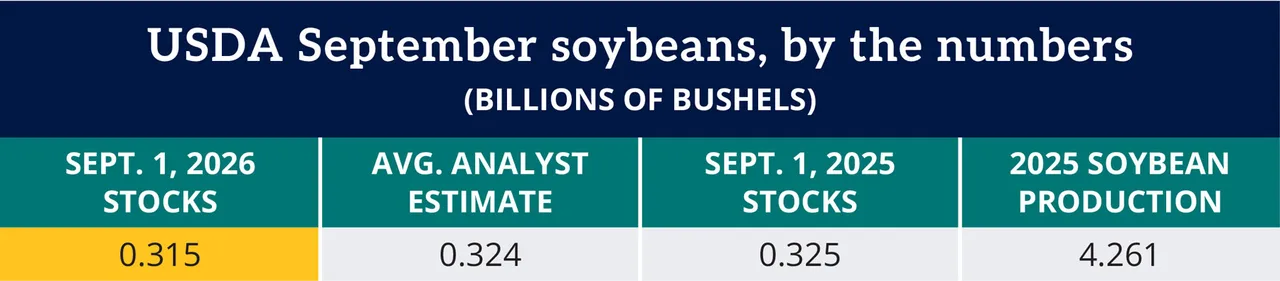
USDA pegged Sept. 1 soybean stocks at 315 million bushels, which was down 3.1% from the same date a year earlier and left U.S. supplies at a three-year low. As long as demand holds up, $13 beans remain in reach, and $14 isn’t out of the question over the long term.
Based on supply and demand fundamentals, “$13 soybeans are certainly a very fair value and still could go up, depending on what happens with U.S.-China trade relations, South America and other factors,” said Jon Scheve, an adviser and owner of Minnesota-based Scheve Grain.