Cattle futures prices slid lower for most of summer, losing over $30 along the way. September had cattle futures in a $10 consolidation price pattern, with that trend continuing into October as the market balances fundamental news.
By now you’re likely well versed in the narrative surrounding the cattle complex. A historically low U.S. cattle herd and strong domestic demand lifted prices to historic peaks in early 2026. Front-month cattle futures soared to $258.72 in April, testing the very top of the upward channel line that had been intact since 2020.
Over the course of this past summer, the bullish narrative weakened, and cattle futures prices faded, as profit-taking by the fund traders emerged throughout the third quarter.
As we start the fourth quarter of 2026, cattle futures prices are trying to hold on to that long-term uptrend.
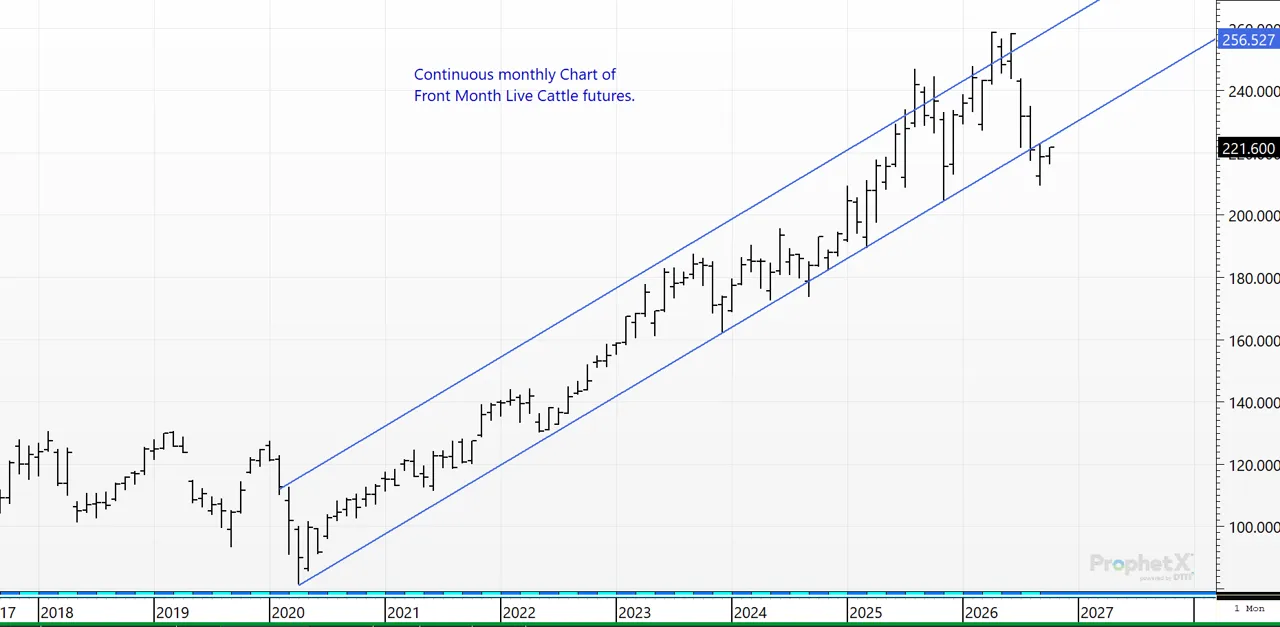
4th-quarter action
What will traders monitor in the fourth quarter? Will the uptrend resume? Or will prices begin to fade below $200? Here are factors to monitor in fourth quarter of 2026:
The U.S. cattle herd is not growing. Drought in much of the Plains this summer made it hard for producers to source feed, thus providing little incentive to hold heifers back for breeding. The lower sources of pasture for grazing due to drought also was a reason to send older cows to slaughter.
Because of the drought, cattle-on-feed reports from this summer showed slightly higher numbers. Keep in mind, this was due to feeder cattle going into feedlots, rather than being put on pasture.
Looking ahead, industry chatter is that future cattle-on-feed reports may show lower numbers. Placement numbers are also expected to be low, lending price support in this quarter and into early 2027. These factors should continue to support prices. However, other factors at play may keep a lid on prices in the short term.
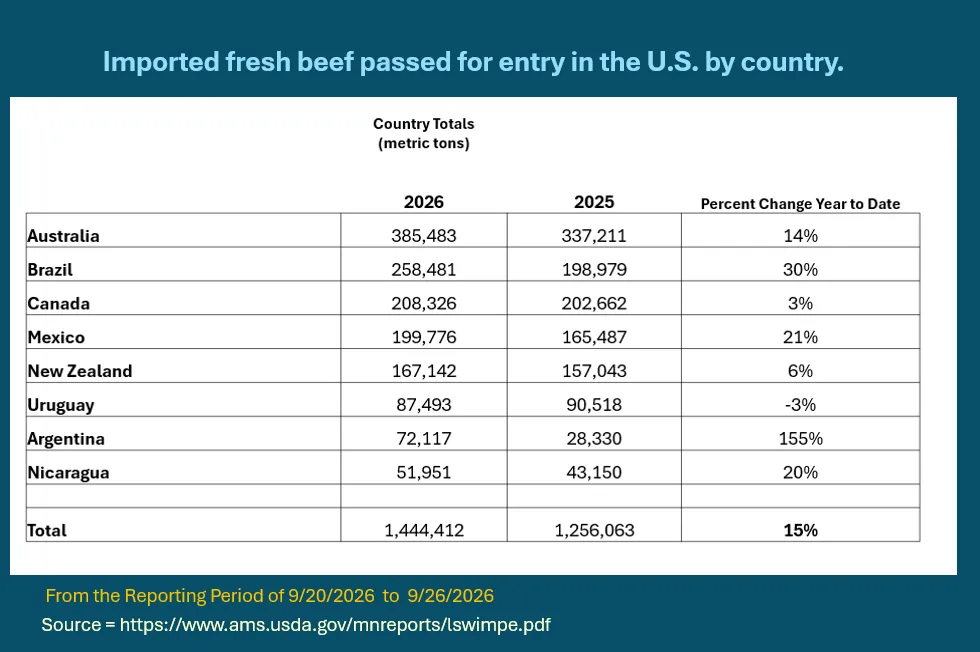
Rising beef imports are not a secret. The current administration has encouraged it. Last month, President Donald Trump announced a plan to allow 300,000 metric tons of beef to enter the United States over a 90-day period without being subject to out-of-quota tariffs.
Overall, imported fresh beef into the U.S. is up 15% year over year. That trend is expected to continue. The U.S. will likely import even more beef from Brazil and other South American countries into year-end (to meet Trump’s 300,000-metric-ton increase over 90 days).
Future consumer demand is in question. With high fuel prices at the gas pump and stubbornly high prices at the grocery store, will the consumer finally balk at higher-priced beef and opt for cheaper protein?
While demand for higher cuts of beef has been reduced slightly, demand for cheaper cuts of beef and ground beef remains strong. America loves “Taco Tuesday” and grilling burgers at fall tailgates. The question heading into the holidays, with finances tight for many U.S. families, is whether consumers will buy higher-priced cuts of meat for this year’s holidays.
Where will managed money funds go next? Finally, a last major component of cattle futures prices has to do with the fund traders. Managed money funds have shed nearly 100,000 contracts from their peak earlier in 2026. As of the Sept. 29 Commitment of Traders report, managed money funds were long 51,304 contracts of cattle, down from the peak of 156,909 contracts. To show profits on the books, they shed more than 100,000 contracts over the third quarter. In this first week of October, they emerged as buyers. Will that trend continue into year-end?
Prepare yourself
The cattle complex is at a crossroads. The U.S. herd is not rebuilding, but cheaper imports of beef are being brought into this country. Consumer demand has been strong, but will it remain strong into the holidays with families maybe opting to buy gifts rather than high-priced steaks? Will managed money fund traders begin to build back a long position? Or might they continue to liquidate the remaining portion of their long contracts? Time will tell.
Disclaimer: The data contained herein is believed to be drawn from reliable sources but cannot be guaranteed. Individuals acting on this information are responsible for their own actions. Commodity trading may not be suitable for all recipients of this report. Futures and options trading involve significant risk of loss and may not be suitable for everyone. Therefore, carefully consider whether such trading is suitable for you in light of your financial condition. Examples of seasonal price moves or extreme market conditions are not meant to imply that such moves or conditions are common occurrences or likely to occur. Futures prices have already factored in the seasonal aspects of supply and demand. No representation is being made that scenario planning, strategy or discipline will guarantee success or profits. Any decisions you may make to buy, sell or hold a futures or options position on such research are entirely your own and not in any way deemed to be endorsed by or attributed to Total Farm Marketing. Total Farm Marketing and TFM refer to Stewart-Peterson Group Inc., Stewart-Peterson Inc., and SP Risk Services LLC. Stewart-Peterson Group Inc. is registered with the Commodity Futures Trading Commission (CFTC) as an introducing broker and is a member of National Futures Association. SP Risk Services, LLC is an insurance agency and an equal opportunity provider. Stewart-Peterson Inc. is a publishing company. A customer may have relationships with all three companies. SP Risk Services LLC and Stewart-Peterson Inc. are wholly owned by Stewart-Peterson Group Inc. unless otherwise noted, services referenced are services of Stewart-Peterson Group Inc. Presented for solicitation