Corn futures plunged over 20 cents to an eight-week low after USDA unexpectedly hiked its production and yield estimates for the U.S. crop, signaling an ample supply outlook for 2027 while undercutting ideas that adverse summer weather in parts of the Midwest would lead to sharp losses. Soybean futures initially sank after USDA’s yield and production numbers exceeded forecasts but rallied to end higher.
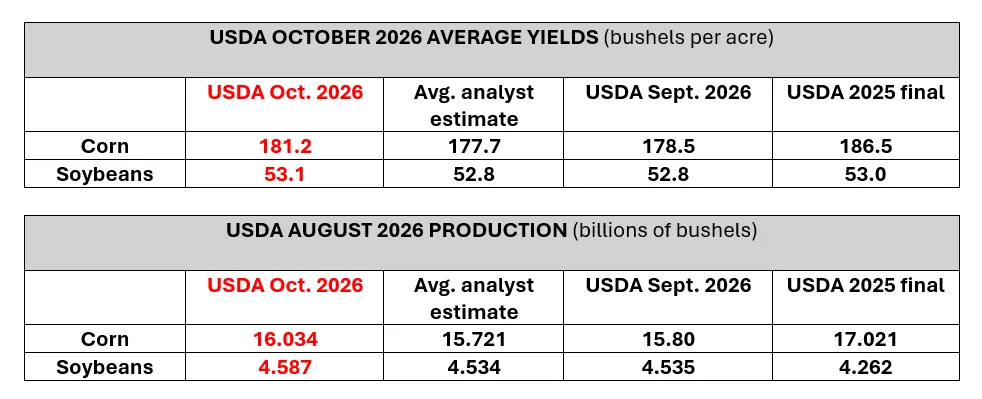
In its monthly Crop Production report today, USDA boosted its estimate for average 2026 U.S. corn yields to 181.2 bushels per acre, up from 178.5 bpa in September. Analysts expected the yield to drop slightly to about 177.7 bpa. The average soybean yield was raised to a record 53.1 bpa from 52.8 bpa, clashing with expectations USDA would hold the number steady (see full USDA tables below).
Corn and soybeans rallied near three-year highs late last summer amid ideas that extreme heat or extreme rains in different parts of the Midwest would harm crop potential. But today’s numbers suggested damage was less severe or less widespread than once thought. The result appears to be another year of historically large harvests that could keep a lid on upside price potential.
USDA raised corn production about 234 million bushels to 16.034 billion bushels, which would be down 5.5% from 2025’s record harvest but still the second-largest crop on record. Soybean production rose 12 million bushels to a record 4.587 billion bushels, up 7.1% from 2025.
“The USDA thinks the yields are going to be there,” said Brady Huck, principal and adviser at Empower Ag Trading. “I don’t know that you can explain it. Everything today was essentially the opposite of what the trade was looking for.”
While corn demand is expected to remain robust, the market looks to remain well-supplied for much of the coming year. In its monthly Supply and Demand update, also released today, USDA hiked its forecast for U.S. corn stockpiles at the end of the 2026-27 marketing year to 1.849 billion bushels, up 282 million bushels from last month’s estimate and above expectations for a smaller increase to about 1.67 billion bushels.
At the close of trading, December corn futures fell 20.5 cents to $4.7975 per bushel, down 13% from a three-year high near $5.50 posted Sept. 2 and the contract’s lowest close since Aug. 13. November soybeans ended with a gain of 4.5 cents to $12.92, rebounding after an initial drop to a six-week low at $12.6975. December soft red winter wheat fell 12.25 cents to $6.71, an eight-week low.
Stronger corn yields for many key states
USDA’s October Crop Production update followed two previous monthly reports based on objective yield and farm operator surveys. For today’s report, USDA said it surveyed about 8,300 producers between Sept. 24 and Oct. 5.
The higher U.S. corn yield in part reflected better-than-expected prospects in several states that suffered from extreme heat and drought over the summer. USDA hiked Nebraska’s estimated yield by 11 bpa to 188 bpa, while South Dakota improved to 151 bpa, up 6 bpa from a month ago. Iowa’s average yield was left unchanged at 219 bpa, up from 210 bpa in 2025.
Yield numbers are sure to generate skepticism because heavy rains have delayed fieldwork in much of the Midwest, in theory limiting data on actual harvest results. Early this week, USDA reported 23% of the U.S. corn crop was harvested as of Oct. 4, below the 27% average for that date the past five years. Iowa was just 7% harvested. The U.S. soybean crop was 25% harvested, below the 33% five-year average.
USDA will update corn and soybean numbers in November and January Crop Production reports.
Despite the bearish yield and production numbers, USDA’s Supply and Demand report still held demand-driven reasons for price optimism for both corn and soybeans.
USDA raised estimated U.S. corn exports for the 2026-27 marketing year by 25 million bushels, to 3.3 billion bushels, and boosted ethanol industry use 50 million bushels to 5.65 billion bushels. In soybeans, 2026-27 exports were raised 10 million bushels to 1.695 billion bushels. Domestic crushing demand was kept unchanged at 2.78 billion bushels, a record for the sixth year in a row.
Soybeans ‘holding up well’ amid demand optimism
The combination of strong demand and still-strong charts helped soybean futures recover, Huck said, adding that the recent price pullback in corn and beans could encourage global buyers to step up purchases.
“The soybean side is holding up well,” Huck said. “Maybe this break in prices will lead to some buying opportunities for end-users and importing countries like China. You may see some more ‘flash’ sales from China, or Mexico stepping up to the table, buying more bushels.”
The corn market may face a tougher time regaining upside momentum in the wake of USDA’s ending stocks increase, which lifted the closely followed stocks-to-use ratio for 2026-27 to 11.3% from 9.7%, above the psychologically important 10% threshold. Ratios below 10% have historically been associated with rallying markets.
Huck cautioned that today’s reports were just the latest among several USDA data sets that will ultimately determine the true size of the 2026 crops. Nothing is etched in stone and more changes are likely.
“The balance sheets are going to be dynamic,” Huck said. “It's changed a lot over the last couple of months, and I think it will continue to change going forward. This will not the last ending stocks numbers we see for the 2026-27 balance sheet. It’s going to be dynamic and going to continue to evolve and change.”
The following are summaries of key numbers from today’s Crop Production report: