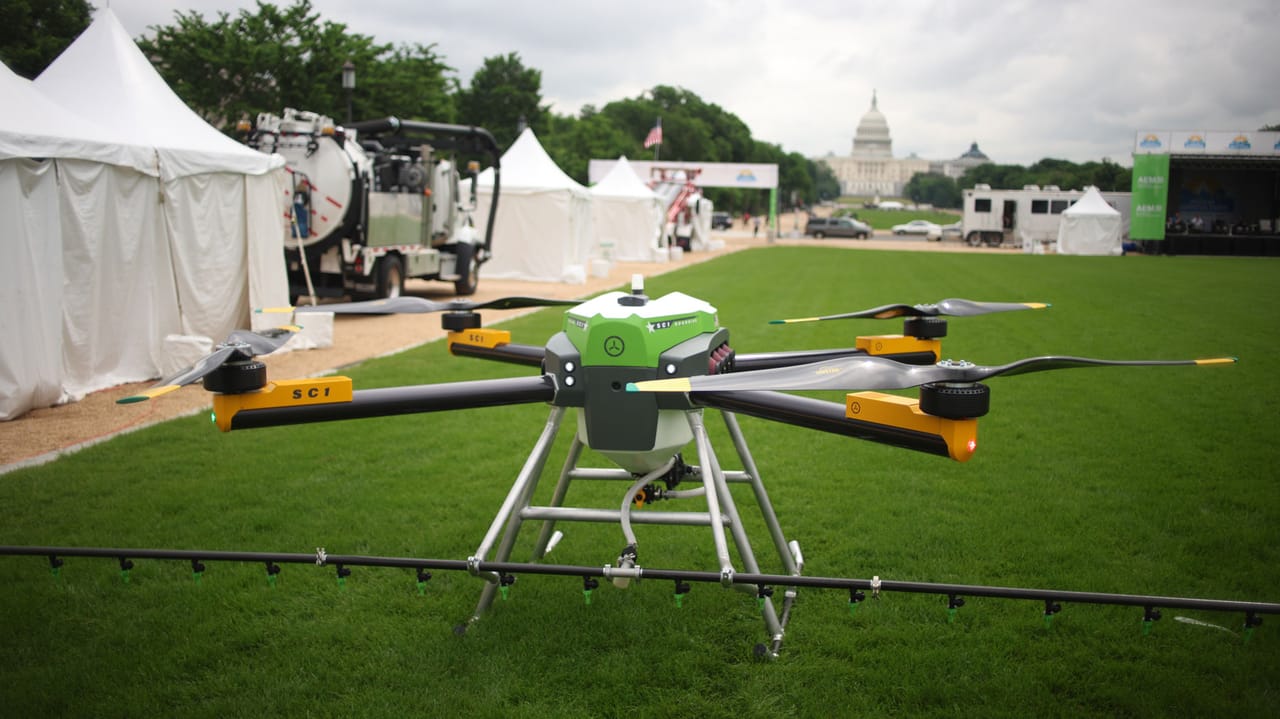
At last year’s National Farm Machinery Show in Kentucky, XAG’s E150 spray drone caught farmers’ eyes.
With its 154-pound payload capacity and 18.5-gallon liquid tank, the 2024 Chinese-made E150’s advanced radar system and rapidly charging battery represented cutting-edge ag spray drone technology. However, XAG’s presence at trade shows this year was clouded by regulatory uncertainty.
In December, the Federal Communications Commission banned all new-to-market foreign-made drones and their critical components, citing “unacceptable risks to the national security of the United States and to the safety and security of U.S. persons.”
Distributors say the regulations, which extend beyond radio frequencies to include motors, batteries, telemetry systems and flight controllers, harm many spray drone companies who use foreign-made drones and their farmer-customers who depend on the technology.
“I don’t think we’re going to feel the impact of the ruling this year. But we are going to feel the impact of this ruling in the next two years. 2026 will be a very interesting year; 2027 will probably be an even more interesting year,” said Nathan Stein, owner of Airstrike Ag in Barnum, Iowa, which supports XAG drones. “This is the best technology in the entire world right here. This is the very best drone — 45 mph and it is ridiculously complicated.”
While drones that are already certified can continue to fly indefinitely, Stein said new models from brands including XAG and DJI will face major regulatory hurdles. Replacement parts could also get more expensive. The market disruption is substantial, given that DJI owns 80% of the U.S. spray drone market share, according to the American Spray Drone Coalition.
Now, most future models won’t be able to be imported or sold domestically at all if they don’t meet certain U.S. requirements. XAG, for one, is taking those necessary steps to continue its domestic presence.
“They’re going to make their own manufacturing here, or find a partner to work with and make that manufacturing happen. Then, the technology will be part of a [licensed] domestic product line,” Stein said. “XAG, for one, has U.S.-based servers. The data has always remained here. They did this years ago in preparation for these types of things. They’re even moving a coding office into the U.S.”
Essential role
Spray drones have become “almost essential” to modern farming operations, according to Stein, who farms in Iowa. He has seen a 50-bushel-per-acre increase using drones to effectively manage southern rust. The late-December ruling could have far-reaching impacts beyond the drone-makers. Stein calls the financial position of those who’ve recently made substantial investments in now-restricted brands “precarious.” With input costs up and commodity posts stagnant, the stakes are high.
“It does put a lot of us farmers in a bad pinch for parts, service and supply. It would have probably been wiser to do this over a period of time, so that the market could remain stable,” he said. “Nobody else can build [drones] that fast. The U.S. has still got a lot to learn. I’m not saying that we can’t do it.”
There are other concerns besides manufacturing capacity. At least for now, American manufacturers are technologically behind their Chinese competitors, who can make more capable drones at less cost. There’s a reason why they’re so popular. Even so, Owen Jenkins of Iowa-based Terraplex Ag said farmers he has spoken with would rather support drones from elsewhere.
“We’ve had a lot of guys who, at farm shows back when we were selling Chinese drones, would come up to us and ask where it’s made. We’d tell them ‘China,’ and they’d kind of scoff and just walk away,” Jenkins said. “That’s the voice we’re hearing from the American farmer. That’s not really where they want their money going. They’d rather invest in something that is non-Chinese.”
Based on those conversations, Terraplex Ag began a strategic pivot away from selling DJI drones about 6 months ago. They’ve since partnered with Brazilian brand GTEEX and its Revolution Drone series, which is not impacted by the FCC rules.
Scaling production
With less competition, U.S. drone manufacturers are pivoting to fill the sudden void by scaling up their production.
“We didn’t directly lobby for this in any sort of way. In fact, it was surprising. We’re in the right place at the right time,” said Arthur Erickson, CEO of Texas-based Hylio. “It has always been a really big priority for us to be as U.S.-made as possible, even when it wasn’t a legal requirement 11 years ago when we started.”
Erickson projects a five-year runway to scale America’s drone manufacturing capability that includes batteries, magnets, lithium refinement and brushless electric motors, among other components. Without as much foreign competition, Erickson said domestic drone brands can create long-term plans and build the infrastructure needed to develop technologies. It’s also an opportunity to expand into other industries, which are likewise impacted by the rule.
“We are the pioneers in industrial automation, and scale manufacturing and optimization,” he said. “We taught the Chinese how to do what they’re doing. We sent them the machinery and infrastructure in the ’70s and ’80s. It was ours to begin with.”
But while there’s opportunity, there’s also risk. By scaling too fast, Erickson said manufacturing quality could be lost. Further, a drone is only as effective as its dealer network. And those can’t be developed overnight.
“If you grow too fast, you can forget what actually makes your business successful, which is delivering good products that are reliable, consistent, efficacious and have customer support,” he said. “Right now, we can produce something on the order of 2,000 to 3,000 drones per year. By the end of 2027 or so, we expect to have 5,000 units coming off the line per year, and then so on and so forth. Of course, we could accelerate that process even if we raise more money and partner with others.”
Uncertain future
Meanwhile, some impacted brands are fighting the FCC rule.
“DJI, the world’s leader in civilian drones and creative camera technology, is challenging the Federal Communications Commission’s decision to prohibit DJI from marketing, selling and importing new products into the United States,” the Chinese drone brand announced in a statement. “To protect its business and American consumers who rely on its products, DJI has filed a petition for review in the 9th Circuit, contesting the FCC’s addition of DJI’s communications and video surveillance equipment to the commission’s ‘Covered List.’”
No matter how the chips fall and which manufacturers expand or contract, Stein said agricultural spray drones are here to stay. Farmers across the country will continue using them as they currently are, and the market will adjust.
“The American farm depends on and demands it,” he said. “We found a tool that works really well. We like it, and now we need to adapt it to the American market. I don’t think we can get rid of it.”