By Hallie Gu
Soybeans are likely to be on the agenda when trade chiefs from the U.S. and China next meet, a conversation that could shed light on when Beijing plans to resume purchases in earnest.
U.S. Treasury Secretary Scott Bessent, Trade Representative Jamieson Greer and China’s Vice Premier He Lifeng are expected to convene in Paris this weekend, in preparation for a summit in Beijing between presidents Donald Trump and Xi Jinping at the end of the month.
Soybeans are central to U.S.-China trade relations, highlighting a co-dependency between the Chinese farmers who need imports to feed their vast herds of livestock, and the — often Trump-voting — American farmers who rely on exports for their livelihoods.
“The market consensus is that the meeting between top leaders of the two nations would definitely provide some incentive for more purchasing,” said Meng Zhangyu, an analyst at Wuchan Zhongda Futures Co.
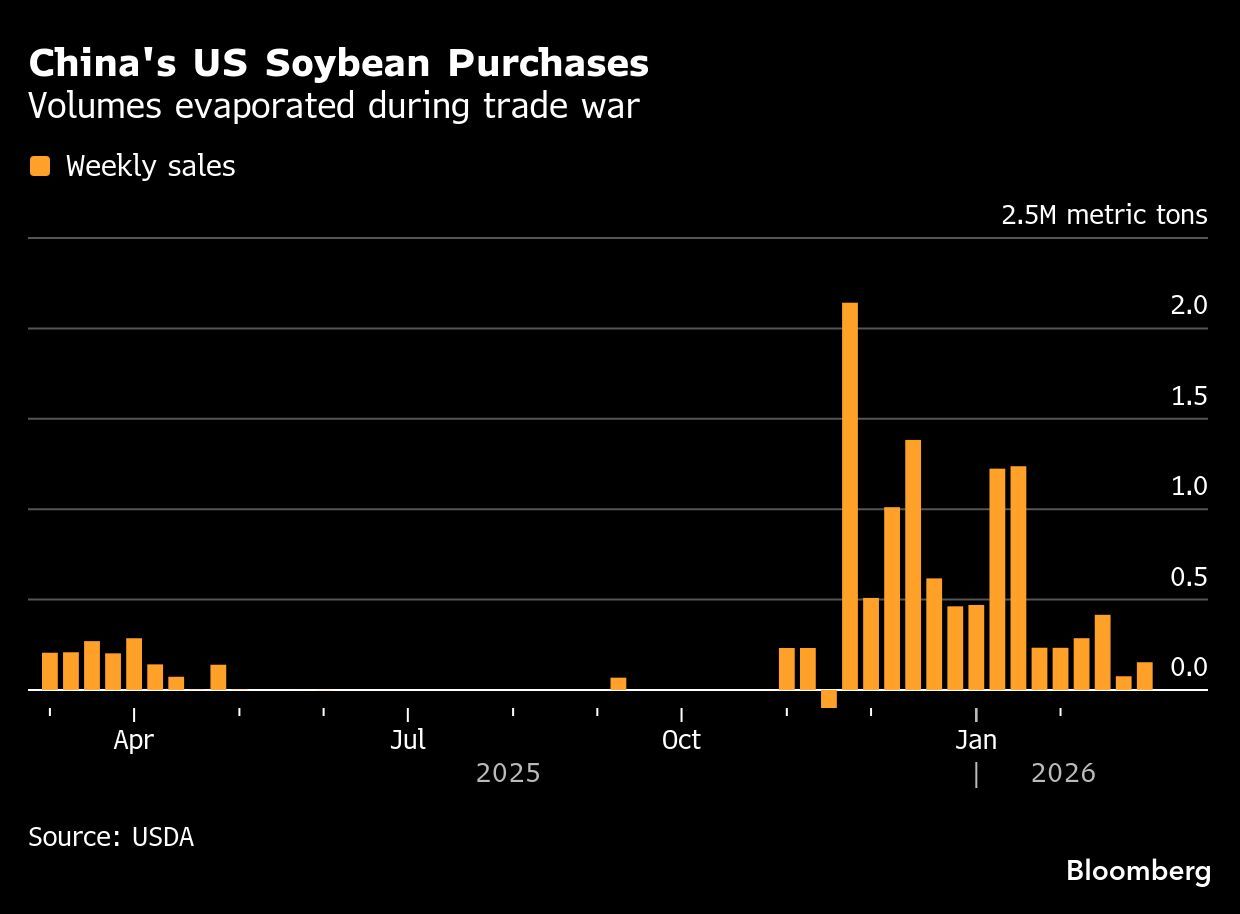
After a months-long trade war in 2025 cut Chinese purchases to zero, Beijing quickly made good on its agreement in October to buy 12 million tons of U.S. beans. But purchases have since stalled. Expectations on when they might pick up aren’t clear-cut, and the war in Iran has made geopolitical conditions much stormier.
The truce between Washington and Beijing projected annual imports of 25 million tons for the three years from 2026. Having cleared the initial 12-million-ton hurdle, traders thought Chinese buyers might pause until the new U.S. crop becomes available from September, when prices are often most attractive.
But Trump has since fueled expectations that more beans could be bought earlier, after posting on his Truth Social account in February that China is considering lifting purchases to 20 million tons in the current season.
China hasn’t commented on any of the agreements, nor on Trump’s post, so what happens next is unclear. And there are other complications. U.S. leverage in trade talks may have taken a knock after the Supreme Court’s ruling to curb the president’s tariff powers. The U.S.-led war in Iran, which China opposes, could also cloud the Trump-Xi summit, although Beijing has been careful to avoid destabilizing relations with Washington over the conflict.
“The market appears to be dialing back expectations for a major trade breakthrough,” said No Bull Ag analyst Susan Stroud. “The Middle East conflict has injected fresh uncertainty and shifted focus away from China.”
Goodwill buying
Then there are commercial issues. The southern hemisphere harvest is currently in full swing, and China has taken steps in recent years to diversify its supply with Brazilian soybeans in particular.
State-backed Chinese importers were responsible for buying U.S. beans since October, a move driven by politics rather than profit. Private crushers, however, are more sensitive to price and their preference is clear: Brazilian beans are now plentiful and cheap, while American supplies are dwindling and still subject to a 13% tariff.
Politics could once again override economics, though, which would set the stage for a summit that seals more bean-buying as a welcoming gift to Trump.
“We’re now 10 days into March without any goodwill soybean purchases from China — something we’ve seen in past negotiations,” said No Bull Ag’s Stroud.
On the wire
President Donald Trump’s administration started the first of several sweeping trade investigations that set the stage for new tariffs, the centerpiece of a push to replace levies struck down by the U.S. Supreme Court.
China is increasingly clawing back profits from state companies to cover some of the government’s spending needs, drawing on them more than ever during a year that saw an almost unprecedented decline in budget revenue.
As policymakers mull measures to shield their economies from spiking energy prices stemming from the war in Iran, the nation using the largest share of oil coming via the Strait of Hormuz may prove best placed to weather the storm.
© 2026 Bloomberg L.P.