Worry about rising food prices has gripped markets and traders alike since March when wars in Iran and Ukraine sent crude oil past $100 a barrel. But a surge in inflation could help farmers, whatever their worries about the ghost of former Fed Chair Paul Volcker.
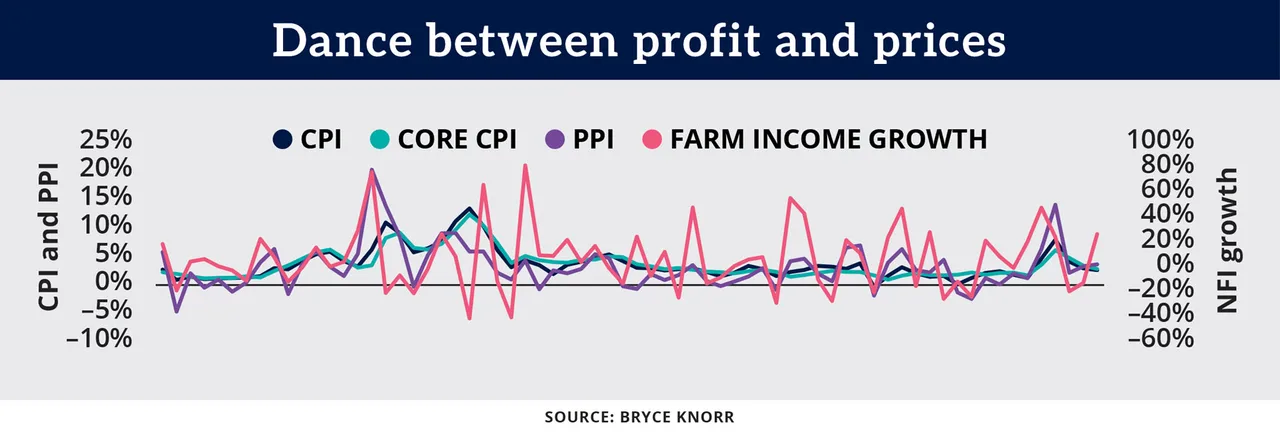
The key is in the capitals — CPI and PPI, not Washington, Moscow, Tehran or Kyiv. While there’s no connection between Labor Department indexes on consumer prices and farm earnings, costs paid by producers are another story. Higher producer price index readings translate into stronger net farm income, on average. Still, this two-step is a tricky dance, because agriculture is both a producer of food and energy, as well as a consumer of fuel and other inputs made from crude oil and refined products.
Unsurprisingly, opinions about the trajectory of rates vary widely. Prediction markets factor in two quarter-point hikes in the Federal Reserve target rate through 2027, building on the increase approved in September. Betting on Federal Funds futures focused on three of these moves, which would take the cost of money to between 4.5% and 4.75%.
For sure, those rates are a far cry from the spike above 20% that helped trigger the farm crisis of the 1980s. In that context, a tick more — 25 basis points — doesn’t seem like much of a mountain. Is it more than a mole hill? That could depend on whether the market gets spooked by the threat of a shift in trends that can run much longer. Trouble is that these indexes measure what has happened — not necessarily what will be.
How hot is hot?
So, how hot was the inflation data? The consumer price index jumped 3.7% on an annualized basis in September. Food overall wasn’t the issue for consumers; prices away from home rose, but at-home costs fell. But the index for gasoline surged 9.1%.
As for producers, the 12-month hike in PPI of 6.3% was the largest since the 6.4% rise posted in December 2022. Energy was a big reason why: Costs rose 35.4%. The pain wasn’t spread evenly. While gasoline jumped 20.9%, diesel expenses for these businesses was up “only” 13.5%. Growers benefited from this arbitrage if crops sold to biofuel plants helped offset higher costs when on-farm tanks were filled. Grains included in the PPI surged 31.6%, and oilseeds were 27.8% higher year on year.
Traders volleyed these numbers like top seeds playing at Wimbledon. That kept prices moving back and forth too, providing few firm clues on just what the trends were. December corn held a test of August lows, sticking to a broad 80-cent range. November futures did the same for soybeans but kept to a band of about 75 cents thanks to reports of active Chinese buying. And on Wall Street, the stock market traded a narrowing range of higher lows and lower highs, hovering below records from early October.
The Fed could throw a stick of dynamite at this beaver dam when officials debate changes to monetary policy Oct. 27-28. The central bank’s statement is the main fuse watched by the market, but comments by officials, notably Chair Kevin Warsh, also could light a fire if the new Fed chief steps into the breech or other members of the Federal Open Market Committee disagree.
The world already knows what President Donald Trump thinks: Interest rates should be lower. But don’t expect big changes at the Fed until after November elections — if then.