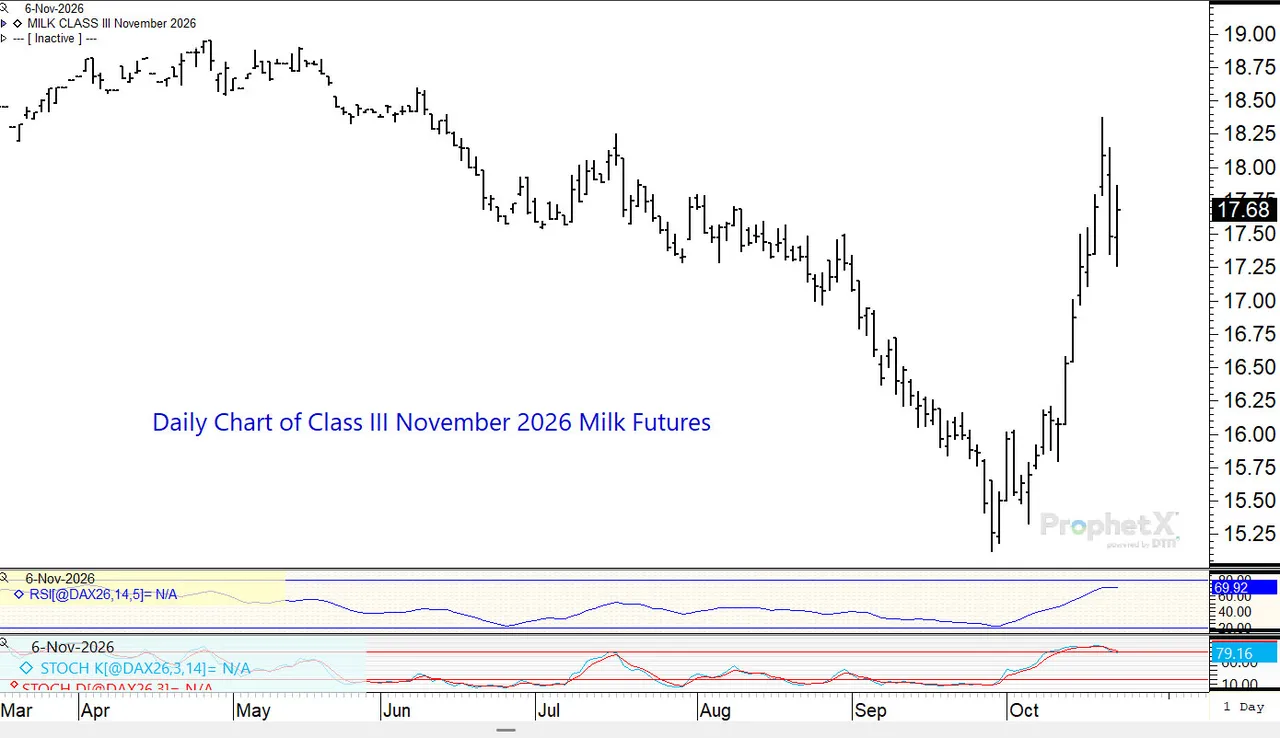
October was an exciting month for Class III milk futures, with nearby contracts enjoying a price rally of nearly $3 — essentially gaining back the entire price loss endured over the summer. However, the theme of higher milk production continues and may keep any future rallies at bay.
What’s happened
Plaguing milk futures prices for all of summer was the reality of abundant milk production throughout the U.S. Prices kept drifting lower as each month’s Milk Production report from USDA confirmed two things: a large U.S. milking herd and record milk production. Ample milk led to robust production of cheese, pushing cash cheese prices lower as well.
Finally, in late September, users deemed spot cheese prices “cheap enough,” stepped in and began aggressively buying. Since flipping the calendar to October, cheese rallied nearly 40 cents through the first 20 days of the month. Not to be left out, whey prices recently reached a new all-time high of 89.5 cents per pound. The good news for cheese and whey demand led to short covering for milk futures, which turned into technical buying and amplified the quick rally.
From a marketing perspective
But where to from here? We know demand for dairy products is strong, especially heading into the holiday season. The question is whether the recent rally will come to a halt or be a springboard for a resumption of the early highs in 2026.
The most recent USDA Milk Production report suggested that the production surplus continues. Specifically, the report said: “Milk production in the 24 major states during September totaled 18.7 billion pounds, up 2.7% from September 2025. August revised production, at 19.3 billion pounds, was up 2.5% from August 2025. The August revision represented an increase of 132 million pounds or 0.7% from last month’s preliminary production estimate.”
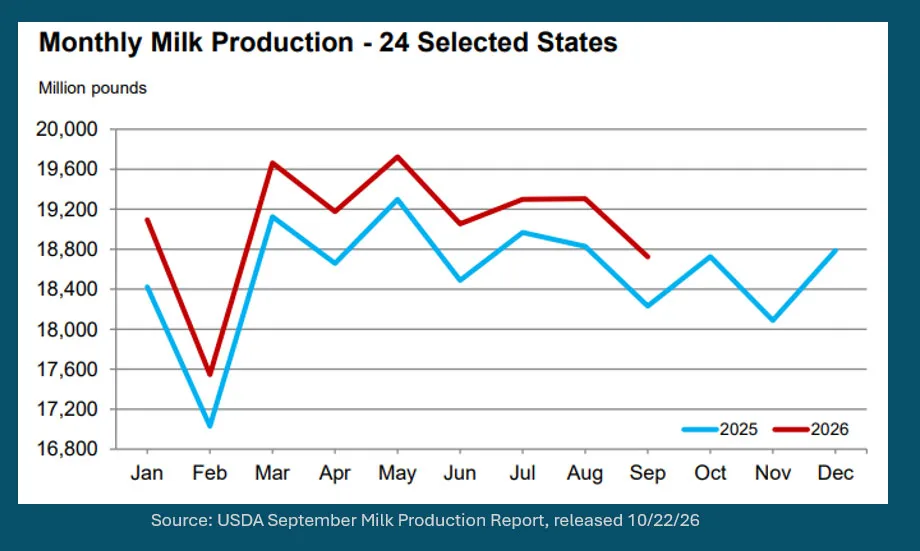
The continuation of strong demand for beef-on-dairy calves continues to keep older cows in production. The report went on to say: “Production per cow in the 24 major states averaged 2,012 pounds for September, 18 pounds above September 2025. The number of milk cows on farms in the 24 major states was 9.3 million head, which is 162,000 head more than September 2025, and 24,000 head more than August 2026.”
The takeaway: This surplus in U.S. milk production may keep a lid on milk prices in the short term.
Prepare yourself
Ever the fluid marketplace for Class III milk futures. For now, the theme continues to be abundant milk production with no end in sight as long as demand for beef-on-dairy calves continues. That keeps older cows in production for longer than normal. Extra cows in production means more milk. More milk is likely to keep rallies in check for now. Thankfully, demand for dairy products remains robust to help offset the milk glut.
Disclaimer: The data contained herein is believed to be drawn from reliable sources but cannot be guaranteed. Individuals acting on this information are responsible for their own actions. Commodity trading may not be suitable for all recipients of this report. Futures and options trading involve significant risk of loss and may not be suitable for everyone. Therefore, carefully consider whether such trading is suitable for you in light of your financial condition. Examples of seasonal price moves or extreme market conditions are not meant to imply that such moves or conditions are common occurrences or likely to occur. Futures prices have already factored in the seasonal aspects of supply and demand. No representation is being made that scenario planning, strategy or discipline will guarantee success or profits. Any decisions you may make to buy, sell or hold a futures or options position on such research are entirely your own and not in any way deemed to be endorsed by or attributed to Total Farm Marketing. Total Farm Marketing and TFM refer to Stewart-Peterson Group Inc., Stewart-Peterson Inc., and SP Risk Services LLC. Stewart-Peterson Group Inc. is registered with the Commodity Futures Trading Commission (CFTC) as an introducing broker and is a member of National Futures Association. SP Risk Services, LLC is an insurance agency and an equal opportunity provider. Stewart-Peterson Inc. is a publishing company. A customer may have relationships with all three companies. SP Risk Services LLC and Stewart-Peterson Inc. are wholly owned by Stewart-Peterson Group Inc. unless otherwise noted, services referenced are services of Stewart-Peterson Group Inc. Presented for solicitation