I hope you’ve had a safe and successful harvest 2026. I’m writing this just a few short hours after my family and I wrapped up harvest at our place. While fall fieldwork, spraying, mowing and cleanup still remain, it’s really nice to know that all of the crop is out.
Here’s a bit of a harvest update from our farm. I live and farm in the Charleston area of east-central Illinois. We farm a wide range of ground, from some really good to some really average. Our 2026 crop as a whole was really good, although I would maybe stop short from calling it great. We had an almost perfect growing season outside of an unseasonably wet June, where we got hurt in places with too much rain. Our home farm received 11.5 inches of rain in the month of June.
I haven’t made time to really dig into yield data yet — as you know, there’s often more than meets the eye when it comes to data — but our corn crop appears to have been 8 to 10 bushels above actual production history. It’s a similar yield to what we had last year, and 5 to 7 bushels short of being a record. For soybeans, we were also a few bushels higher than APH, but a few bushels short of a farm record. Compared to last year, this year’s bean crop was 5 to 7 bushels better, but we had a rather poor bean crop last year because of a super-dry August.
Because yield is a hot topic right now with USDA’s shocking revision higher in the October World Agricultural Supply and Demand Estimates report, I decided to gather a bit of data. (Note: On Oct. 23, USDA revised the September yield estimate higher, but left October’s estimate the same. That revision is not particularly market-moving since it was already old data. It simply makes the bridge between September and October’s change a bit shorter.)
So, I sent a text to a few of my clients asking this question: “Rate your crop for me on a scale of 0 to 5. 0 is a disaster; 5 is a record.” It’s far from a scientific study, but I wanted to gauge sentiment across the Corn Belt. Based on the information I gave about my crop, I would rate both my corn and soybean crops as a 4 using this scale. Here are some responses below, including where the person farms.
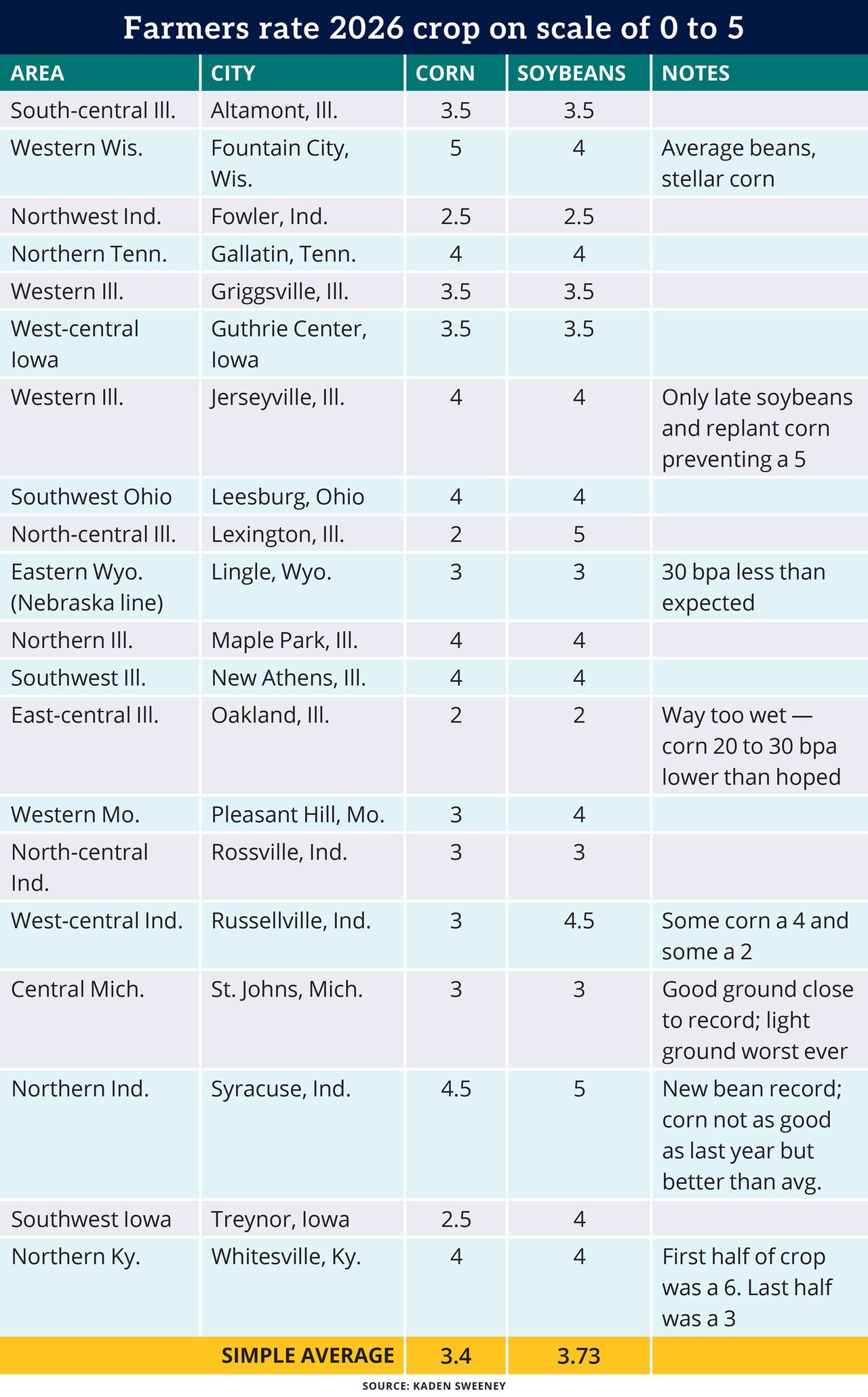
What’s the takeaway? Like I said, this is far from a scientific study. For whatever faults you want to cast on USDA and its survey process, it is definitely better than this. But when looking at a data set like this, I care more about the big picture and trends than I do the actual numeric responses.
For example, last year was the first year we surpassed a national average corn yield of 180 bushels per acre. After October’s revision higher, USDA has us above 180 bpa again for the second year in a row. Logically, in order to accomplish that, we don’t necessarily need yields to be equivalent to last year — last year’s average of 186.3 bpa smashed the 180 barrier — but we need to be close.
Of these handful of responses, only one person thinks they set a record. The average score of all the corn responses is 3.4, which to me signifies a crop that’s better than APH but not close to a record. If this were accurate across all U.S. corn acres — and there’s no reason to assume that it is — it would be very difficult, in my opinion, to be above 180 bpa on national yield. Admittedly, I didn’t receive any responses from Minnesota, which seems likely to have high yields this fall, or Kansas and Nebraska, which seem to be the swing yield states right now. But these few responses don’t scream big corn yields to me.
Secondly, the one thing USDA has been consistent on in recent months is a strong soybean yield matching or exceeding last year’s record. The majority of respondents to my little survey agreed that their beans were better than their corn; yet only two growers set records. This may lead me to believe USDA is a touch high on soybean yield, but I think it’s by a much smaller percentage. Bean yield is so tough to guess that I wouldn’t really argue this point yet. Thinking big picture, I agree with USDA that bean yields are better than corn yields.
At the end of the day, my opinion isn’t worth much to USDA. We will all find out together what changes the agency decides to make in the coming WASDE reports. USDA can edit yield in both November and December WASDE reports, but I don’t expect a big yield change until the January report, when final yield numbers are released. Until then, the market has to try to figure out where it thinks that January number will come in. For my money, I think January’s number will be lower than the 181.2 bpa we received in October.
Disclaimer: The risk of loss in trading futures and/or options is substantial, and each investor and/or trader must consider whether this is a suitable investment. AgMarket is a GIB of StoneX. This material has been prepared by an agent of AgMarket or a third party and is, or is in the nature of, a solicitation. By accepting this communication, you agree that you are an experienced user of the futures markets, capable of making independent trading decisions, and agree that you are not, and will not, rely solely on this communication in making trading decisions. Past performance, whether actual or indicated by simulated historical tests of strategies, is not indicative of future results. Trading information and advice is based on information taken from 3rd party sources that are believed to be reliable. We do not guarantee that such information is accurate or complete, and it should not be relied upon as such. Trading advice reflects our good faith judgment at a specific time and is subject to change without notice. There is no guarantee that the advice we give will result in profitable trades. The services provided by AgMarket may not be available in all jurisdictions. It is possible that the country in which you are a resident prohibits us from opening and maintaining an account for you.