USDA’s next Crop Production report and Supply and Demand update comes Nov. 9, six days after the big midterm U.S. elections. Does that mean farmers should cast a “protest vote” and ignore the numbers?
Of course not. But farmers are understandably exasperated following recent USDA crop estimates that either wildly and bearishly diverged from expectations, or were just plain wrong.
The latest example came on a Friday afternoon in late October, when USDA announced its September Crop Production report included erroneous corn yield estimates for Kansas and Nebraska. USDA’s National Agricultural Statistics Service found a “processing error” that affected September corn plant populations, ear counts, yields and production for those states, which also had knock-on effects for other aspects of the report, including the nationwide average yield, which was slightly increased.
Here’s a quick recap of USDA’s actions:
- lowered Kansas average September corn yield 3 bushels per acre to 119 bpa
- raised Nebraska average yield 5 bpa to 182 bpa
- raised U.S. average yield 0.3 bpa to 178.8 bpa
In USDA’s subsequent October report, the average corn yield was increased to 181.2 bpa. The October numbers were “reviewed, validated and not changed,” NASS said.
USDA’s explanation likely did little to assuage farmers who watched corn futures tumble over $1 from a three-year high around $5.50 at the beginning of September. The September corrections came just a few weeks after USDA reported an unexpectedly large Sept. 1 quarterly stocks number that contributed to a late-summer selloff and extended through October. And back in January, USDA dropped a 17 billion-bushel bombshell estimate of the 2025 crop (since revised slightly lower).
Farmers are skeptical
The corrections further fueled farmer skepticism and mistrust over USDA data while raising other questions, such as whether this is a result of the Trump administration slashing over 20% of the agency’s workforce since, which included cuts to NASS staff. Separately, USDA in September announced a pilot project that reportedly will rely more heavily on technology as part of a broader effort to improve crop acreage and yield estimates.
But here are a couple of other things about the recent USDA corrections: One, they’re old news, and two, they’re a moot point. The October numbers have been traded. What matters to the market is what’s ahead, and the Nov. 9 reports are front and center.
Some may argue the corrections “wreck the credibility” of USDA, said Jon Scheve, an adviser and owner of Minnesota-based Scheve Grain. “But I would argue it does the complete opposite. It shows the USDA is willing to admit when they make a mistake, and they take action to correct it as soon as they can,” Scheve said.
With most of the corn and soybean harvest typically finished by the release, November Crop Production reports tend to be among the most impactful of this data series. The market then must wait out another two months before USDA reports annual numbers in January — though those numbers are sometimes revised later.
November yields tend to shrink
This year’s November numbers will draw scrutiny, as always, and will likely influence the direction of corn and soybean markets into 2027. For corn, this month’s report could offer clues as to whether prices are near or have established a harvest low.
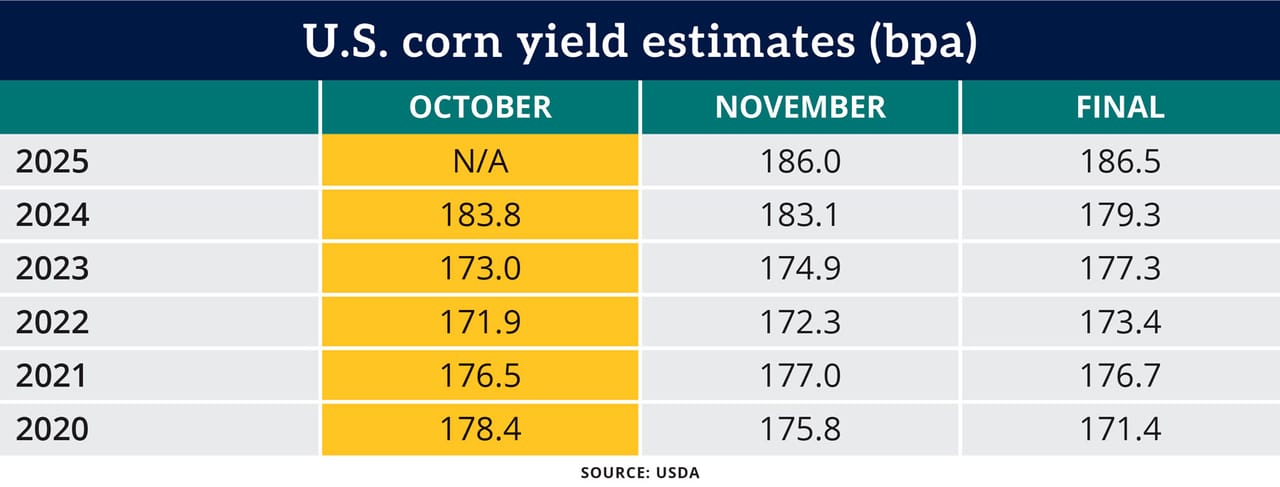
Some analysts expect USDA to reduce its corn yield estimate, citing anecdotal reports of subpar yields in prime growing areas like Illinois. A slight historical tendency for smaller November yields supports that idea. Over the previous 20 years, USDA lowered its November yield estimate 11 out of 18 times, by an average of about 0.9%. (No October reports were released in 2013 and 2025 due to government shutdowns.)
A yield reduction could help confirm a long-awaited price bottom and/or help catalyze a postharvest rally. Last year, December 2025 corn futures posted a harvesttime bottom around $4.09 on Oct. 14 and then rallied as much as 34 cents a month later. (As of late October this year, prices were still searching for an elusive bottom, with December futures dropping below $4.48 to a four-month low.)
Then again, a bearish report could propel further downside, perhaps toward or below the June low of around $4.25.
If there’s a takeaway from the past year of USDA-watching, perhaps it’s this: It’s ok to be chafed at USDA for weird-seeming numbers. But it’s more important to expect surprises, in any direction, and prepare accordingly.