USDA crop data brought grain market bulls out of hiding just in time for Thanksgiving. Whether they stick around through the holidays and beyond remains to be seen.
Two highly anticipated November USDA data sets, Crop Production and World Agricultural Supply and Demand Estimates, delivered a much-needed dose of price-friendly news for farmers. A combination of larger-than-expected yields and a tightening 2027 supply outlook sparked a brief corn rally and fueled hopes that prices may have found a bottom following a near-unrelenting two-month slide.
Farmers working their way through fall harvest would have been better off keeping both eyes on the corn rows rather than glancing at their quote screens, because the previous two months weren’t pretty. December corn futures tumbled from a three-year high near $5.50 per bushel at the beginning of September to a four-month low under $4.40 in early November.
So now what? A bullish November surprise, coming after a series of bearish USDA stink bombs over the past year, could be viewed as an early Christmas gift. But as farmers ponder an uncertain 2027 following a tumultuous 2026, the numbers raise as many questions as they answer. A few takeaways:
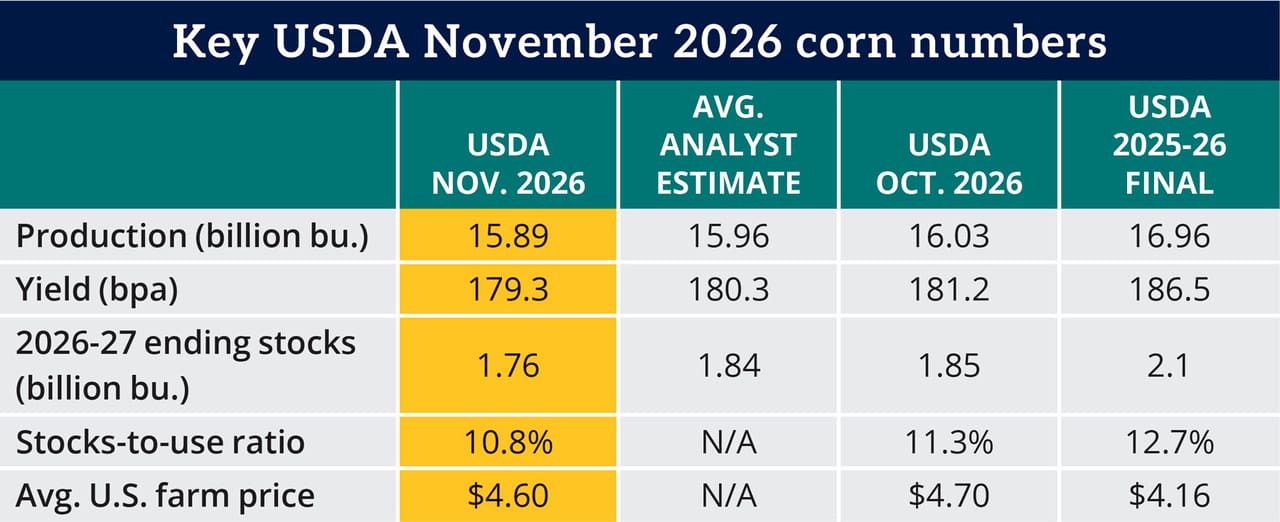
Yields come back to Earth. To many observers, the November numbers confirmed what they’d long suspected: USDA’s initial yield projections for some prime states were too high. Illinois’ average yield was slashed 8 bushels per acre to 200 bpa. Yields for Indiana, Kansas, Missouri and Nebraska were also cut. The nationwide yield was lowered 1.6 bpa to 179.6 bpa.
Supplies are growing snugger. Estimated corn stocks at the end of 2026-27 shrank 91 million bushels to 1.76 billion bushels, down 16% from 2025-26. That dropped the closely followed stocks-to-use ratio to 10.8%, the lowest in four years.
Export demand and the dollar. Other aspects of the reports offered reasons to curb bullish enthusiasm. USDA lowered 2026-27 U.S. corn exports by 25 million bushels to nearly 3.26 billion bushels, down 4.5% from last year’s record. Sustaining the breakneck export pace of recent years was always going to be tough, but lagging sales commitments will need to improve or further cuts are likely, and the U.S. dollar’s recent strengthening to a 19-month high may become an increasing headwind. Both bear watching in 2027.
South America looms larger. Barring an El Niño-driven disaster that has yet to emerge, Argentina and Brazil will again be fierce competitors on global export markets. USDA hiked production and exports for both countries amid generally favorable early growing conditions. The countries’ combined corn exports in 2026-27, at 3.27 billion bushels, will nearly match the U.S. kernel for kernel, if USDA’s numbers are on target.
What’s next
USDA’s annual summary report in mid-January will serve as the “final” word on the 2026 corn and soybean crops, and it’s likely yields and other key numbers will be revised again. That leaves a two-month data void during and after when any number of outside factors could move markets and generate volatility, including South American weather, Russia-Ukraine and trade relations with China.
If indeed corn prices have bottomed, at least for now, farmers should stay on alert for postharvest rallies and opportunities to “re-own” any previously sold grain — through call options linked to March or May 2027 futures, for example, as some advise.
March futures dropped as low as $4.51 in mid-November, which “seems pretty cheap now,” said Jason Gehler, senior market strategist at Blue Line Futures. “For any bushels you sold in the past, or if you had to sell off the combine, I think this could be a re-ownership opportunity. Watch for a 20- or 30-cent bounce, stay disciplined, look for those opportunities.”