As the storied trade bonds with the U.S. unravel, Canada is casting its net abroad to find new trade partners. At the same time, it’s implementing domestic development strategies to support its drive for greater food sovereignty.
Both efforts intersect in the country’s National Food Security Strategy, unveiled in June by Prime Minister Mark Carney.
The strategy is an unprecedented, ambitious effort by the Canadian government to support food sovereignty and the food supply chain there. President Donald Trump’s ongoing threats to destabilize Canada economically made Canadians twitchy about unaffordable food imports and crippling tariffs. Lawmakers like Carney took notes. Shortly after being elected prime minister, he acted, starting with domestic policy.
A summer of change
In June, Carney announced that his government would take measures to increase consumption of domestically produced and processed food by 10%. He set a goal for gross domestic product growth of the food processing industry to increase from 1.6% a year to 2.75% annually between 2027 and 2035.
To support these goals, Carney introduced the 10-year, $3.2 billion National Food Security Strategy. It is part of his Canada Strong campaign, designed to counter Trump policies.
The food security strategy is well-heeled. It includes:
- $1 billion for food terminals and hubs to support independent grocers
- $1 billion agrifinance fund via Farm Credit Canada, its biggest ag lender
- $750 million to expand controlled-environment agriculture such as greenhouses and vertical farms
On-farm food processing, another focus of the strategy, is designed to help farmers add value to raw commodities.
“Canada is one of the world’s great food producers, but too much of what we grow is processed elsewhere, and too many Canadians still rely on imported food at higher prices,” Carney said. “Canadian farmers deserve more options to sell their produce, and Canadians deserve more options for where they buy their food.”
Another domestic effort in Canada is to reduce archaic trade barriers erected by provinces to protect their respective parts of the agrifood system. These barriers affect transportation and labor standards, with current rules dictating that vehicles and workers from one province are not considered qualified in another.
Over CA$530 billion ($371 billion) of goods and services move across provincial and territorial borders, but the federal government says eliminating barriers could boost GDP by as much as CA$200 billion ($142 billion).
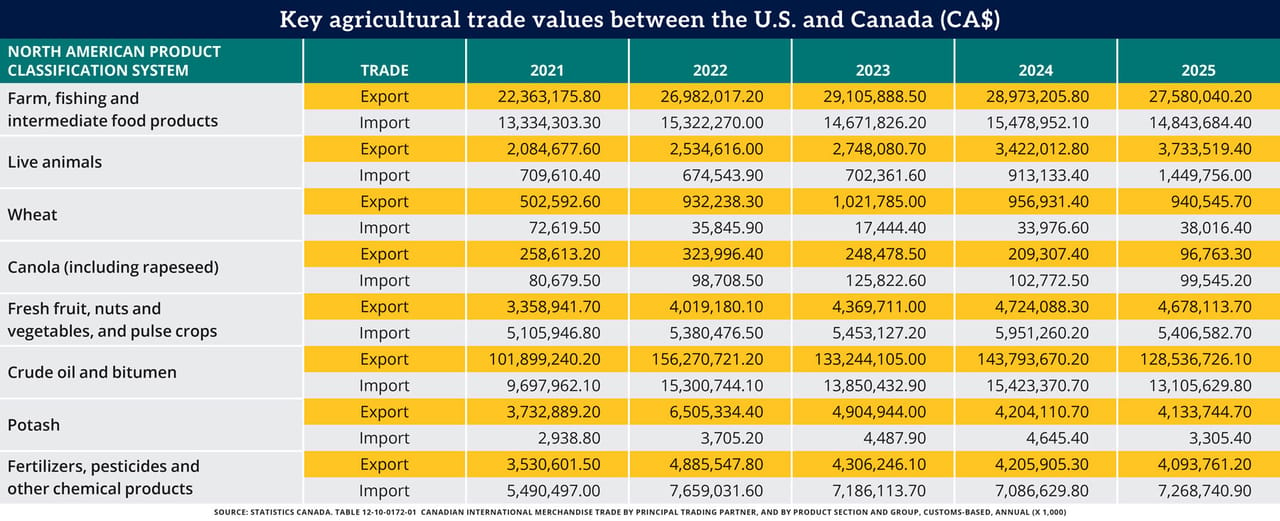
Carney is also pursuing new trade deals outside Canada to offset its dependence on the U.S. In September, he said that over the next six months, new deals with members of the Association of Southeast Asian Nations and India would double Canadian businesses’ tariff-free access to 3 billion consumers.
Ties to Europe grow
But Carney’s highest-profile connection has been with Europe, with which Canada already has a free trade deal, the 10-year-old Canada-European Union Comprehensive Economic and Trade Agreement.
For Carney, a successful stint from 2013-20 as the Bank of England governor — the first non-Briton to ever hold the post — made him a familiar figure in the EU. That familiarity is credited with helping Canada garner an invitation to become the EU’s first associate member.
The invitation was dangled before such a designation was formalized, so the details are vague. But at press time, the two nations were meeting to consider how an alliance and associate membership would work, and to start planning for an EU-Canada summit next year. All told, such activity points to greater EU-Canada connectivity.
It hasn’t all been a walk in the park for Carney though. His Canada Strong platform was tested Oct. 19 when resource-rich Alberta held a vote to consider separation. Some Albertans feel the federal government isn’t compensating them adequately for energy production. Ultimately, nearly 75% of Albertans voted to stay in Canada.
And despite all the glad-handing over the EU, some Canadian farmers have reservations about a closer liaison with that coalition. Science-based crop protection standards in Canada, along with biotechnology uptake, are much more closely aligned with the U.S. than with Europe. So are prices and markets, said seventh-generation Canadian farmer Ryan Marshall, who grows corn and soybeans in Halton Hills, Ontario.
He’d like to see the rhetoric calmed and the trade war resolved.
“Trade wars upset the normal flow of grain,” Marshall said. “Once you lose a customer, it’s hard to get them back again or replace them. We saw that when China went to South America for cheap soybeans. We need to learn a lesson from that. The U.S. and Canada have long-established trade connections that we can’t lose.”