As farmers head into Plant ’26, the high-stakes game of guessing USDA’s numbers to gain advantage in the commodity market heats up coming into the March 31 Prospective Plantings and Quarterly Stocks reports.
To add data to market strategy, Farm Futures surveyed farmers across the U.S. to find out what they’re thinking.
The upshot, Farm Futures Senior Editor Bruce Blythe said, is corn acres may not decline as drastically as USDA predicted in February, but they will be dropping over 2 million acres, even as soybean acres swell.
That’s the latest intel from a new survey of U.S. farmers conducted by Farm Futures, a Farm Progress brand.
Here’s the numbers on the cards farmers showed Farm Progress:
Corn
The Farm Futures survey leans toward a 2.4% drop in acreage from 2025, which would result in plantings shrinking by about 2.36 million acres, to roughly 96.4 million acres. USDA last month forecast 2026 U.S. corn plantings at 94 million acres, down 4.9% from last year’s 98.8 million acres, the highest since 1936. Plantings above 96 million acres would still be historically high, noted Farm Futures senior editor Bruce Blythe, ranking among the top half-dozen figures since the end of World War II.Soybeans
A 6% increase from 2025, adding nearly 4.9 million acres, would result in soybean plantings above 86 million acres. In February, USDA forecasted a 4.7% boost in soybean acreage, to 85 million acres. A 6% increase from 2025, adding nearly 4.9 million acres would result in soybean plantings above 86 million acres.In February, USDA forecasted a 4.7% boost in soybean acreage, to 85 million acres.
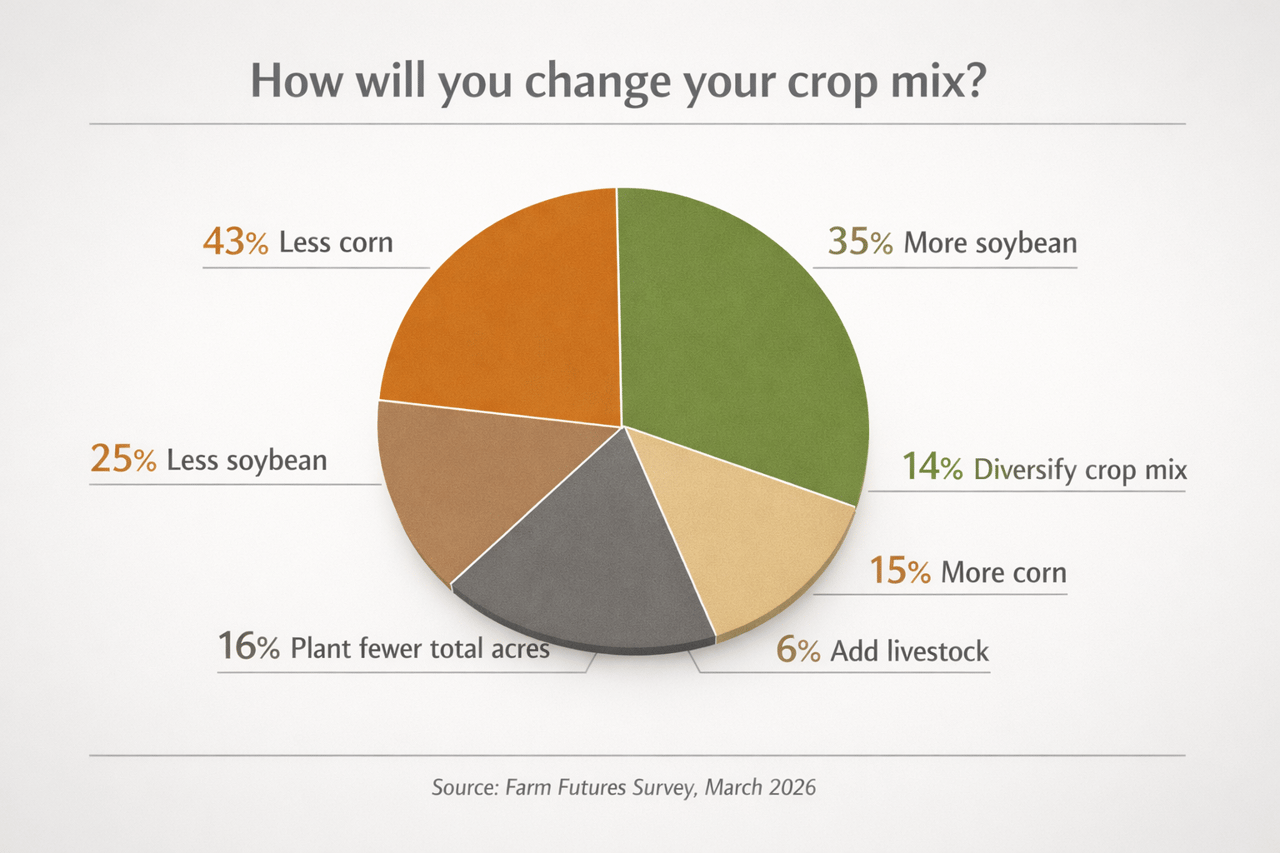
The Farm Futures survey of 96.4 million corn acres and 86 million soybean acres shows 2 million more acres than a recent AgMarket.Net survey that pointed to 94.4 million corn acres and 86.1 million soybean acres.
"Beans are at levels we haven't had a chance to hedge at in a long time," says AgMarket.Net co-founder and CEO Matt Bennett. "The combination of stronger soybean prices, the natural corn-to-soybean rotation and what it costs to put corn out this year — all of those things point to a larger shift in soybean acres."
The bean boost, Bennett and Blythe noted, comes in part from the fringe of the core grain-producing states.
“Soybean acres appear poised to jump in part as farmers in the Southeast shift away from unprofitable cotton and rice,” Blythe said. “Optimism around biofuels demand, which helped drive a winter rally in futures above $12 per bushel, is surely making soybeans enticing for many farmers. Additionally, hopes for further purchases from China continue to linger.”
With a focus on the business of farming and marketing grain crops, Farm Futures serves large-scale farm operators across the country. One of the services that Farm Futures provides to its market-oriented farmer audience is regular surveys to help them adjust production direction to maximize profit. Included in those surveys are topical management and economic questions. The spring survey is designed to indicate planting intentions to help farmers make marketing decisions ahead of USDA’s Prospective Planting and Quarterly Stocks reports, which will be released next Tuesday.
USDA’s March report is the first government report of the season to rely on farmer surveys.
The caveat on any planting intentions survey is that agronomics largely dictates cropping decisions. In the Farm Futures survey, more than half of the farmer respondents said planting decisions are based on a crop rotation strategy. Another 35% said about 75% of their acreage is tied to a fixed rotation.
Bennett, who also farms, noted crop rotation considerations in discussing his company’s survey numbers.
"Producers are still going to want to plant corn. Producers can insure more revenue for less money invested this year,” Bennett said. “At the same time, it's a bit more prohibitive to plant corn. Last year's aggressive corn acres drive the rotation shift and surging energy and input costs from the crisis in the Middle East add to that pressure."
Production costs certainly are an additional pressure weighing on planting decisions. The impact of the war in Iran and continuous tariff turmoil create volatility not only in the grain markets but also at the ag retail store. Bennett’s comment on the impact of input costs — chemicals, fuel and fertilizer — echo what Farm Futures heard from respondents.
A solid third of the farmers who participated in the Farm Futures survey said their biggest concern ahead of planting is input prices. Those farmers who added to their response shared comments such as “Moisture, input prices, and poor prices” and “Staying in business, market prices and maintaining a profit.”
Ultimately, Farm Futures Senior Editor Ben Potter said, “Farmers aren’t necessarily looking to make big changes to capitalize on commodity price trends. Only 15% of respondents say their acreage intentions have changed over the past two months for this reason.”